
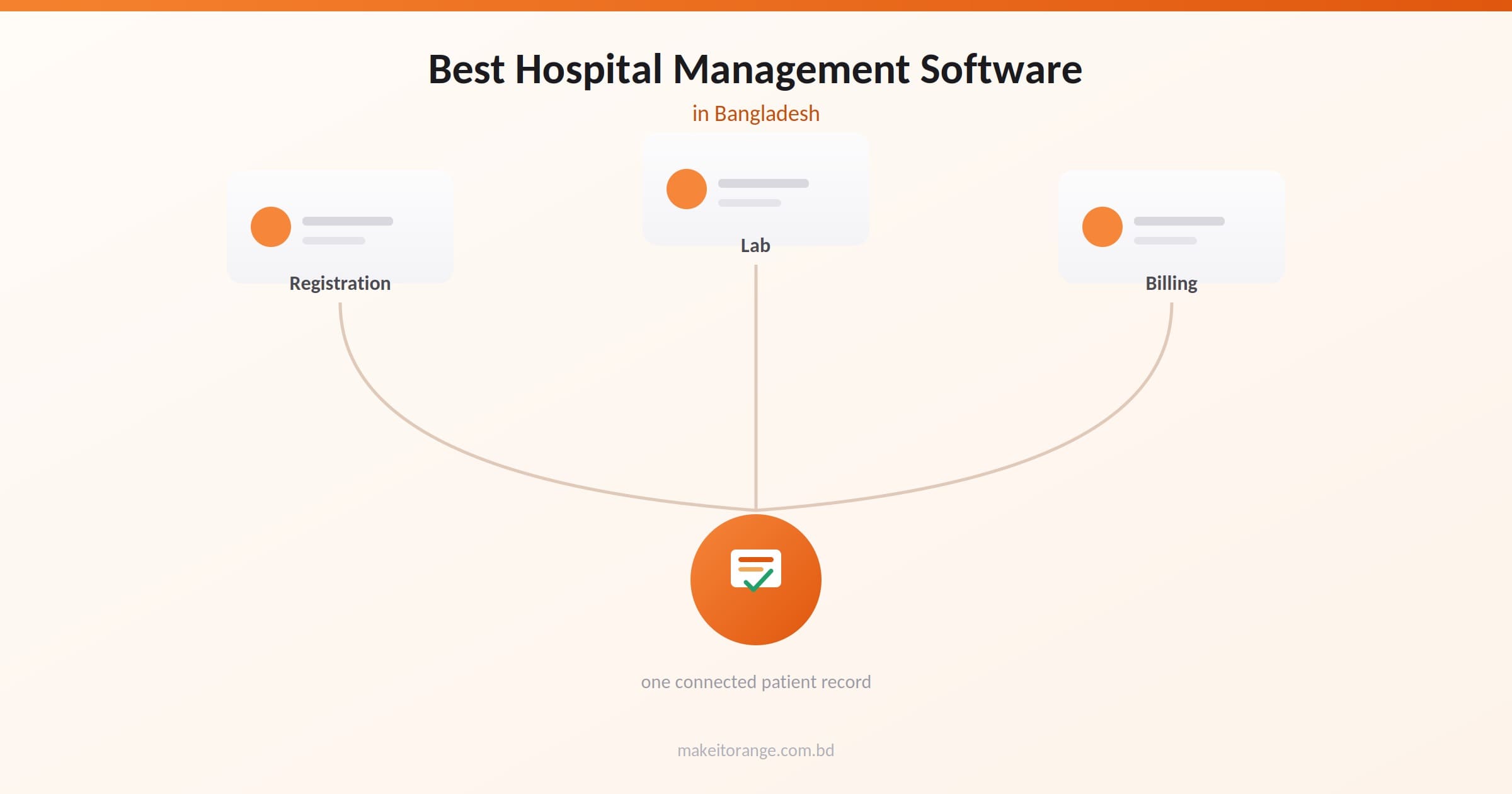
Best Hospital Management Software in Bangladesh
Key takeaways
- Hospital management software in Bangladesh typically ranges from ৳50,000–4,00,000 for a small clinic to ৳20,00,000 and beyond for a full hospital implementation, and the real cost includes machine integration, training, and ongoing support, not just the license.
- What separates a functioning system from a collection of disconnected tools is whether a patient's record follows them automatically between registration, clinical care, lab, and billing, not just which module names appear on a feature sheet.
- Both on-premise and cloud-hosted deployment are genuinely available in this market; the right choice depends on data-sovereignty needs versus remote accessibility.
- Not every vendor in this comparison is general-purpose; one is built specifically for ophthalmology and eye hospitals, worth knowing before assuming it fits a general facility.
There is no single best hospital management software in Bangladesh, the right choice depends on whether you run a full hospital, a clinic, or a diagnostic center, how many departments need to connect, and how much of the work is currently done on paper. For most Bangladeshi hospitals and larger clinics, ZAB Medisuit by Orange Solutions is the strongest overall choice, because it connects patient records, billing, pharmacy, diagnostics, and daily operations into one system built for local healthcare workflows.
Want to see ZAB Medisuit before you decide? Book a free demo.
A diagnostic center in Narayanganj ran on three separate systems for years, one for patient registration, a different one for billing, and lab results written up by hand and typed into a shared spreadsheet at the end of the day. A patient would register once at the front desk, then repeat the same information to the lab technician, then again at billing. Reports occasionally went to the wrong patient file because two people shared similar names and nobody had a single record connecting registration to results to payment. It wasn't until an insurance claim was rejected over a mismatched patient ID, discovered only after the patient had already gone home, that the center's owner realized the three separate systems had never actually been talking to each other.
That kind of disconnect, three departments each keeping their own version of the truth, is exactly what hospital management software exists to remove. Before comparing specific vendors, it's worth understanding what a system actually needs to connect, and where it's easy to end up with something that looks complete but leaves the same gaps.
What does a hospital management system actually need to do?
A hospital management system connects patient registration, clinical records, billing, pharmacy, and diagnostics into one shared record, so information entered once, a patient's registration details, a lab result, a prescription, is available everywhere it's needed next, without being re-entered or re-explained. In Bangladesh, this typically means covering OPD (outpatient), IPD (inpatient), billing, pharmacy, and reporting as a connected minimum, with lab, radiology, and operation theatre management as common additions for larger facilities.
Why "connected" is the actual requirement, not just "has these modules":
Most vendors list similar module names, OPD, IPD, billing, pharmacy, and on a feature sheet they can look interchangeable. What actually separates a functioning hospital system from a collection of separate tools with the same branding is whether a patient's record follows them automatically. When a doctor orders a lab test, does it appear on the lab technician's queue without someone re-typing the order? When the lab result is ready, does it attach to the same patient file the billing team will use, without a name mismatch like the one in the Narayanganj scenario? That connection, not the presence of any single module, is what a hospital is actually buying.
The minimum a general hospital or clinic system should cover:
- Patient registration and a single, findable patient record
- OPD and IPD workflow, appointments, admissions, discharge
- Billing that pulls directly from services rendered, not re-entered separately
- Pharmacy and inventory, especially expiry and stock-level tracking
- Reporting, daily and department-level, without manual compilation
Larger facilities typically add lab (LIS) and radiology (RIS) integration, operation theatre scheduling, and sometimes insurance claim processing, covered in more detail as we go through the comparison below.
On-premise or cloud, which fits a Bangladeshi hospital?
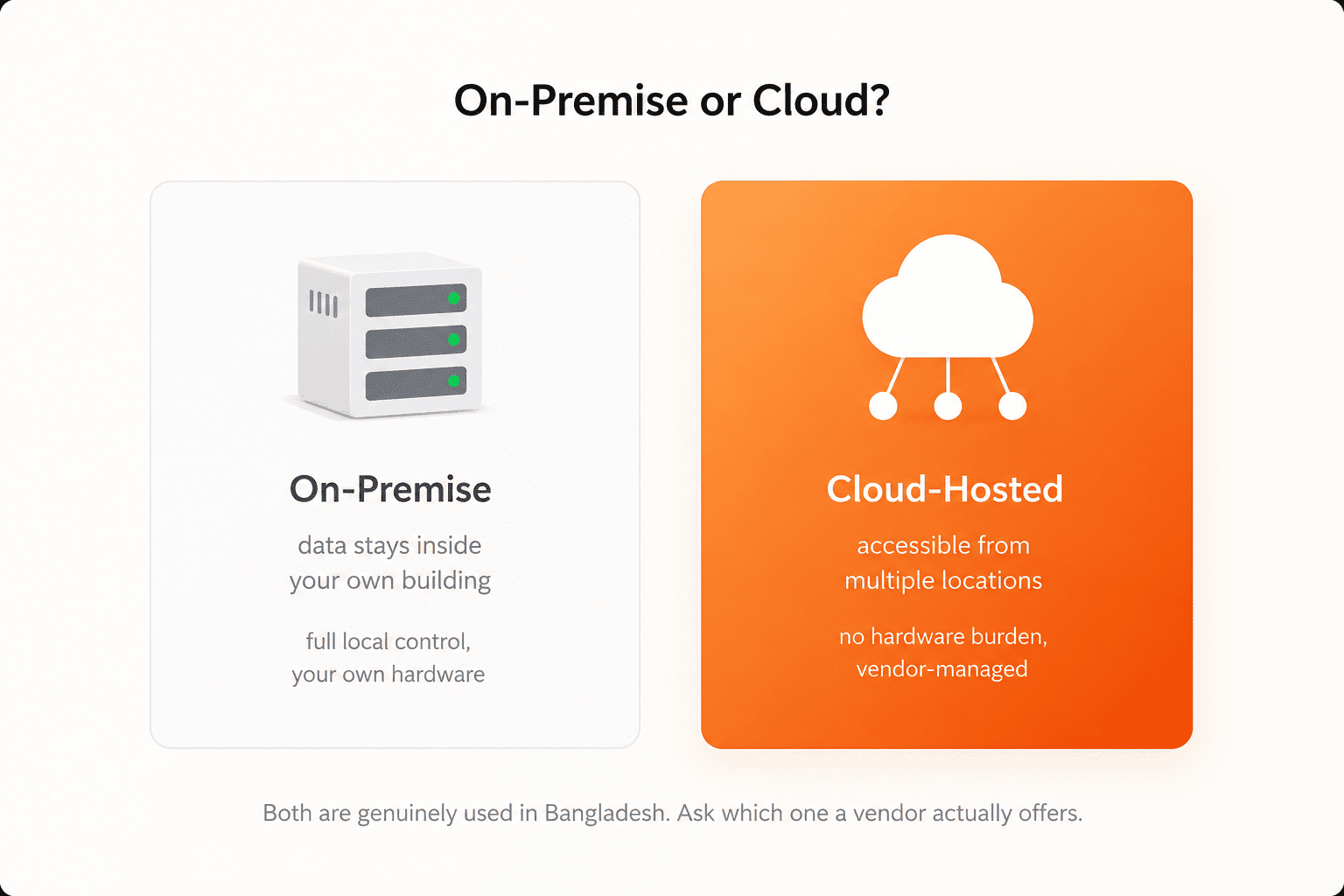
Both are genuinely used by hospitals in Bangladesh, and the right choice depends on how much control you need over where patient data physically sits versus how much accessibility you need across locations. On-premise keeps data on servers inside your own facility, giving you full local control; cloud-hosted systems run on the vendor's infrastructure, giving broader remote access but requiring you to trust the vendor's security practices.
Why this decision matters more for a hospital than for most other businesses:
Patient data carries a different weight than sales or inventory records, both in sensitivity and in the operational cost of losing access to it. An on-premise system means your data never leaves your building, which some hospitals require for internal policy or data-sovereignty reasons, but it also means you're responsible for your own server hardware, backups, and what happens if that hardware fails. A cloud-hosted system removes that hardware burden and lets doctors or administrators reach patient information from outside the building, useful for a multi-branch hospital or a doctor checking a patient's file remotely, but it depends entirely on the vendor's uptime and security practices.
What to actually ask a vendor:
- Is on-premise, cloud, or both actually available, not just one deployment model presented as the only option?
- If cloud-hosted, where is the data physically stored, and what security certifications does the hosting have?
- If on-premise, who's responsible for backups and hardware failure, the hospital's own IT team or the vendor?
- Can you switch deployment models later if your needs change, or is that a full re-implementation?
What should hospital management software cost in Bangladesh?
Hospital management software in Bangladesh typically starts around ৳50,000 to ৳4,00,000 for a small clinic or diagnostic center with basic modules, while a full hospital-wide implementation, OPD, IPD, pharmacy, lab, billing, and machine integration together, commonly runs ৳20,00,000 and can exceed ৳1,00,00,000 depending on facility size and module count. None of these figures typically include hardware, staff training, or ongoing annual support, which is where much of the real cost lives.
Why the range is so wide here specifically:
Unlike a POS system or general business ERP, hospital software genuinely varies enormously by what it needs to connect to, a small diagnostic center needs patient registration and billing; a full hospital needs that plus IPD bed management, operation theatre scheduling, lab and radiology machine integration, pharmacy inventory, and often insurance claim processing. Every vendor in this comparison, ZAB Medisuit included, prices based on facility size and the specific modules selected rather than a single flat number, so treat any figure you see, including ours, as a starting point for a conversation, not a quote.
What to actually ask before comparing prices:
- Does the price include machine and lab-analyzer integration, or is that quoted separately?
- Is patient data migration from paper records or an existing system included?
- What's the cost of adding a module later, a new department, a second facility, insurance claim processing, if you don't need it on day one?
- What's the ongoing annual support and update cost, as a real number?
The best hospital management software in Bangladesh, compared
| Rank | Software | Best For | Deployment | Starting Price |
| 1. | ZAB Medisuit (Orange Solutions) | Hospitals and larger clinics wanting OPD, IPD, billing, pharmacy, and diagnostics connected in one system | Cloud or on-premise | Request a quote |
| 2. | Arch HMS (Esteem Soft Limited) | Hospitals wanting a system with a long, publicly documented track record | Cloud/SaaS only, no on-premise option | Request a quote |
| 3. | PrideHealth (Pridesys IT) | Hospitals already using, or considering, other Pridesys products | Cloud or on-premise | Request a quote |
| 4. | ShifaSoft | Diagnostic centers and clinics wanting a cloud-based system with named client references | Cloud-based | Request a quote |
| 5. | Smart Medical Care (Smart Software Ltd.) | Eye hospitals and ophthalmology clinics specifically | Cloud-based | Request a quote |
ZAB Medisuit (by Orange Solutions)
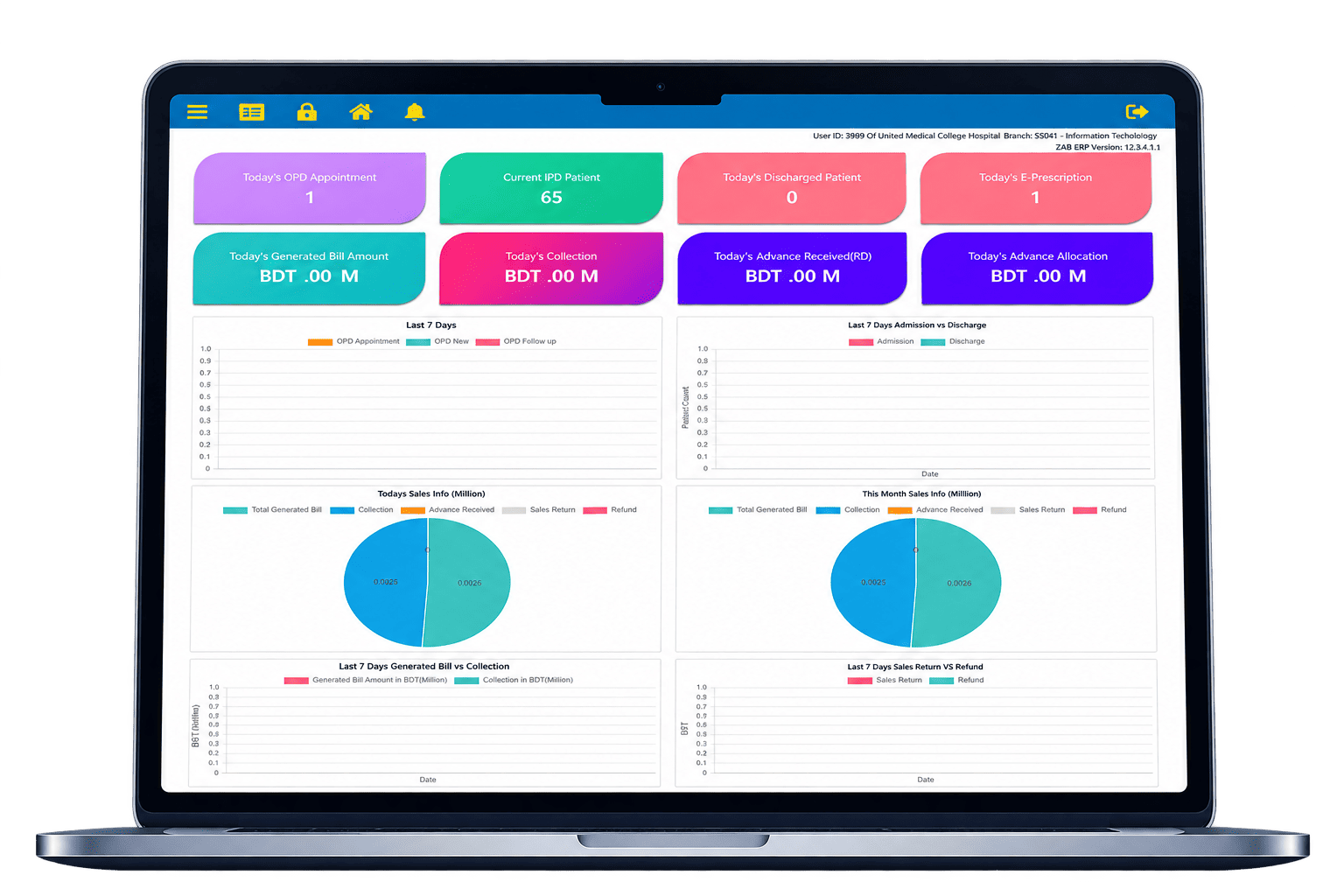
ZAB Medisuit is a hospital management system built by Orange Solutions, covering patient registration, OPD and IPD workflow, billing, pharmacy, and diagnostics as one connected record, with the choice of on-premise deployment for full local data control or cloud-hosted deployment for broader accessibility.
Why it leads this comparison:
The disconnect described in the opening scenario, three departments each keeping a separate version of a patient's information, is precisely what ZAB Medisuit's architecture is built to prevent. A patient registered once has that record available to the doctor, the lab, the pharmacy, and billing without re-entry. The system's stated module coverage is genuinely broad for the Bangladeshi market, extending beyond the core OPD/IPD/billing/pharmacy set into operation theatre scheduling, CSSD (sterilization) management, diet and nutrition, and named department/centre management (neuro, diabetic, heart, and similar specialty units), a wider stated scope than what's independently confirmed for the other four vendors in this comparison.
Deployment flexibility, the choice between on-premise and cloud, is a genuine strength but not unique to ZAB Medisuit in this comparison; PrideHealth also offers both. Where ZAB Medisuit and PrideHealth both differ from Arch HMS specifically is that Arch HMS's own FAQ states it is cloud/SaaS only, with no on-premise option offered at all, worth knowing directly if local server control is a firm requirement for your facility. One private hospital that implemented ZAB Medisuit cut patient discharge clearance from 3 to 4 hours to under 15 minutes, worth reading in full if you want a sense of what the rollout actually looked like.
Who it's for, and who it isn't:
ZAB Medisuit is built for hospitals, clinics, and diagnostic centers, according to Orange Solutions, with the depth of setup adjusted to what each facility needs, patient registration, appointments, billing, and records for a clinic; the fuller OPD/IPD/pharmacy/lab/billing set for a hospital. It is not positioned around a single medical specialty the way Smart Medical Care is for ophthalmology, covered later in this comparison.
Consider: pricing isn't published, request a quote directly for your facility's size and module needs, including which modules are included by default versus configured per facility.
Arch HMS (by Esteem Soft Limited)
Arch HMS is a hospital management system built by Esteem Soft Limited, designed for hospitals, clinics, diagnostic centers, and individual doctors in Bangladesh. According to Esteem Soft's own FAQ, it is offered exclusively as cloud-based software as a service, "we are not selling the software, we are providing it as SAAS," with no on-premise deployment option.
What sets it apart:
Arch HMS has the longest publicly documented track record among the vendors in this comparison, winning the National ICT Award in 2019, and its own site lists named facilities using the system, including Madani Hospital, Moon Hospital, Mainamoti Medical College & Hospital, Omega Medical Complex, and Abedin Hospital, with attributed quotes from hospital administrators describing remote, mobile-based monitoring as a specific benefit. Esteem Soft's own FAQ also states the system supports bi-directional LIS (lab information system) integration, along with canteen, blood bank, ambulance, EMR, and nursing station modules.
Who it's for, and who it isn't:
Arch HMS suits a hospital, clinic, or diagnostic center comfortable with a subscription-only, cloud-hosted model and wanting a vendor with a long, publicly verifiable client history. According to Esteem Soft's own FAQ, pricing is based on factors like number of beds, organization type, and location, billed monthly, quarterly, or yearly. It is not an option for a facility that requires or strongly prefers on-premise hosting, since Esteem Soft's own materials state that isn't offered.
Consider: the cloud-only, subscription-only model is a real structural limitation, not a minor detail, confirm directly whether that fits your facility's data-hosting requirements before comparing pricing. Ask specifically what happens to your data and continuity of service if you ever needed to move away from a subscription model.
PrideHealth (by Pridesys IT)
PrideHealth is a hospital management system built by Pridesys IT, the same company behind PrideERP, PridePOS, and PrideCRM, covered elsewhere on this site. It offers both cloud and on-premise deployment options.
What sets it apart:
PrideHealth's stated module list is broad, covering IPD, OPD, billing, testing, and bed management alongside less commonly advertised features like blood donor records, patient meal and diet history, and staff review/feedback tracking. Like PridePOS, it's one product inside a larger Pridesys family, worth asking directly how it connects with other Pridesys products if your hospital already uses, or is considering, PrideERP or PrideCRM for other parts of the organization.
Who it's for, and who it isn't:
PrideHealth is positioned for hospitals and other health organizations wanting a fully integrated system with on-demand customization, according to Pridesys' own product page. We could not independently verify pricing, named client facilities, or specific scale guidance (small clinic versus large hospital) from what's publicly available, unlike Arch HMS or ZAB Medisuit, where more specific detail exists.
Consider: pricing isn't published; request a quote directly. Because independently verifiable detail on this product is thinner than for some other vendors in this comparison, ask for named references and a live demo before assuming feature parity with vendors that have more publicly documented track records.
ShifaSoft
ShifaSoft is a cloud-based hospital and diagnostic center management system, with named client facilities including Hope and Health Diagnostic Center, Ashia Health Care, Sheba Digital Diagnostic Center, and Mridula Specialized Hospital, according to ShifaSoft's own site.
What sets it apart:
Where several vendors in this comparison describe general modules without naming specific clients, ShifaSoft's own materials name real facilities directly, alongside an attributed testimonial from a named doctor. ShifaSoft also states annual billing with free onboarding included, a different commercial structure from vendors quoting monthly or quarterly subscriptions, and cites more than 50 report types as part of its reporting capability.
Who it's for, and who it isn't:
ShifaSoft is positioned for diagnostic centers and clinics, based on the named client facilities on its own site, which lean toward diagnostic and specialized care rather than large multi-department general hospitals. We found no independent confirmation of on-premise deployment, only cloud-based, so a facility requiring local server control would need to confirm directly whether that's available.
Consider: pricing isn't published beyond the annual-billing structure; request a quote directly for your facility's size. Because the named clients are diagnostic centers and specialized facilities rather than large general hospitals, ask specifically for a reference closer to your own facility type if you run a large multi-department hospital.
Smart Medical Care (by Smart Software Ltd.)
Smart Medical Care is a cloud-based hospital management system built specifically for eye hospitals and ophthalmology clinics, not a general-purpose hospital system, according to Smart Software's own site. It's the only vendor in this comparison built around a single medical specialty.
What sets it apart:
Where the other four vendors in this comparison aim to cover general hospital operations, Smart Medical Care is purpose-built around ophthalmology workflows specifically, a Refraction and Vision module for vision testing and prescriptions, and an Optic Shop and Auto Prescription module for eyewear and lens sales. Smart Software states the product was developed with input from ophthalmologists alongside healthcare and IT professionals, and cites 10+ customers using the system, according to their own site.
Who it's for, and who it isn't:
Smart Medical Care is for eye hospitals, ophthalmology clinics, and multi-location eye-care chains specifically. It is not a fit for a general hospital, diagnostic center, or clinic without an ophthalmology focus, the four other vendors in this comparison are built for that broader use case; this one deliberately isn't.
Consider: pricing isn't published; request a quote directly. If your facility is a general hospital rather than an eye-care specialist, this is very likely the wrong entry on this list for you, not a limitation to work around, but a genuine scope mismatch. If you do run an eye hospital or ophthalmology practice, that specialization may be a real advantage over a general system adapted to your needs after the fact.
Is hospital management software only for large hospitals?
No. Clinics and diagnostic centers use hospital management software too, typically with a lighter setup than a full hospital, patient registration, appointments, billing, and records, without needing IPD, bed management, or operation theatre scheduling. ZAB Medisuit and ShifaSoft, both covered above, are explicitly positioned to support clinics and diagnostic centers directly, not just large hospitals.
Why the "hospital" name is misleading for smaller facilities:
The category is called hospital management software, but most systems in this comparison scale down to what a smaller facility actually needs, rather than forcing a diagnostic center to buy and configure modules built for inpatient wards it doesn't have. A clinic doesn't need bed management or discharge workflows; it needs fast registration, accurate billing, and a findable patient record, the same core connection problem described in the opening scenario, just at a smaller scale.
What to ask if you run a clinic or diagnostic center specifically:
- Can the system run with only the modules you need, or are you paying for hospital-scale features you won't use?
- Does the vendor have named clients that are actually clinics or diagnostic centers, not just large hospitals, the way ShifaSoft's client list leans toward diagnostic centers specifically?
- How does pricing scale down for a smaller facility versus a full hospital?
Is my hospital or clinic ready for this software yet?
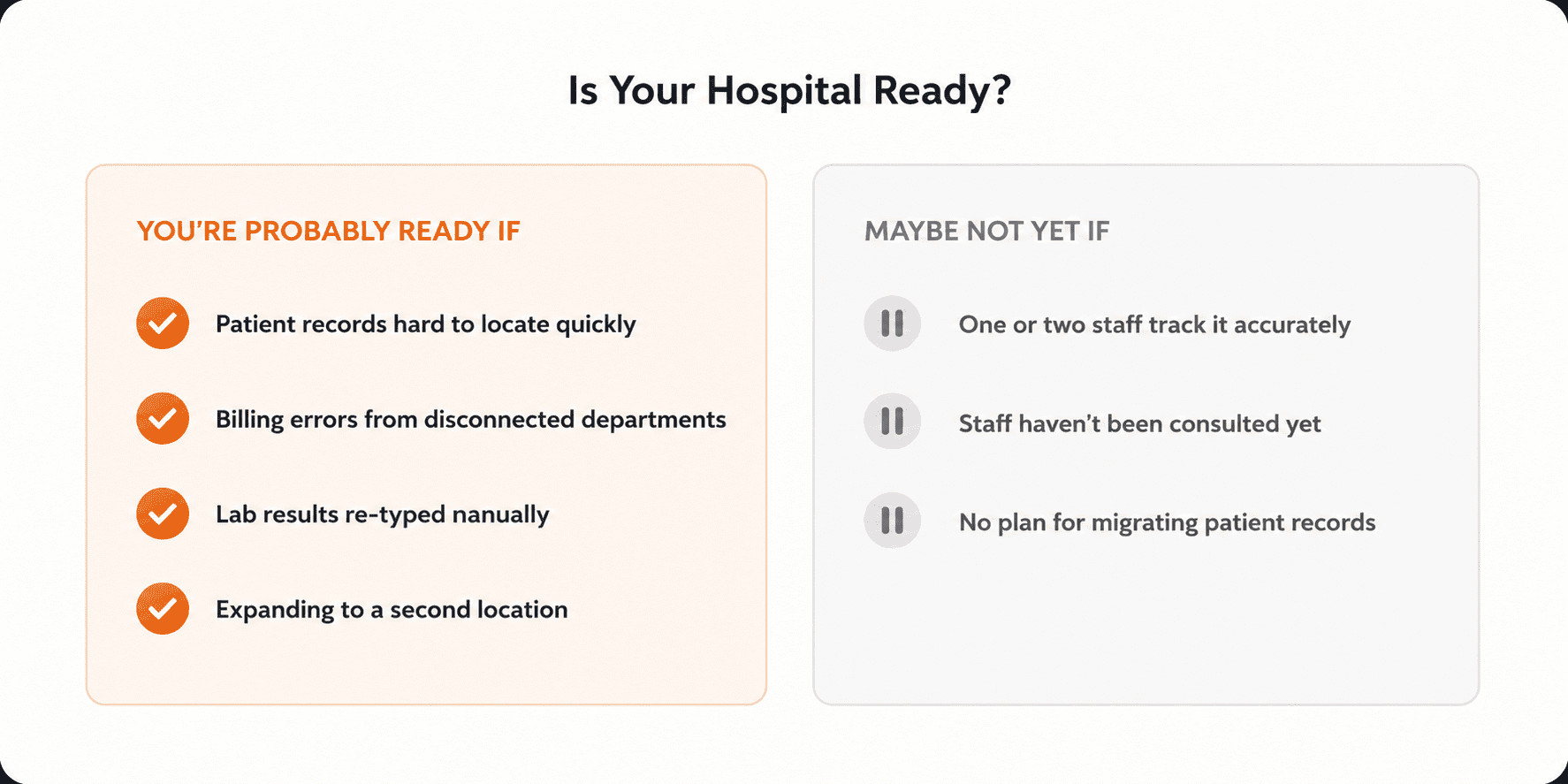
Most Bangladeshi hospitals and clinics are ready for management software once paper-based or disconnected record-keeping starts creating real risk, a patient's history that can't be found quickly, a billing mismatch discovered only after the patient has left, or staff re-entering the same information three times across departments. The readiness signal isn't facility size, it's whether the current process is already producing errors like the one in the opening scenario.
Signs you're ready:
- Patient records are hard to locate quickly, especially across departments or repeat visits.
- Billing errors or mismatches happen because departments aren't working from the same information.
- Lab or diagnostic results are recorded manually and re-typed into a separate system or file.
- You're expanding to a second location, or adding departments that will need to share patient information.
Signs you might not be ready yet:
- Your current paper or basic digital process is small enough that one or two staff members can track it accurately without errors.
- Your staff haven't been consulted yet on how a new system would fit their actual daily workflow, adoption resistance from doctors and nurses is a common reason hospital software rollouts struggle, not the software itself.
- You don't yet have a plan for migrating existing patient records, moving years of paper or spreadsheet-based history into a new system is real work that needs a plan, not an afterthought.
If most of the "ready" signs sound familiar, the evaluation steps below are the next move. If it's mostly the second list, particularly the staff-consultation point, that's worth addressing before you talk to any vendor, a hospital system that doctors and nurses resist using becomes an expensive, half-adopted burden rather than a solution.
How do you evaluate a hospital software vendor before signing?
Ask for a live demo using realistic patient scenarios, not the vendor's sample data, confirm exactly how patient data access is controlled by staff role, get written confirmation of which lab or diagnostic machines the system actually integrates with, and talk to an existing client whose facility type matches yours before signing anything.
The four steps that matter most in a healthcare context specifically:
- Demo with a realistic patient scenario, not sample data. Ask the vendor to walk a single patient through registration, a doctor visit, a lab order, and billing, live, in front of you. This is where the actual connection between departments, or the lack of it, becomes visible, not in a features list.
- Ask specifically how role-based access control works. Not every staff member should see every patient's full record. Ask exactly what a nurse can see versus a billing clerk versus a doctor, and how that's configured, this is a patient-privacy question, not just a technical one, and it's covered directly in ZAB Medisuit's own FAQ as something they build around role-based access.
- Confirm machine and lab-analyzer integration in writing, not as a general claim. "We support LIS integration" is not the same as "we support integration with your specific lab analyzer model." Ask for a list of machines and systems the vendor has actually connected to before, not just the general capability.
- Talk to a reference from a similar facility type. A large general hospital's experience tells you little if you run a diagnostic center, and vice versa, ShifaSoft's clients lean diagnostic-center, Arch HMS and PrideHealth's public references lean hospital-scale. Ask for a reference that matches your actual facility type, and ask them directly what broke or took longer than expected during implementation.
Which hospital management software should you choose?
Choose based on your facility type and deployment requirements, not just the ranking above. A quick guide by situation:
- Hospital or larger clinic wanting OPD, IPD, billing, pharmacy, and diagnostics connected, with a choice of on-premise or cloud → ZAB Medisuit
- Hospital wanting a cloud-only system with a long, publicly documented track record → Arch HMS
- Hospital already using, or considering, other Pridesys products → PrideHealth
- Diagnostic center or clinic wanting a cloud-based system with named, checkable client references → ShifaSoft
- Eye hospital or ophthalmology clinic specifically → Smart Medical Care
- Small clinic or diagnostic center that doesn't need full hospital-scale modules → see the clinic-specific section above; ZAB Medisuit and ShifaSoft both scale down for this
- Facility requires on-premise deployment specifically → ZAB Medisuit or PrideHealth; Arch HMS does not offer this option
Whichever you're leaning toward, run it through the evaluation steps above, a demo with a realistic patient scenario, a written answer on role-based access, confirmed machine integration, and a reference from a similar facility type, before signing anything. Not sure which system fits your facility? Request a quote or demo.
FAQ
What is the best hospital management system in Bangladesh?
There's no single best system, it depends on your facility type, size, and deployment needs. For most hospitals and larger clinics, ZAB Medisuit is the strongest overall choice in this comparison; see the full ranked list above for other facility types, including eye hospitals and diagnostic centers.
What is hospital ERP, and is it different from a hospital management system?
The terms are generally used interchangeably in Bangladesh. Both describe software that connects patient registration, clinical care, billing, pharmacy, and diagnostics into one system rather than separate tools, "ERP" and "management system" both appear on vendor pages, including ZAB Medisuit's own, to describe the same category of product.
What does good hospital management software actually include?
At minimum, patient registration, OPD and IPD workflow, billing, pharmacy, and reporting, connected so a patient's information follows them between departments automatically. Larger facilities typically add lab (LIS) and radiology (RIS) integration, operation theatre scheduling, and insurance claim processing.
Is there hospital software specifically for clinics or diagnostic centers, not full hospitals?
Yes. ZAB Medisuit and ShifaSoft are both positioned to support clinics and diagnostic centers with a lighter setup than a full hospital deployment, registration, appointments, billing, and records, without needing inpatient-specific modules.
What is healthcare ERP, and how is it different from general business ERP?
Healthcare ERP is a hospital or clinic-specific version of the same underlying idea as general business ERP, one connected system instead of separate tools, but built around patient records, clinical workflows, and healthcare-specific compliance rather than general sales, inventory, and accounts. See our general ERP comparison if you're evaluating both.
How much does hospital management software cost in Bangladesh?
Small clinics and diagnostic centers typically start around ৳50,000 to ৳4,00,000, while full hospital-wide implementations commonly run ৳20,00,000 and can exceed ৳1,00,00,000, depending on facility size and module count. Hardware, training, and ongoing support are usually billed separately.
Which software works for a general hospital versus a specialty hospital?
ZAB Medisuit, Arch HMS, PrideHealth, and ShifaSoft are all built for general hospital and clinic use. Smart Medical Care is the exception in this comparison, built specifically for eye hospitals and ophthalmology clinics, not general use.