- Neptune Heights (5th floor), Plot #2, Road #11, Block C, Section-6, Mirpur, Dhaka-1216

Retail ERP Software for Bangladesh
ERP for retail is one system that connects the sales floor, stockroom and back office, so stock, prices, promotions and customer data update everywhere at once. ZAB Retail is Orange Solutions' retail ERP, built for supermarkets, chain stores and clothing businesses in Bangladesh. It includes inventory management, ensuring accurate stock levels across every location. Point of sale (POS) integration streamlines sales processes, syncing transactions directly with inventory and pricing in real time. Customer relationship management (CRM) enhances customer service and loyalty, while procurement, order processing, and financial management keep the operational side running without manual reconciliation. Reporting and analytics provide insights for inventory planning and sales trends, and integration with e-commerce platforms supports omnichannel retail selling in-store and online without maintaining separate stock records. Ultimately, a retail ERP enhances efficiency, customer satisfaction, and profitability across the retail business, whether that's a single storefront or a multi-branch chain.
Suggested Solution: ZAB Retail
Retail ERP vs. General ERP: What's the Difference
Not every ERP built for retail is actually a retail ERP. Many businesses run their retail operations on a general-purpose ERP system, one built to handle accounting, inventory, and reporting across any industry, with retail features added on top. That works for basic needs, but it's a different tool than a system built specifically for retail from the ground up.
A general ERP, like ZAB ERP, is broad by design. It covers finance, inventory, procurement, and reporting across many types of businesses, and can be configured to support retail operations alongside other functions. This is useful for a business that needs retail as one part of a wider operation, or that plans to expand beyond retail over time.
A dedicated retail ERP, like ZAB Retail, is built around the specific rhythm of retail operations: POS transactions syncing instantly with stock levels, pricing and promotions that update across every channel at once, barcode-driven inventory accuracy, and loyalty programs tied directly to the sales record. These aren't add-on features. They're the core of how the system is designed to work.
For a business that is primarily retail, whether a single store, a chain, or a multi-branch operation, a dedicated retail ERP typically means faster setup, fewer workarounds, and functionality that matches daily operations without needing custom configuration. A general ERP makes more sense when retail is one piece of a larger, more varied business.
What Retail Businesses Struggle With Without a Dedicated ERP
Retail businesses running on spreadsheets, disconnected POS systems, or a general accounting tool tend to hit the same set of problems, whether they operate one storefront or several.
- Disconnected inventory and sales data. When the POS system doesn't talk to the inventory system in real time, stock counts drift from reality. Staff sell items that are already out of stock, or miss reorder points until shelves are empty.
- Inconsistent pricing across channels. A price change made in-store doesn't always reach the online store, or vice versa. Promotions and discounts applied manually in multiple places create mismatches that frustrate customers and cost margin.
- Manual reconciliation at day's end. Without an integrated day-end process, closing out sales, matching cash to transactions, and updating inventory becomes a manual task prone to error, repeated at every location, every day.
- No unified view of the customer. Purchase history, loyalty points, and preferences often live in separate systems, or nowhere at all, making it difficult to run loyalty programs or personalize service.
- Limited visibility into what's actually selling. Without integrated reporting, decisions about restocking, promotions, and purchasing are based on gut feeling rather than real sales data.
- Supply chain and vendor coordination handled separately. Purchasing decisions are disconnected from actual sales velocity and stock levels, leading to overstocking on slow items and stockouts on fast-moving ones.
Choosing the right retail ERP means solving these problems specifically, not just digitizing them. A system that automates data entry but still leaves inventory, pricing, and sales disconnected doesn't solve the underlying issue.
What modules does a retail ERP include?
A retail ERP brings the core functions of running a retail business into one connected system. The features that matter most are the ones that directly touch daily operations, not back-office reporting alone.
- Point of sale (POS). Sales processing that updates inventory and reporting the moment a transaction happens, with support for multiple payment methods including cards, mobile payments, and digital wallets.
- Inventory management. Real-time stock monitoring across every location, with demand forecasting and order management to prevent both stockouts and overstocking.
- Pricing and promotions management. Centralized control over pricing, discounts, and promotional campaigns, applied consistently across every sales channel at once.
- Supply chain and procurement. Coordination between purchasing decisions, supplier management, and actual stock needs, so buying is driven by real demand rather than guesswork.
- Barcode management. Automated product identification and tracking that reduces manual entry errors and speeds up both receiving and checkout.
- Day-end process automation. Cash reconciliation, sales reporting, and inventory updates handled automatically at close, rather than compiled by hand at every location.
- Customer relationship management and loyalty. Centralized customer profiles, purchase history, and loyalty points, enabling personalized offers and repeat-business tracking.
- Reporting and analytics. Sales trends, inventory levels, and performance data available in real time, supporting decisions instead of following them.
Not every retail business needs every feature at full depth from day one. A single storefront may prioritize POS and inventory accuracy first, while a multi-branch retailer needs supply chain coordination and cross-location reporting from the start. The right retail ERP should support both starting points and grow with the business.
How to Choose a Retail ERP for Your Business
With several retail ERP options available, choosing the right one comes down to matching the system to how the business actually operates, not just comparing feature lists.
- Business size and number of locations. A single storefront has different needs than a multi-branch chain. Smaller retailers often do well with a lighter, faster-to-implement system, while larger or multi-location operations need stronger cross-location inventory and reporting from day one.
- Sales channels. A retailer selling only in-store has different requirements than one selling in-store, online, and through marketplaces at once. The ERP should support every channel the business actually sells through, not just the ones it sells through today.
- Segment-specific needs. A supermarket managing perishables has different priorities than a clothing retailer managing seasonal stock and sizes. The right system should fit the specific rhythm of the retail segment, not just retail in general.
- Local payment and infrastructure support. In Bangladesh, that means genuine support for mobile payment methods like bKash alongside cards and cash, and a deployment approach, cloud or on-premise, that holds up against local internet reliability rather than assuming constant connectivity.
- Local vendor support. How quickly a vendor responds when something goes wrong matters as much as the feature list itself, particularly for a business that can't afford downtime at the till. Local support and response time should be a real evaluation factor, not an afterthought.
- Scalability. A retail ERP should support the business as it grows, whether that means adding new locations, adding online sales, or expanding into new product categories, without requiring a full system change later.
The most reliable way to evaluate a retail ERP is to map these factors against your actual operation first, then compare vendors against that list, rather than starting from a feature comparison and working backward. For a full comparison of ZAB Retail against other Bangladeshi vendors, see our retail management software comparison.
ZAB Retail: Retail ERP Built for Bangladesh
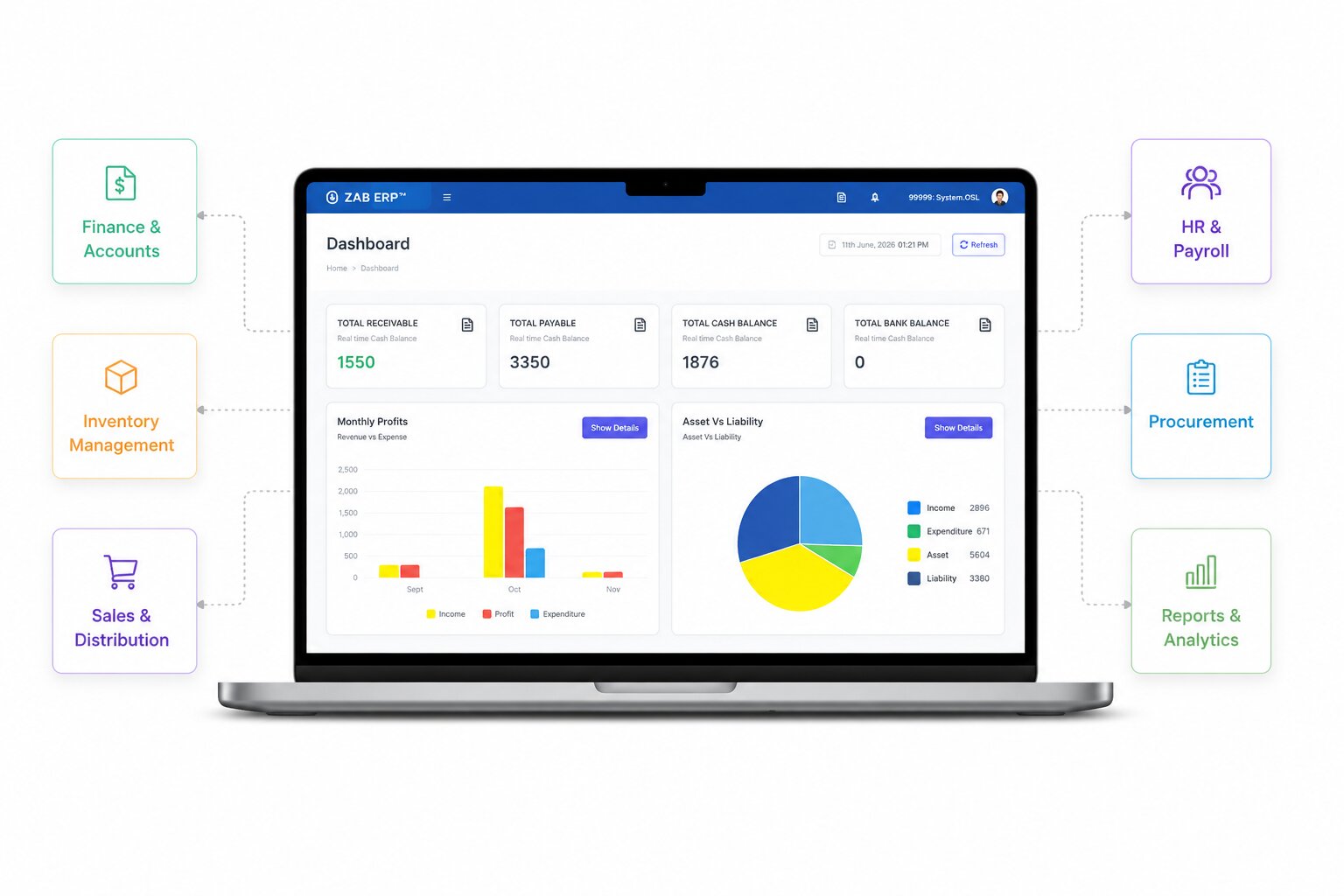 ZAB Retail is a dedicated retail ERP solution built by Orange Solutions Ltd to streamline and automate end-to-end retail operations for supermarkets, chain stores, and clothing businesses operating in Bangladesh. Rather than retrofitting general ERP features for retail use, ZAB Retail is built around the modules retail businesses actually run on every day.
- Retail POS with real-time sales processing and multiple payment support
- Real-time inventory management with demand forecasting and stock monitoring
- Centralized product and pricing management across every sales channel
- Supply chain and supplier management tied directly to demand
- Barcode generation, scanning, and stock tracking
- Automated day-end process, including cash reconciliation and reporting
- Promotion and discount management, including BOGO offers and coupon systems
- Membership and loyalty program management with personalized offers
ZAB Retail scales from a single storefront to a multi-branch retail chain, covering everything from point of sale and inventory to supply chain and customer loyalty within one system.
For retail businesses that also need broader ERP functionality beyond retail operations, such as multi-industry operations or more extensive financial and HR management, ZAB ERP offers a general-purpose ERP platform that can be configured to support retail alongside other business functions.
Pricing for ZAB Retail depends on the number of locations and the modules required. Contact our sales team for a custom quote.
Proof from a Bangladeshi apparel retailer: A multi-outlet clothing brand moved to ZAB Retail without re-tagging its existing barcodes, and went live within a single night. Stock transfers from the central warehouse to outlets are now tracked with receiving confirmation. These are the client’s reported outcomes, not independently audited, and the brand is unnamed at its request. Read the full apparel case study.
See ZAB Retail features
FAQs
What is ERP for retail?
ERP for retail is one system that connects point of sale, stock, purchasing, pricing, customers and reporting, so a sale in one store updates stock, reorders and reports everywhere.
What is the difference between a retail ERP and a POS?
A POS records sales at the counter. A retail ERP also connects stock, purchasing, pricing, customers and finance across stores. A single shop can start with a POS and move to ERP when it adds branches.
Do small retail stores need ERP?
Usually not. A single shop with one location is well served by a good POS. ERP pays off when you run several stores, hold stock in a warehouse, or run promotions and loyalty across branches.
What are the main retail ERP modules?
POS, inventory, pricing and promotions, procurement, barcodes, day-end automation, CRM and loyalty, and reporting.
What is the best ERP for retail in Bangladesh?
It depends on your size and format. See our retail management software comparison for how the main options differ.
