
How ZAB MediSuit Cut Discharge Time From 4 Hours to 15 Minutes
Industry: Healthcare — Multi-Specialty Private Hospital
Product: ZAB MediSuit
Implementation type: Hospital Management Information System (HMIS)
Region: Bangladesh
Running a standalone clinic or a small diagnostic center is one thing. Managing a large, multi-specialty private medical college and hospital with round-the-clock emergency care, hundreds of indoor beds, a busy OPD, operation theaters, and an in-house central pharmacy is another problem entirely.
A standard commercial ERP can balance ledgers and manage stock. Healthcare needs more than that: every minute affects patient care, and every operational gap shows up directly in both reputation and revenue.
(Note: at the client's request, this hospital is not named. What follows is a real implementation account the specific problems, the technical fix, and the measured results with identifying details removed. If you're evaluating hospital management software in Bangladesh, this is what an actual multi-department HMIS rollout looked like.)
The Problem: What the Hospital Was Dealing With Before ZAB MediSuit
Before implementation, the hospital was running on basic legacy software layered on top of manual paperwork. As daily patient volume grew, that setup started causing real clinical and financial problems:
- No automated e-prescription module. Doctors either handwrote prescriptions or fought with slow, clunky software screens — wasting consultation time and creating confusion at the pharmacy counter.
- Scattered patient history, no unified EMR. When an outpatient was admitted to a ward or ICU, their past diagnostic reports, allergy notes, and previous visit history were trapped in paper files. Doctors had to treat patients without a complete history on one screen.
- Manual lab entry from disconnected machines. The hospital owned modern pathology and radiology equipment, but none of it was connected to the software. Technicians had to manually read results off machine screens and re-type them — slow, and a real source of transcription error.
- Pharmacy over-purchasing and expiry waste. With no reliable purchase forecasting, the central pharmacy regularly over-bought slow-moving, expensive drugs that expired on the shelf, while running short on emergency medicines.
- Discharges that took 3–4 hours. Discharging an admitted patient meant billing staff physically collecting paper slips from the pharmacy, lab, nursing stations, and OT — a process that routinely produced billing disputes, unbilled consumables, and crowded billing counters.
- Delayed management visibility. Hospital directors waited days for end-of-month spreadsheets just to see daily revenue, department-wise earnings, or bed occupancy.
- Reception congestion. Patients queued just to find out whether their lab report was ready or to pay a routine bill — an overcrowded, noisy front-of-house experience that reflected poorly on the hospital regardless of the quality of care behind it.
This pattern isn't unique to one hospital. It's consistent with what's documented at the sector level: a systematic review of pharmacy inventory practices across Asia-Pacific hospitals found that inconsistent adoption of structured methods like FEFO is common across the region, largely due to infrastructure and workforce constraints — exactly the gap this hospital's pharmacy was falling into.
The Fix: Implementing ZAB MediSuit Hospital ERP
To eliminate these problems, the Orange Solutions team deployed ZAB MediSuit, an enterprise-grade Hospital Management Information System (HMIS) built specifically for Bangladesh's healthcare ecosystem. Here's how the implementation simplified and automated the hospital's operations:
- Dedicated doctor portal and fast e-prescriptions. An intuitive digital workspace for doctors, with pre-built clinical templates, quick-click dosages, and one-click diagnostic test ordering. Doctors can now generate accurate digital prescriptions in under 60 seconds.
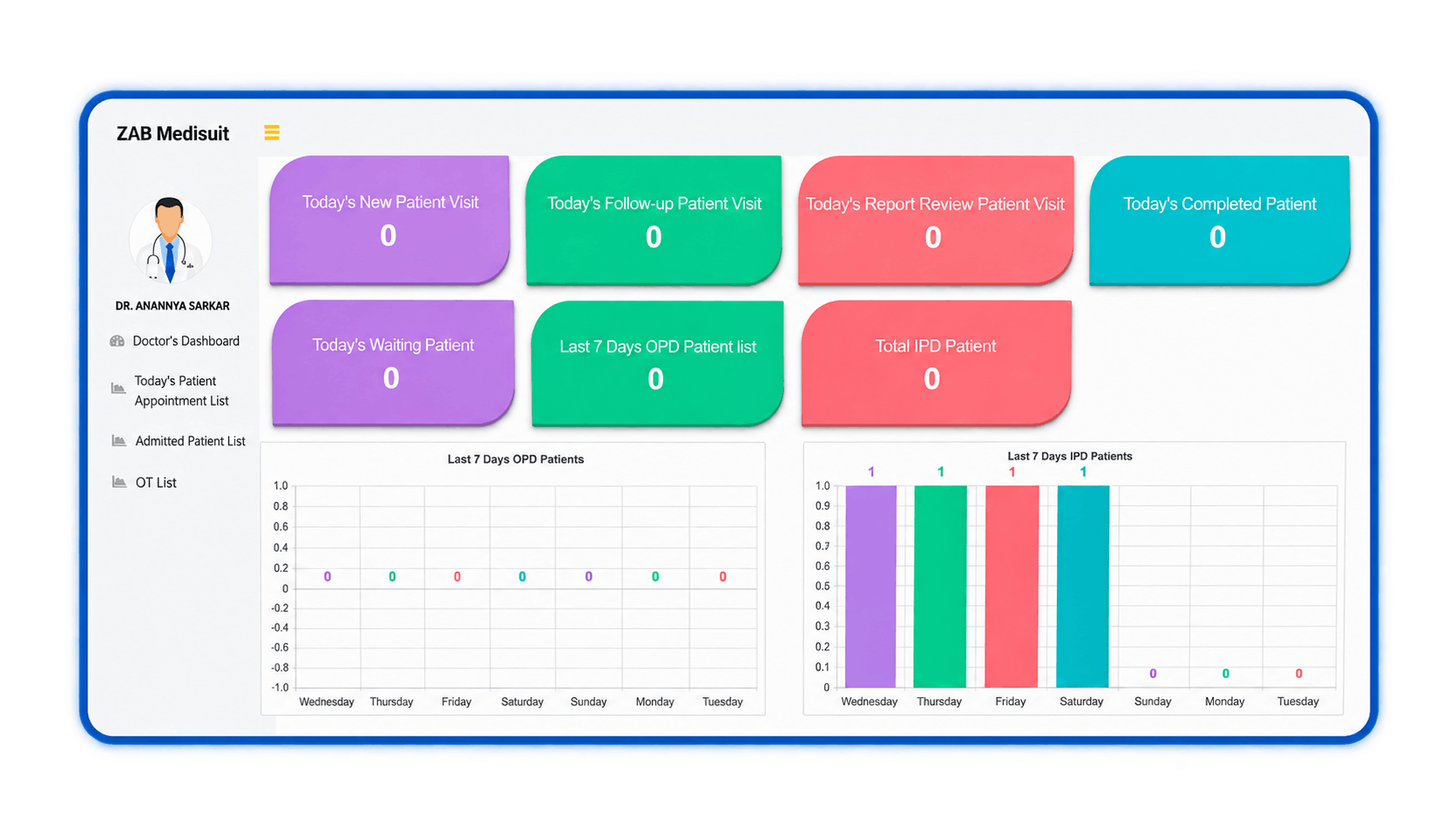
- Unified patient history under a single ID (UHID). Every patient was assigned a permanent Unique Hospital ID. Whether a patient comes through OPD, emergency, or an indoor bed, doctors can now see their entire past medical history, prior prescriptions, and lab results on a single screen.
- Direct machine integration — bi-directional LIS and RIS. The hospital's laboratory analyzers and radiology machines were integrated directly with ZAB MediSuit. The moment a blood test or imaging scan finishes on the machine, the result transfers automatically into the ERP; once a pathologist verifies it, it's instantly visible in the doctor's portal and the patient's profile.

Implementation note: this kind of machine-to-ERP connection is built on the same interoperability logic used across the healthcare IT industry — structured messaging standards (most commonly HL7) that let a lab analyzer, a radiology machine, and a hospital's software all describe a result the same way, so a machine from one vendor can talk to software from another without manual re-entry. It's worth noting that Bangladesh's own health system has been building toward this kind of integration at the national level too — the DGHS-backed Shared Health Record initiative documents similar lab-system and inventory integration work across the public sector, which is the same direction this hospital's private implementation was moving in.
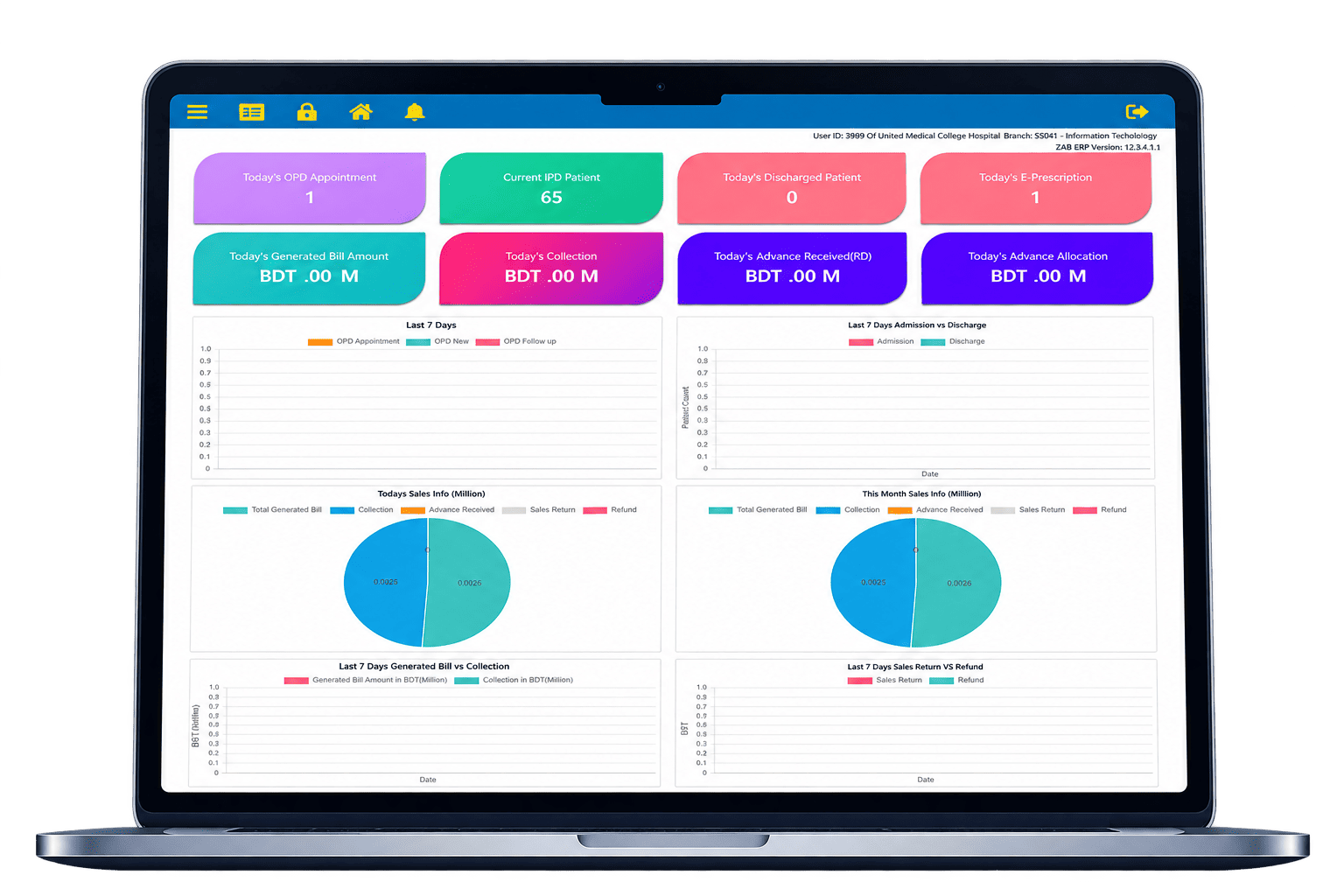
- Smart pharmacy inventory and expense control. Automated minimum-stock alerts, consumption-based purchase recommendations, and strict FEFO (First Expired, First Out) batch tracking. This stopped speculative over-purchasing, prevented expiry losses, and freed up working capital that had been sitting on shelves as dead stock.
- Automated real-time billing and 15-minute discharge. Every medicine issued, lab test run, bed charge, and nursing item now posts directly to the patient's digital bill in real time. Final discharge clearance that once took 3–4 hours is now completed in under 15 minutes.
- Automated SMS alerts for patients. Patients get an instant SMS the moment their lab report is signed off and ready, removing the need to queue at a delivery counter. Inpatients receive daily bill-update summaries by SMS, so billing stays transparent throughout their stay rather than surfacing as a surprise at discharge.
- Management mobile app and daily closing SMS. Hospital leadership gets 24/7 visibility — live OPD footfall, current bed occupancy, and department-wise collections through the ZAB MediSuit mobile app, plus an automated SMS every evening summarizing the day's total revenue and cash collection.
The Result: What Changed After Implementation
Following the rollout, the hospital saw measurable improvement across departments:
- Seamless go-live — zero hospital downtime during implementation; doctor schedules, existing patient data, and medicine lists migrated without disrupting ongoing care.
- ~70% faster consultations — doctors spend far less time typing or writing and more time with patients, based on comparing average consultation-slot duration before and after go-live.
- Lab turnaround cut by more than 50% — direct machine-to-ERP integration removed manual data entry and its associated delays and transcription errors.
- Zero billing leaks — automatic linking between pharmacy, OT, labs, and central accounts eliminated the unbilled-service and manual-calculation errors that were previously routine.
- Working capital recovered in pharmacy — controlled purchasing and automated expiry alerts stopped over-stocking and cut dead-stock losses.
- Discharge time down from 3–4 hours to under 15 minutes, and queue-free reporting/billing counters as a direct result of the automated real-time billing described above.
(Numbers reflect internal comparisons of hospital operational data from before and after go-live, provided by the client for this case study. Exact figures are not independently audited but are consistent with the process changes described above.)
Why ZAB MediSuit Fits Complex Hospital Workflows
Standard business software treats an organization like a factory or a shop — track stock, balance the ledger, done. A hospital doesn't work that way. ZAB MediSuit is built around that difference:
| Feature Dimension | Before (Legacy System) | After ZAB MediSuit |
| Doctor Prescription | Manual handwriting or slow data entry |
1-click e-prescription with smart clinical templates and a doctor portal |
|
Patient Medical Records |
Scattered across physical paper files |
Complete lifelong EMR under a single patient ID (UHID) |
|
Diagnostic Lab (LIS) |
Manual result typing from machine screens |
Direct machine-to-ERP integration (LIS & RIS) |
|
Pharmacy Control |
Blind over-purchasing, stock expiry waste |
Smart batch control, FEFO tracking, purchase limits |
|
Hospital Accounts & Billing |
Paper chits, frequent unbilled revenue leaks |
Automated real-time folio accumulation across departments |
|
Inpatient Discharge |
3–4 hours of manual cross-checking |
1-click clearance in under 15 minutes |
|
Patient Communication |
Long physical lines to check report status |
Automated instant SMS for ready reports, bills, and tokens |
|
Management Oversight |
Delayed monthly Excel reports |
Live mobile app dashboard and daily closing revenue SMS |
Frequently Asked Questions
How long does it take to implement a hospital ERP like ZAB MediSuit without disrupting patient care? This hospital went live with zero downtime — doctor schedules, patient data, and medicine lists were migrated in the background before cutover. Timelines vary by hospital size, department count, and how much historical data needs migrating; book a consultation for a timeline specific to your facility.
Can hospital software really integrate directly with lab and radiology machines? Yes — this is standard in modern HMIS platforms and is typically done through structured interoperability standards like HL7, which let different machine brands and software systems exchange results without manual re-typing. See the implementation note above for how that worked in this case.
Does this level of automation only make sense for large hospitals? The core problems — scattered records, manual lab entry, pharmacy over-purchasing, slow discharge — start showing up as soon as a facility has multiple departments coordinating around one patient, not just at very large scale. Diagnostic centers and mid-sized private hospitals see similar gains from the same modules.
How does FEFO tracking actually reduce pharmacy losses? FEFO (First Expired, First Out) automatically prioritizes dispensing stock with the nearest expiry date first, rather than relying on staff to check manually. Industry research on hospital pharmacy inventory practices consistently identifies inconsistent FEFO adoption as a major driver of preventable drug wastage — automating it removes the dependency on manual vigilance.
Ready to Fix Discharge Delays, Lab Turnaround, or Pharmacy Losses in Your Hospital?
If your hospital or diagnostic center is dealing with any of the problems described above — slow discharges, disconnected lab machines, pharmacy over-purchasing, or delayed management reporting — Orange Solutions can walk you through how ZAB MediSuit would fit your facility.
You can also see how we've approached this challenge at the industry level in our related guide: Best Hospital Management Software in Bangladesh.
Book a free consultation with the Orange Solutions team See how ZAB MediSuit works