
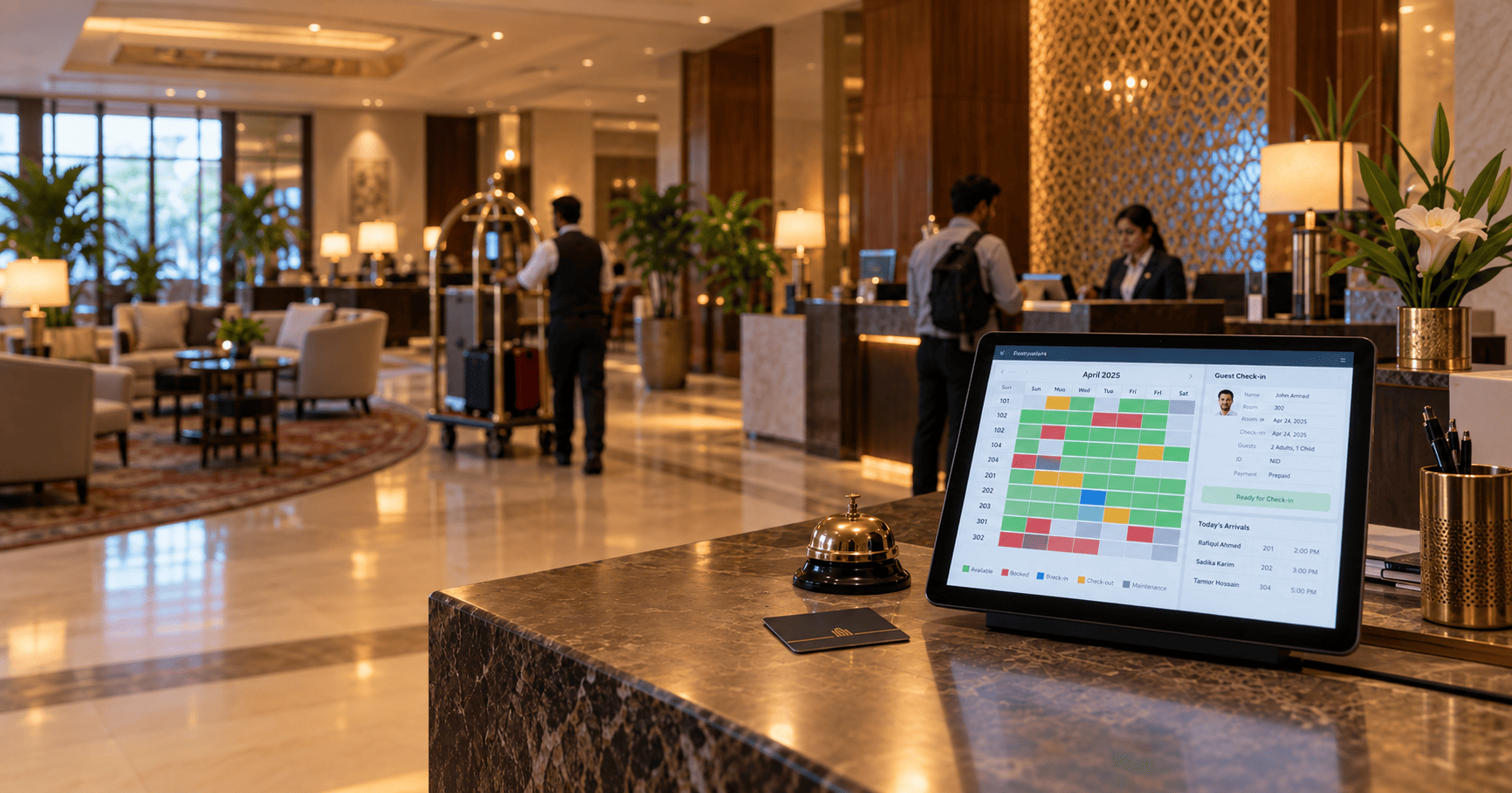
Run Your Hotel From One Screen: Best Hotel Management Software in Bangladesh
Key takeaways
- Hotel management software connects room reservation, front desk, housekeeping, and billing into one system; the real test is whether a booking on any channel updates availability everywhere else instantly.
- No vendor in this comparison publishes a fixed price; real cost depends on room and property count, deployment type, module count, and integration needs, ask about each specifically.
- Deployment varies significantly by vendor, two of five explicitly offer both cloud and on-premise, two are cloud-only, and one hasn't confirmed its deployment model at all.
- OTA and channel-manager integration, syncing bookings across sources like Booking.com and your own front desk, is the one feature most likely to prevent the exact double-booking problem described in the opening scenario, and not every vendor confirms it in detail.
There is no single best hotel management software in Bangladesh, the right choice depends on your property's size, whether you need OTA and channel-manager integration, and how many departments, front desk, housekeeping, F&B, need to work from the same information. For most Bangladeshi hotels and resorts, ZAB Hotels by Orange Solutions is the strongest overall choice, because it connects room reservation, front desk, housekeeping, billing, and restaurant management into one system, with the choice of cloud or on-premise deployment.
A mid-sized resort in Cox's Bazar took bookings through three channels, its own front desk, a phone reservation line, and two online travel agencies, each tracked in a separate spreadsheet updated by hand. During a busy holiday weekend, the same room got booked twice, once through Booking.com, once by a walk-in guest the front desk staff didn't realize was already reserved online. The guest who'd booked online arrived to find their room occupied, and the resort had to comp a night at a nearby property to make it right, a cost and a reputation hit that a synced room inventory would have prevented entirely.
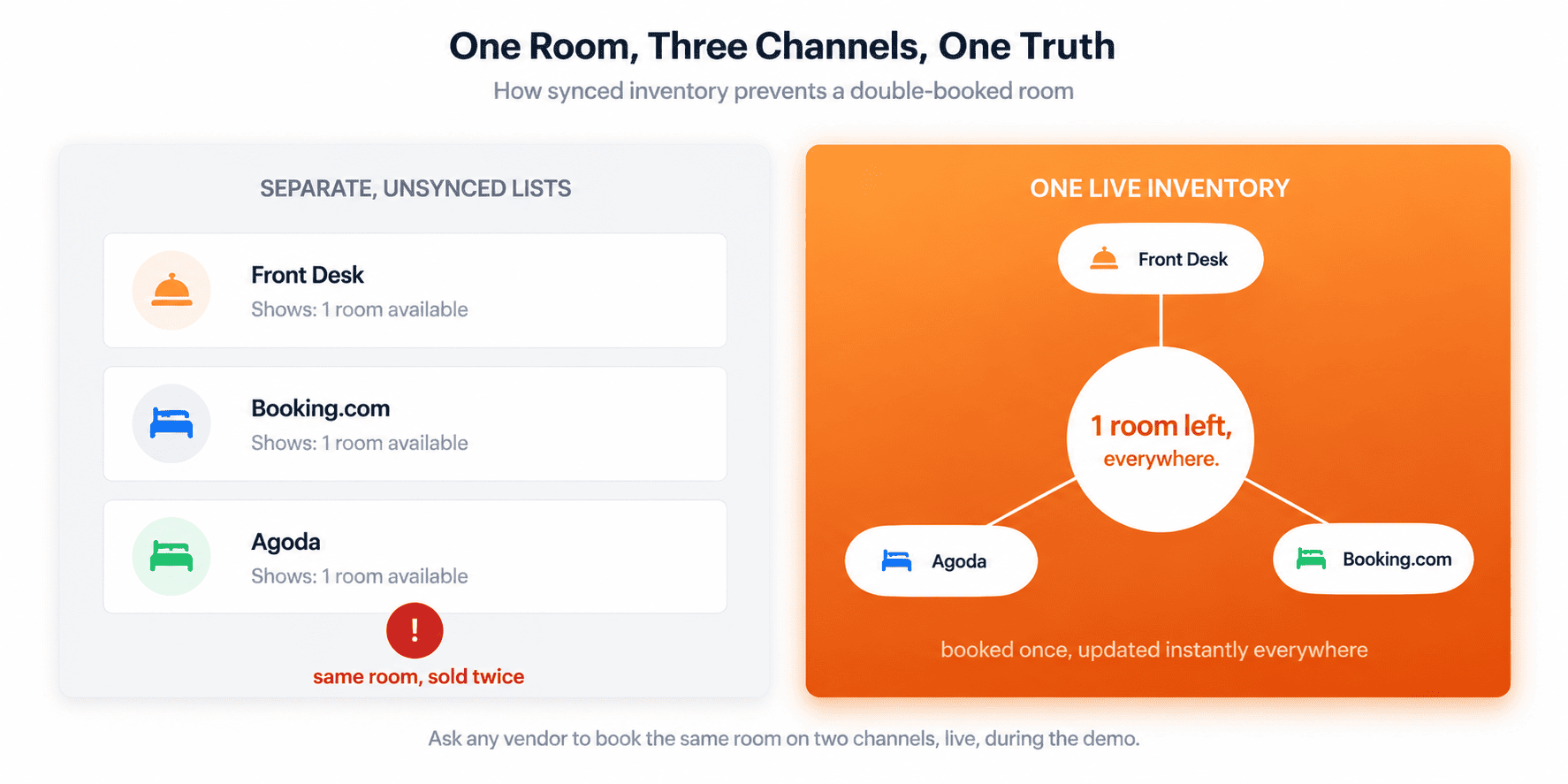
That's not a staffing problem, it's a synchronization problem, the same one hotel management software exists to solve: real-time room inventory that updates the moment a booking comes in, from any channel, so front desk, housekeeping, and every OTA are all working from the same numbers. Before comparing specific vendors, it's worth understanding what a hotel system actually needs to connect, and where a basic booking spreadsheet or a narrow PMS falls short of that.
What does hotel management software actually need to do?
Hotel management software connects room reservation, front desk, housekeeping, and billing into one shared system, so a booking made through any channel, the front desk, a phone call, or an online travel agency, updates room availability everywhere at once, and a guest's information follows them from check-in through checkout without being re-entered. In Bangladesh, this typically means a property management system (PMS) core, reservation, front desk, housekeeping, billing, as a connected minimum, with restaurant/F&B, HR and payroll, and channel-manager integration as common additions for larger properties.
Why "connected" matters more here than in most other business software:
A hotel runs on one resource that can't be duplicated or oversold, a room, on a given night. Most vendors list similar module names, reservation, front desk, housekeeping, billing, on a feature sheet they look interchangeable. What actually separates a working hotel system from a collection of separate tools is whether a booking made on one channel instantly updates availability everywhere else, whether housekeeping knows the moment a room is checked out and needs cleaning, and whether the front desk can see a guest's full booking and billing history without calling another department. That connection, not the module list, is what prevents the exact double-booking problem described in the opening scenario.
The minimum a hotel system should cover:
- Room reservation with real-time availability across every booking channel
- Front desk management, check-in, check-out, room allocation
- Housekeeping, room status tracking and maintenance scheduling
- Billing and invoicing that pulls directly from room charges and any additional services
- Basic reporting, occupancy, revenue, and booking trends
Larger properties typically add channel-manager integration for OTAs, food & beverage or restaurant management, HR and payroll, and revenue management with dynamic pricing, covered as we go through the comparison below.
Cloud or on-premise, which fits a Bangladeshi hotel?
Both exist in this market, though most vendors we found lean cloud-only, and the right choice depends on how much you need your reservation and billing data accessible from anywhere versus kept entirely on your own property's servers. Cloud-based systems let you check occupancy and revenue from a phone anywhere; on-premise systems keep everything local, which some hotel groups prefer for control, but it also means you're responsible for your own hardware and backups.
Why this matters specifically for a hotel:
A hotel owner or general manager often isn't on-site around the clock, a cloud system means checking tonight's occupancy or this month's revenue from a phone, whether you're at another property or traveling. That accessibility is a real advantage for a hospitality business specifically, more than for a single retail shop with one till. On-premise still has a place, a hotel group with strict internal data policies, or one already running its own server infrastructure, may prefer to keep reservation and guest data entirely in-house rather than route it through a vendor's cloud.
What to actually ask a vendor:
- Is this cloud-based, on-premise, or does the vendor offer both, and is that a real option or just something they'll agree to for a large enough deal?
- If cloud-based, what happens to bookings and check-ins if the internet goes down during a busy check-in period?
- If on-premise, who handles backups and what happens if the local server fails during peak season?
What should hotel management software cost in Bangladesh?
There's no single reliable price to quote here, none of the five vendors in this comparison publish their own pricing, and even competitor guides researching this same market recommend against trusting any single number. What actually drives the cost is room and property count, deployment type, module count, integration needs, and the level of support and training included, ask about each of these specifically rather than expect a flat quote upfront.
Why the real cost drivers matter more than a headline price here:
A basic front-desk and reservation system for a small guesthouse costs far less than a full hotel ERP bundling housekeeping, F&B, HR, payroll, and channel-manager integration for a resort with multiple properties. Even one industry guide covering this same Bangladeshi market states plainly that quoting a single price is misleading given how much it varies, and instead names the real factors: number of rooms and properties, deployment type (cloud subscriptions are usually recurring, on-premise licenses often involve a larger upfront cost), module count, integration needs like OTA channel managers and payment gateways, and the level of support and training offered.
What to actually ask before comparing prices:
- Does the price scale by number of rooms, number of properties, or a flat rate regardless of size?
- Is OTA channel-manager integration included, or a separate add-on?
- What's the difference in total cost between the cloud subscription model and an on-premise license, over three years, not just the first year?
- Is training for front-desk and housekeeping staff included, or billed separately?
The best hotel management software in Bangladesh, compared
| Rank | Software |
Best For |
Deployment |
Starting Price |
| 1 | ZAB Hotels (Orange Solutions) |
Hotels and resorts wanting reservation, front desk, housekeeping, billing, and restaurant management connected in one system |
Cloud or on-premise |
|
| 2 | PrideHotel (Pridesys IT) |
Larger hotels and hotel chains wanting an enterprise-grade system with real-time inventory sync and revenue forecasting |
Cloud |
Request a quote |
| 3 | Pro-Inn (Glorious IT) |
Small to mid-sized hotels wanting a straightforward system with Bangla-language support |
Not explicitly confirmed; vendor confirmation required |
Request a quote |
| 4 | Smart Hotel ERP (Smart Software Ltd.) |
Hotels wanting a system from a vendor with a verified multi-vertical track record |
Cloud confirmed; on-premise not advertised |
Request a quote |
| 5 |
GCTL Infosys |
Hotels wanting detailed dashboard reporting alongside core PMS functions |
Cloud or on-premise, both explicitly confirmed |
Request a quote |
ZAB Hotels (by Orange Solutions)
ZAB Hotels is a hotel management system built by Orange Solutions, covering room reservation, checkout, housekeeping, billing, food & beverage, restaurant management, member management, HR, accounts, transport management, and employee health management, twelve modules in total, according to Orange Solutions. It offers both cloud and on-premise deployment, a real difference from most of the other vendors in this comparison.
Why it leads this comparison:
The double-booking and disconnected-department problem described in the opening scenario is precisely what a connected system like ZAB Hotels is built to prevent, a booking, a room status change, or a bill all draw from the same live system rather than separate tools. Its stated module list is genuinely the broadest in this comparison, extending well beyond the core reservation-front desk-housekeeping-billing set into areas like transport management and employee health management that none of the other four vendors mention at all. That breadth suggests a system built for larger, more complex hospitality operations, a resort with its own restaurant, transport service, and larger staff, rather than a narrow booking tool.
Who it's for, and who it isn't:
ZAB Hotels is built for hotels, resorts, and hospitality groups wanting a genuinely broad system that goes beyond core PMS functions into staff, transport, and food service management. A very small guesthouse with a handful of rooms and no restaurant or transport service may find several of these modules unnecessary for now.
Consider: pricing isn't published; request a quote directly for your property's size and module needs. The product page doesn't state OTA or channel-manager integration explicitly; if syncing bookings across multiple online travel agencies is a priority, ask specifically how this is handled.
PrideHotel (by Pridesys IT)
PrideHotel is a cloud-based hotel management system built by Pridesys IT Limited, the same company behind PrideERP, PridePOS, and PrideHealth, covered elsewhere on this site. It's built as a full hotel ERP rather than a basic booking tool, combining reservation management, guest management, housekeeping, food & beverage, revenue management, back-office operations, and security/access control in a single platform.
What sets it apart:
Where several vendors in this comparison describe their modules only in general terms, PrideHotel's own detailed listing names specific, checkable capabilities: real-time room reservation with duplicate-booking prevention across multiple channels, guest check-in and check-out with QR-code support and automatic room allocation, housekeeping with maid assignment by floor or block, and revenue management with forecasting-based dynamic pricing. That duplicate-booking prevention feature is a direct, stated answer to exactly the kind of failure described in the opening scenario of this guide, a system explicitly built to stop the same room from being sold twice across different channels.
Who it's for, and who it isn't:
PrideHotel is positioned, according to Pridesys' own materials, for larger hotels and hotel chains needing enterprise-scale infrastructure, alongside mid-sized properties that want broader feature coverage than a basic PMS. It's part of a wider Pridesys product family, worth asking directly how it integrates with other Pridesys tools if your hotel group already uses, or is considering, one of them.
Consider: pricing isn't published; request a quote directly. Pridesys' own guidance is worth taking seriously here, don't expect or accept a single flat number, ask specifically how the price scales with room count, property count, and the modules you actually need.
Pro-Inn (by Glorious IT)
Pro-Inn is a cloud-based hotel ERP built by Glorious IT, covering reservations, front office, housekeeping, restaurant management, and HR, run from a single centralized dashboard. It's positioned for hotels, resorts, guesthouses, and villas, with a web-based booking engine so guests can book directly and pay online, cutting out third-party commission fees.
What sets it apart:
Glorious IT names several specific back-office capabilities most competitors in this comparison describe only in general terms: multi-currency transactions with VAT invoicing for non-room folios (restaurant charges, spa services, and similar add-ons billed separately from the room itself), automatic night posting to close out each day's charges, and POS and telecommunication charges that transfer instantly to a guest's room account rather than needing to be reconciled by hand at checkout. For a property juggling multiple revenue sources beyond the room itself, restaurant, phone charges, extra services, that level of automatic charge consolidation is a genuine, specific strength.
Who it's for, and who it isn't:
Pro-Inn is positioned by Glorious IT and independently described by a competitor's own listicle as suited to hotels, resorts, and guesthouses wanting an all-in-one ERP covering hospitality operations and staff/payroll management under one vendor. We could not independently confirm whether an on-premise option exists alongside the cloud deployment; ask directly if local server control matters to your property.
Consider: pricing isn't published anywhere we could verify; request a quote directly. One note worth knowing: identical marketing copy describing Pro-Inn also appears on Mediasoft's own website, which never explicitly claims the product as its own the way Glorious IT's page does. We've attributed Pro-Inn to Glorious IT based on that direct, first-person ownership claim and independent confirmation from a competitor's own listicle, but it's worth confirming ownership directly with whichever company you're evaluating.
Smart Hotel ERP (by Smart Software Ltd.)
Smart Hotel ERP is a cloud-based hotel management system built by Smart Software Ltd., the same company behind Smart POS and Smart Restaurant Management, both covered in our POS and restaurant software comparisons. It connects front office, guest management, billing, restaurant management, HR, and payroll into a single shared database, so every department works from the same real-time information.
What sets it apart:
Smart Software Ltd. is the only vendor in this comparison with an independently confirmed track record across three separate verticals, retail, restaurants, and now hotels, which we've verified directly in this series rather than taking on faith. Their own materials describe the hotel system less as a checklist of features and more as a single shared database feeding every department, front office, restaurant, HR, and payroll, all drawing from the same live numbers rather than reconciled after the fact. That's consistent with the same "one connected system" framing their retail and restaurant products use.
Who it's for, and who it isn't:
Smart Hotel ERP suits a hotel or resort wanting a system from an established, multi-vertical local vendor, particularly one that already runs, or wants, a restaurant operation connected to the same platform. Cloud deployment is confirmed directly on their own site; no on-premise option is advertised anywhere we found, so a property that specifically needs local server control should ask directly rather than assume it's available.
Consider: pricing isn't published anywhere we could verify; request a quote directly. Because this entry, like Smart Software's other products, emphasizes breadth across departments rather than deep, hotel-specific features like duplicate-booking prevention or channel-manager sync, ask specifically how OTA integration is handled if managing multiple online booking sources is a priority for your property.
GCTL Infosys
GCTL Infosys offers hotel management software available as either cloud-based or on-premise deployment, the only vendor besides ZAB Hotels in this comparison to explicitly confirm both options. It covers core PMS functions alongside detailed dashboard reporting, expense and maintenance-cost tracking, and booking status comparisons.
What sets it apart:
Where most vendors in this comparison describe reporting only in general terms, "analytics," "MIS reporting", GCTL's own materials show specific, named dashboard elements: an expense and maintenance-cost breakdown, and a direct comparison of confirmed versus pending bookings. That's a real, useful level of detail for a hotel manager who wants to see not just whether a room sold, but what it actually cost to run the property that month, an angle the other four vendors' public materials don't describe as specifically.
Who it's for, and who it isn't:
GCTL Infosys suits a hotel or property wanting genuine deployment flexibility, cloud or on-premise, alongside detailed financial and operational reporting. We could not independently confirm room count, property count, or scale positioning (small guesthouse versus large hotel chain) anywhere in what we found, this is the least documented entry in this comparison on that specific point; ask directly whether the system is built for your property's size before assuming.
Consider: pricing isn't published anywhere we could verify; request a quote directly. Because deployment is confirmed but scale and named client references aren't, treat this as a vendor worth a direct conversation and a demo before assuming it fits your property the way it might fit another.
Is this only for large hotels, or does it work for guesthouses too?
No, it isn't only for large hotels. Several vendors in this comparison, Pro-Inn and GCTL Infosys among them, are positioned specifically for small to mid-sized properties, guesthouses, villas, and lodges, not just large hotel chains, and both explicitly name this scale in their own materials.
Why property size changes what you actually need:
A large hotel or resort chain typically needs the fuller module set, revenue management with dynamic pricing, multi-property inventory sync, extensive HR and payroll for a large staff, the kind of enterprise-scale coverage PrideHotel and ZAB Hotels are built around. A small guesthouse with a handful of rooms usually doesn't need most of that, what it actually needs is reliable reservation and front-desk management, straightforward billing, and enough OTA integration to avoid the double-booking problem described in the opening scenario, without paying for HR modules, transport management, or enterprise reporting it'll never use.
What to ask if you run a smaller property specifically:
- Can the system run with just reservation, front desk, and billing, or does it force you to configure modules you don't need?
- Does the vendor have named clients that are actually guesthouses or small properties, not just large hotels or chains?
- How does pricing scale down for a smaller property, and is there a genuinely lighter tier, or is it the same system regardless of size?
Is my hotel ready for this software yet?
Most Bangladeshi hotels and guesthouses are ready for management software once the current booking process, a shared spreadsheet, a phone log, or separate records for each OTA, starts producing real mistakes: a double-booked room, a guest billed incorrectly, or nobody able to say with confidence how many rooms are actually available tonight. The readiness signal isn't the size of the property, it's whether the current process is already breaking down the way it did in the opening scenario.
Signs you're ready:
- You've had a double-booking, or come close to one, because different channels weren't checked against each other in real time.
- Front desk, housekeeping, and billing are tracked separately, and nobody has one place to check a guest's full stay and charges at once.
- You're adding OTA channels, or a restaurant, or a second property, and your current spreadsheet-based process won't scale to track all of it.
- Reconciling the day's charges, room, restaurant, extra services, into one guest bill takes real manual effort every checkout.
Signs you might not be ready yet:
- Your current process, even if manual, is small enough that one person can track every booking accurately without real errors.
- Your front desk and housekeeping staff haven't been part of the conversation about switching systems, staff who weren't consulted are less likely to actually use a new system consistently once it's live.
- You don't yet have a plan for migrating existing reservations, guest records, or historical data into a new system, that's real work, not something that happens automatically on day one.
If most of the "ready" signs sound familiar, the evaluation steps below are the next move. If it's mostly the second list, there's no cost to waiting until the pain is real, a small guesthouse running smoothly on a shared spreadsheet doesn't need to fix a problem it doesn't have yet.
How do you evaluate a hotel software vendor before signing?
Ask for a live demo that actually books a room across two different channels at once to test for double-booking prevention, confirm in writing how OTA and channel-manager integration works, get the real total cost including deployment and training, and talk to an existing hotel or property close to your own size before signing anything.
The four steps that matter most for a hotel specifically:
- Test double-booking prevention directly, don't take the claim at face value. Ask the vendor to book the same room through two different channels, your own front desk and a simulated OTA booking, live, in front of you. This is the exact failure described in the opening scenario, and it's the one thing worth seeing actually work before trusting it.
- Confirm OTA and channel-manager integration by name. Ask specifically which online travel agencies the system syncs with, Booking.com, Agoda, or others relevant to your property, and how quickly availability updates across them. "Multi-channel support" as a general claim isn't the same as confirmed integration with the specific platforms you actually use.
- Get the real total cost in writing, using the cost drivers from earlier in this guide. None of the vendors in this comparison publish pricing, so ask specifically how the price scales with room count, property count, and the modules you need, and what training and onboarding costs on top of that.
- Talk to a reference property close to your own size and type. A large hotel chain's experience tells you little if you run a small guesthouse, and vice versa. Ask the reference what actually broke or took longer than expected during setup, and whether they'd choose the same vendor again.
Which hotel software should you choose?
Choose based on your property's size, deployment needs, and how much OTA integration matters to you, not just the ranking above. A quick guide by situation:
- Hotel or resort wanting reservation, front desk, housekeeping, billing, and restaurant management connected, with the choice of cloud or on-premise → ZAB Hotels
- Larger hotel or hotel chain wanting confirmed, specific double-booking prevention and revenue forecasting → PrideHotel
- Small to mid-sized hotel, guesthouse, or villa wanting Bangla-language support and automatic charge consolidation across departments → Pro-Inn
- Hotel wanting a system from a vendor with a verified multi-vertical track record, especially if you also run a connected restaurant → Smart Hotel ERP
- Property wanting genuine deployment flexibility, cloud or on-premise, with detailed cost and maintenance reporting → GCTL Infosys
- Small guesthouse or property just getting past a spreadsheet-based process → see the smaller-property section above; Pro-Inn and GCTL Infosys are both positioned for this scale
Whichever you're leaning toward, run it through the evaluation steps above, a live double-booking test, confirmed OTA integration, the real total cost, and a reference property close to your own size, before signing anything.
FAQ
What is the best hotel management software in Bangladesh?
There's no single best system, it depends on your property's size, deployment needs, and how much OTA integration matters to you. For most Bangladeshi hotels and resorts, ZAB Hotels is the strongest overall choice in this comparison; see the full ranked list above for other property types.
What's the difference between hotel management software and a hotel ERP?
A property management system (PMS) focuses on core front-desk operations, reservations, check-in and check-out, and room management. Hotel management software or hotel ERP is broader, it typically includes PMS functionality plus channel management, restaurant and POS integration, HR and payroll, and full back-office tools, which is why most vendors in this comparison describe themselves as ERP systems rather than just booking tools.
What are the best hotel management solutions for a booking management system specifically?
If avoiding double-booked rooms across multiple channels is your main concern, PrideHotel's own materials specifically confirm duplicate-booking prevention with multi-channel availability. Ask any vendor in this comparison the same direct question, and test it live during a demo rather than taking the claim at face value.
Is there hotel reservation management software for small guesthouses, not just large hotels?
Yes. Pro-Inn and GCTL Infosys are both positioned for small to mid-sized properties, guesthouses, and villas, not just large hotel chains. See the smaller-property section above for what to ask specifically if this is your situation.
How much does hotel management software cost in Bangladesh?
None of the five vendors in this comparison publish exact pricing. Real cost depends on room and property count, deployment type, module count, and integration needs, request a quote from each vendor directly and ask how the price actually scales with your property's size.
Do these systems support cloud and on-premise deployment?
It varies by vendor. ZAB Hotels and GCTL Infosys both explicitly offer either cloud or on-premise. PrideHotel and Smart Hotel ERP are confirmed cloud-only. Pro-Inn's deployment model isn't explicitly confirmed anywhere we found, ask directly.