

Field Force Automation for a Bangladesh Distributor: An Illustrative ZAB Salesforce Scenario
A distributor with dozens of field sales officers often runs on phone calls, paper memos and evening reports, so managers see what happened only after the fact. Field force automation software moves attendance, route plans, visits, orders, stock checks, collections and approvals onto each officer's phone, so the office can see them as they happen. This page walks through one example distributor, shows what changes at each step, and gives you a way to measure whether it works for your own business.
Why field force automation matters in Bangladesh
Three facts explain why this problem is common here.
- Most retail runs through small shops. The Business Standard estimates that about 97% of retail trade in Bangladesh flows through traditional outlets, such as small neighbourhood shops and rural stores. Distribution therefore depends on reps visiting many small dealers, not on a few large buyers.
- Phones are the practical tool. By the end of June 2026 Bangladesh had 189.83 million active mobile subscriptions and 120.84 million mobile internet subscribers, according to BTRC data reported by The Financial Express. A field app can run on the phones reps already carry.
- Reps spend little of their week selling. In Salesforce's 2022 State of Sales survey of 7,775 sales professionals in 38 countries, reps reported spending 28% of their week selling, with the rest going to other work such as data entry and deal management. This is a global figure from a different company, not a Bangladesh or field-sales number, so treat it as context, not a promise.
The example: a distributor with a manual field process
Example profile (illustrative numbers): a distributor with 40 field sales officers visiting about 1,200 dealers across several districts, selling products such as fast-moving consumer goods, medicines or lubricants through primary and secondary orders.
In a manual setup, these problems typically appear:
- Attendance by phone call, SMS or office register. Supervisors cannot confirm a rep has reached the market on time.
- Visits you cannot verify. A rep may have visited an outlet or settled it by phone, and the record looks the same.
- Morning route coordination by calls. Team leaders phone each rep, and outlets get skipped.
- Orders on paper memos, sent in the evening by message or call, then re-typed. That adds delay and transcription errors.
- No live stock view in the field. Reps sometimes book items that are out of stock, which leads to cancellations.
- Travel claims on paper chits without a verified route, so accounts have to reconcile them by hand.
- Late demand signals. Leadership sees regional sales in periodic reports, so production and promotions respond slowly.
What changes with ZAB Salesforce
ZAB Salesforce is a mobile app for managing a field sales force. In this scenario it is used as follows.
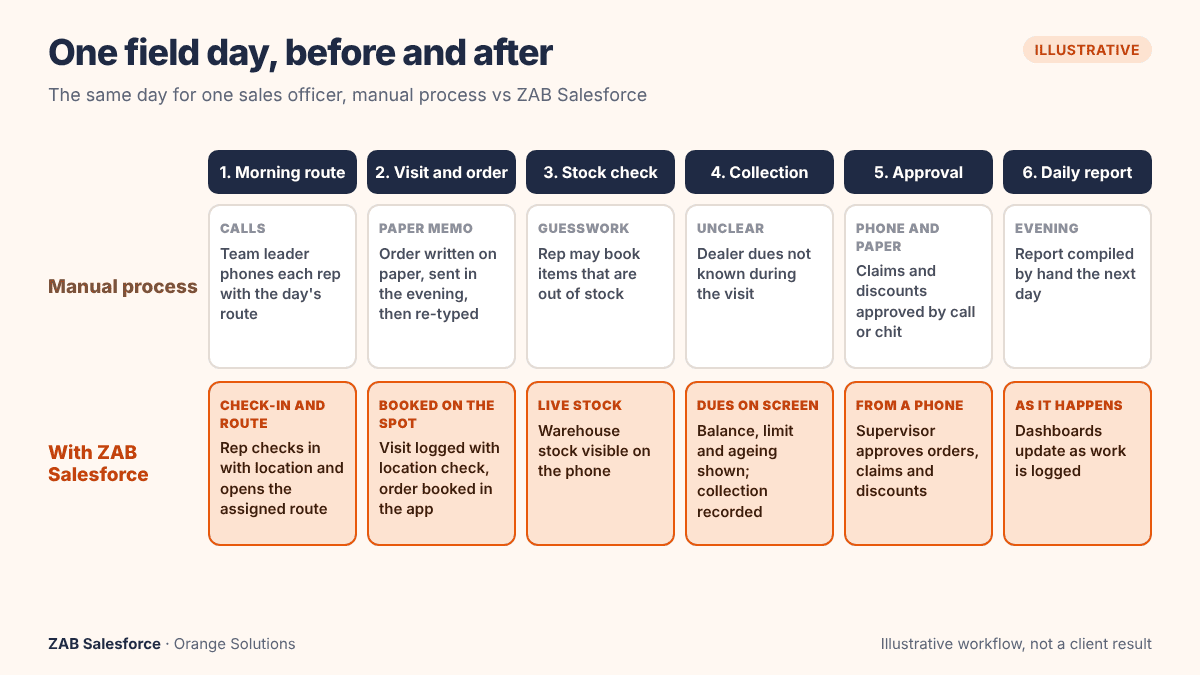
Image 3 (optional, only with real cleaned screenshots), right after the diagram. File: zab-salesforce-app-screens.webp · 1200 x 700 · under 100 KB. Alt text: ZAB Salesforce mobile app screens for attendance, route plan and order booking.
| Step |
In the example distributor |
What the office can see |
|---|---|---|
| Attendance |
The rep checks in and out in the app with location and time. |
Who started, where and when. |
|
Route and beat plan |
The territory manager assigns the daily route and dealer list in the system. The rep opens the app and sees it. |
Planned vs completed visits. |
| Visit logging |
The app checks the rep's location against the outlet's registered location. The rep adds notes, a shelf photo and dealer feedback. |
A verified visit record. |
|
Order booking |
Primary and secondary orders are booked during the visit and sent to the central system. |
Orders as they are booked, not the next day. |
|
Stock and catalogue |
The rep checks warehouse stock and product sheets on the phone. |
Fewer orders for unavailable items. |
|
Travel claims |
Distance between visited outlets is logged from location data. |
Claims that match recorded routes. |
|
Dues and collections |
The rep sees the dealer's outstanding balance, credit limit and ageing, and records a cash or cheque collection with a receipt. |
Collections and dues per dealer. |
|
Approvals |
Supervisors approve orders, claims, discounts and leave from their phones. |
Faster decisions. |
|
Management reports |
Sales by territory, productive-visit ratio, order conversion and KPI dashboards. |
Where demand is strong or slow. |
Manual process vs ZAB Salesforce workflow
This compares the two workflows. It does not report results.
|
Manual field process |
With ZAB Salesforce |
|
|---|---|---|
|
Attendance |
Phone calls, SMS, register |
Check-in and out with location |
|
Visit proof |
Notes without location |
Location-checked visit with photo |
|
Route planning |
Daily calls and notes |
Route and beat assigned in the app |
|
Order capture |
Paper memos sent later |
Booked in the app during the visit |
| Stock visibility |
Reps unaware of live balances |
Live warehouse stock on the phone |
|
Travel claims |
Paper bills, separate checking |
Distance-based digital claims |
|
Credit and ageing |
Dues unclear during the visit |
Dues, limits and ageing on screen |
|
Management view |
Delayed spreadsheets |
Dashboards updated as work is logged |
What does independent research say about the gains?
We do not publish a result for this scenario. For context, here is what published research reports about sales automation in general. None of it measures productive visits for a Bangladeshi distributor, and each figure has limits.
| Source |
What it reports |
Limits |
|---|---|---|
| McKinsey & Company, "Sales automation: the key to boosting revenue and reducing costs" (May 2020) | Early adopters of sales automation reported efficiency gains of 10 to 15 percent and sales uplift of up to 10 percent. | Based mainly on the authors' client experience. It covers B2B sales in general, not field sales in Bangladesh. |
| Nucleus Research, "Assessing the value of SFA technology" (December 2025) | For organisations that adopted a sales force automation platform, it reports seller administrative time down by 25 to 35 percent. | The public summary does not give the number of organisations studied or the method. The full report is behind registration. |
| Nucleus Research, mobile CRM survey (March 2012) | An average productivity gain of 14.6 percent from mobile CRM capabilities, from a survey of 223 CRM decision makers. | Old, and based on decision makers' views. The measure is not defined. |
How to read this: the independent figures range from about 10 to 35 percent, and they measure different things (efficiency, administrative time, perceived productivity). They show that gains are commonly reported, not what your business will see. That is why the table below asks you to measure your own.
How to measure whether it works for you
Pick two or three rows, record your baseline for 2 to 4 weeks before the change, then measure the same way after 30 and 90 days.
|
What to measure |
How to measure it |
Your baseline |
After 30 days |
After 90 days |
|---|---|---|---|---|
|
Productive visits per rep per day |
Visits that ended in an order or a recorded outcome, divided by working days | |||
| Time from order booking to dispatch | Booking time vs dispatch time in your records | |||
| Orders cancelled for stock reasons | Count of cancelled orders with stock as the reason, per month | |||
| Days to settle travel claims | Claim date vs payment date | |||
| Dealer dues older than 30 days | Ageing report total |
Tip: start with a small pilot, for example 5 to 10 reps in one territory for 30 days, and compare them with a similar group that keeps the old process.
Seven questions to ask any field sales app vendor
- Does the app work when the phone has no signal, and what happens to the data afterwards?
- How are attendance and visit location checked, and how do you handle a phone with location turned off?
- Does it connect to our ERP, and which fields sync in each direction?
- Can reps see live stock and dealer dues during a visit?
- Who approves orders, discounts and claims, and can they do it from a phone?
- How long does it take to train our reps, and who does it?
- Who owns our data, and can we export it?
Frequently asked questions
What is field force automation?
Field force automation is software that moves a field sales team's daily work, such as attendance, routes, visits, orders and collections, onto mobile phones and a central system, so managers can see it as it happens.
What is a field sales app?
A field sales app is the mobile part of that software. Reps use it to plan visits, take orders and check stock and dues, while managers see coverage and orders in the office. ZAB Salesforce is Orange Solutions' field sales app for distribution businesses.
What does ZAB Salesforce record?
In this scenario it records attendance with location, planned routes, visits with notes and photos, primary and secondary orders, stock checks, collections, travel distance and approvals.
Does it work without internet?
ZAB Salesforce supports offline functionality, so field tasks can be completed without an internet connection. Ask us at the demo which tasks work offline and how the data syncs when the signal returns.
Does it connect to our ERP?
ZAB Salesforce integrates with CRM and ERP systems, so data can flow between field and office teams. Ask us at the demo how it works with your own ERP.
How do I know if it will work for my business?
Measure it. Use the table above, run a short pilot, and compare it with your own baseline. Any vendor that promises a fixed percentage before seeing your business is guessing.
How do I get a demo?
Book a free demo and tell us how many reps, dealers and territories you run.
Ready to see how it would work for your business?
Tell us your number of field officers and dealers, and we will show you how ZAB Salesforce would handle your routes, orders and collections. Book a free demo.