
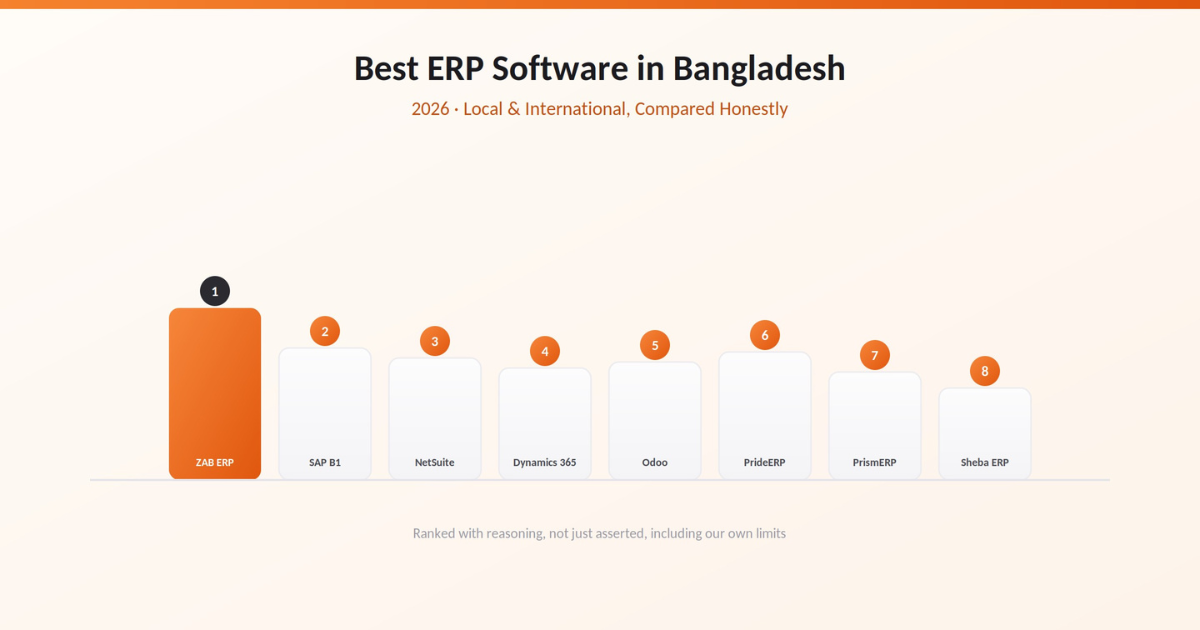
Best ERP Software in Bangladesh
A factory owner in Gazipur told his implementation partner's sales rep exactly what he needed: real-time production tracking across three floors, VAT-ready invoicing, and a system his line supervisors, most of whom had never used anything more complex than a phone calculator, could actually run. The demo was beautiful. Every screen loaded instantly, every report looked exactly like what he'd asked for. Eight months and a partial rollout later, his supervisors were still keeping a paper backup "just in case," because the system that worked perfectly in the demo needed a data structure his factory didn't have, and nobody had mentioned that during the sales call.
This isn't a rare story. Academic research on ERP adoption in Bangladesh, across the textile sector, SMEs, and manufacturing more broadly, consistently names the same failure drivers: high upfront cost, inadequate planning, customization that wasn't scoped properly, and organizational resistance from staff who weren't brought into the process early. Globally, the picture is blunter still: independent industry research puts ERP implementation failure rates at roughly 50 to 70 percent, and full rollouts routinely take anywhere from several months to a few years depending on how prepared the business is going in.
So before any list of "best" ERP software in Bangladesh, here's the more useful question: best for what, and best for whom. Search for "top 10 ERP software" and every ERP software company writes its own version of this list. We're ZAB ERP, built by Orange Solutions, and you'll see us on this list too. Rather than ask you to simply trust that ranking, we're showing the reasoning behind every entry, including our own, the same four questions, the same cost breakdown, the same honest "Consider" notes on every vendor's real limitations. If a claim on this page doesn't hold up to that scrutiny, including a claim about us, it shouldn't be here.
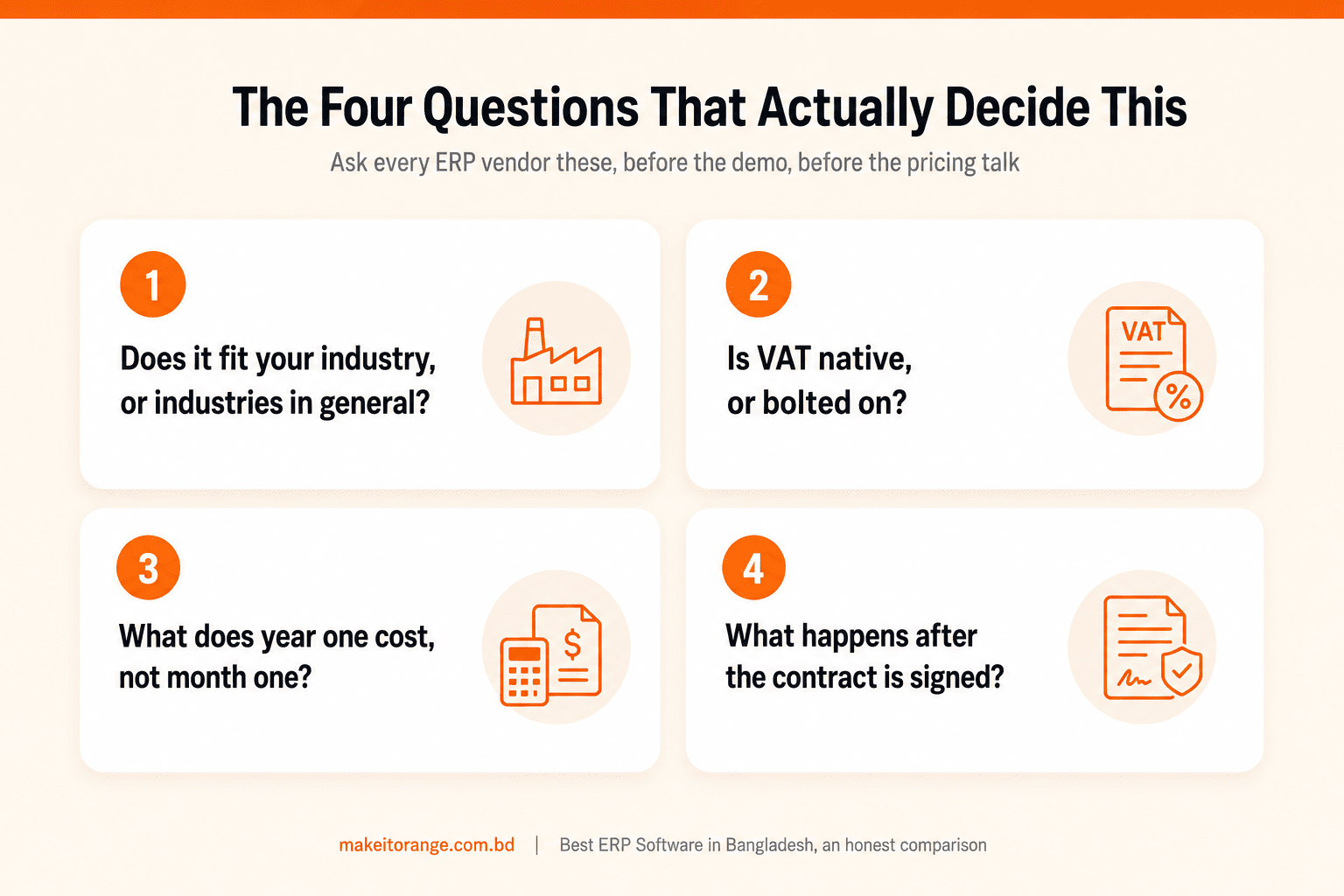
The real decision comes down to four questions, and almost nobody selling you an ERP will bring them up first. We'll walk through them next, then rank the options against them.
The four questions that actually decide this
Every ERP vendor in Bangladesh will tell you their product is the right one. That's not useful information, it's marketing. What's useful is knowing which questions to ask before you sit through a single demo, because these are the four that actually separate a good fit from an expensive mistake. Keep them in mind through the list below; we'll flag how each vendor holds up against them.
- Does it fit your industry, or does it fit "industries" in general?
A system built specifically for garment factories already understands a bill of materials, a production floor, and a shipment deadline without being configured to. A general-purpose system can be taught to understand those things too, but that teaching is customisation work, and customisation work costs time and money that rarely shows up in the first conversation. Ask any vendor plainly: is this built for my industry, or built to be adapted to it?
- Is VAT native, or bolted on?
Every vendor will tell you their system is "NBR compliant." That phrase means almost nothing on its own. Ask specifically whether a VAT challan (Mushak 6.3) generates automatically the moment a sale happens, or whether it's a separate step someone on your team has to remember to run. In a demo, that difference is invisible. Three months after go-live, when someone forgets the separate step during a busy week, it's very visible.
- What does the total cost look like in year one, not month one?
A system quoted at ৳5,000 a month sounds cheaper than one quoted at ৳8,000 a month, right up until you learn the first one comes with a large implementation bill on top and the second doesn't, an illustration of a real pattern buyers hit, not a specific quote from any vendor. ERP pricing in Bangladesh varies enormously by deployment type, and different vendors quote it in different ways, so treat any single number you see, including ours, as a starting point rather than the answer. As a rough sense of the spread: small business cloud plans are commonly quoted anywhere from a few thousand to over ৳1,00,000 a month, while a full implementation for a small or mid-sized business, hardware, customisation, and training included, has been quoted anywhere from ৳50,000 to ৳25,00,000, and considerably more for larger, more complex rollouts. The sticker price on the homepage is almost never the number that ends up mattering; ask every vendor to walk you through what happens after the license fee.
- What happens after the contract is signed?
This is the question a demo cannot answer, because a demo happens before you sign, and this is about after. Who trains your staff, in Bangla, on your actual day-to-day workflow, not a generic walkthrough? Who answers the phone when the system goes down in the middle of a shipment deadline? Ask every vendor for a reference customer close to your own size, in your own industry, and actually call them before you decide.
Keep these four in your pocket. Before the list, three more questions worth asking, the technical ones that rarely come up until they matter.
The technical questions nobody asks until it's too late
The four questions above will shape which vendor you shortlist. These three will shape whether the system you choose actually survives contact with how your business really runs. They're less exciting to ask in a meeting, which is exactly why they tend to get skipped, right up until the moment they matter.
What happens when the internet goes down?
This isn't a hypothetical in Bangladesh. Internet and power interruptions happen, and a cloud ERP that simply stops when the connection drops means your counter, your warehouse, or your production floor stops with it. The honest answer isn't as simple as "cloud bad, on-premise good," though. Cloud systems generally handle a local outage better, if your office loses power or internet, you can often still reach the system from a phone or another location, something an on-premise server sitting in your building cannot do if that building loses power. What cloud systems don't eliminate is a national or provider-level outage, and those do happen. Ask any vendor directly: what does a transaction look like on our end during an outage, does it queue and sync later, or does it simply fail, and how have your other Bangladeshi clients actually experienced this, not in theory.
Who owns your data, and what happens if you leave?
Ask this directly, in these words, and listen for a straight answer rather than a redirect to a privacy policy: "Is our data ours, and if we ever left, could we take it with us in a usable format?" A vendor confident in their product will answer this without hesitation, because they're not worried about you leaving. A vendor who deflects, changes the subject, or can only point you to a document is telling you something. Ask specifically what format your data would export in, and whether there's a cost attached to getting it out. This matters more than it seems to at the moment of signing, and far more than it seems to five years in, when switching costs are the whole reason a vendor stops trying.
Can it talk to what you already use, and what does moving your existing records actually involve?
Very few Bangladeshi businesses are starting from nothing. You likely have an Excel sheet, an old accounting package, or years of paper registers, and probably a bank account and possibly an online store you'll want connected too. Ask precisely what the vendor migrates for you, what you'll need to re-enter by hand, and get a specific timeline, not "a few weeks," an actual week count tied to your data volume. This is where the illustrative cost section earlier in this guide becomes very real: a vendor who can't answer this clearly in the sales conversation is unlikely to answer it any more clearly once you've signed.
The best ERP software in Bangladesh, compared
At a glance
| ERP Software | Key Features | Price (Bangladesh est.) | Best For |
| ZAB ERP (Orange Solutions) | Multi-branch and group consolidation, live inventory view, native VAT. Lighter edition ZAB Lite available | Custom quote. Small/mid-sized businesses: roughly ৳50,000–25,00,000. Larger businesses: roughly ৳25,00,000–50,00,000+. ZAB Lite runs lower-cost subscription |
Groups of companies and multi-entity businesses, local support and VAT built in |
| SAP Business One (via local partners) | Global enterprise platform, standardized financial controls, broad industry applicability | Enterprise-tier; typically higher than local alternatives. Get full multi-year cost in writing | Established mid-market and larger businesses wanting global structure with local delivery |
| Oracle NetSuite (via local partners) | Fully cloud-native, no on-premise option, global app ecosystem | Enterprise-tier; confirm year-one cost with your local partner | Cloud-only businesses, especially with international operations |
| Microsoft Dynamics 365 (via local & international partners) |
ERP and CRM in one platform, deep Microsoft 365 integration |
Enterprise-tier; local support model varies by partner | Businesses standardized on Microsoft's ecosystem |
| Odoo (via local partners) | Modular, open-source, global app ecosystem. VAT compliance built by the local partner | Roughly ৳500,000 to ৳10,000,000+, by scope and partner | Businesses wanting global customisation, with a vetted local partner |
| PrideERP (Pridesys IT) | Merchandising, production planning, industrial engineering, bundle tracking, garment washing, LC handling | Roughly ৳50,000–200,000 for SME deployments; ৳150,000–400,000+ for garment-factory rollouts, custom-quoted for larger operations | Garment and textile factories, small to large |
| PrismERP (Divine IT) | Broad modules across 65+ industries, finance, inventory, sales, branch management, NBR VAT | Similar range to ZAB ERP; scales with configuration | Mid-sized trading, service, and general manufacturing |
| Sheba ERP (Mysoft Heaven) | Bilingual interface, multi-company consolidation, ledger, stock, payroll | Not independently confirmed; request a quote | Established local suite, strong Bangla usability |
Prices are directional estimates from public sources, not confirmed quotes. See the cost section below for why the license fee alone rarely reflects total cost, and get a written breakdown from any vendor before deciding.
1. ZAB ERP (by Orange Solutions)
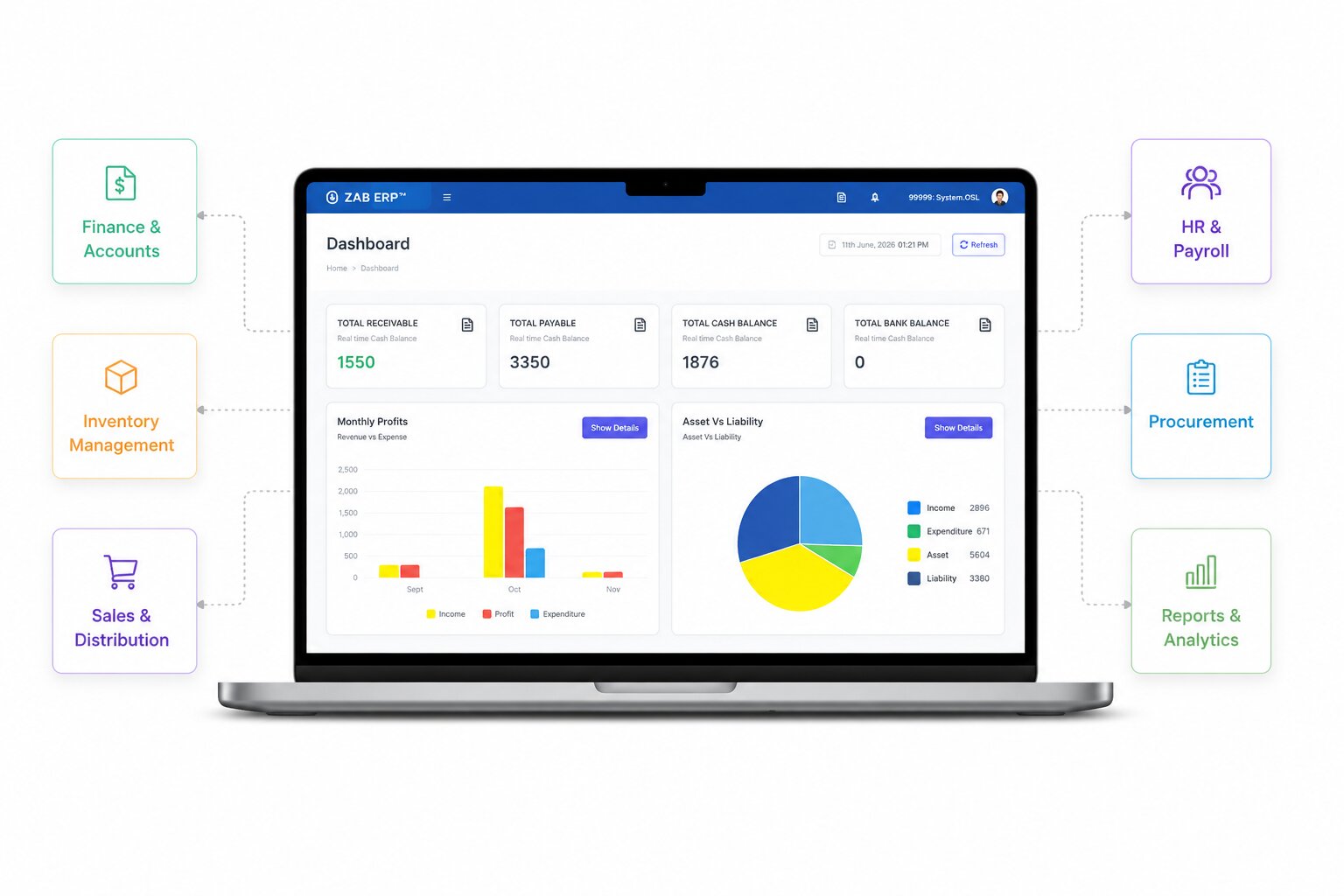 Best for: Growing and complex businesses, including groups of companies, multi-branch organizations, manufacturers, and enterprises that need centralized operations, consolidated reporting, local VAT compliance, customization, and implementation support in Bangladesh.
This is our product, so read the "Consider" note as carefully as the rest. ZAB ERP is a cloud ERP built for a specific kind of growing pain: a business that now has more than one branch, factory, or company under the same ownership, and can no longer get a straight answer to "what's our real position right now" without someone manually pulling numbers from three different places. The system consolidates inventory, sales, and financials across locations and entities into one live view, with VAT handling built into the system natively rather than run as a separate reconciliation step afterward. Orange Solutions is ISO 9001:2015 certified, a BASIS member, and NBR-enlisted.
What this actually means for you: if your specific pain is "I own two shops and I genuinely do not know, right now, which one is doing better this month," "we're a group of four companies, including a manufacturing arm and a trading arm, and closing group accounts takes three weeks," or "our production floor runs on spreadsheets and nobody trusts the numbers," that's exactly what ZAB ERP is built to solve. Being local also means the support conversation happens in Bangla when that's easier, and a compliance question doesn't wait on a time zone.
If you're a smaller business, a single-location retailer or trading company with straightforward needs, full ZAB ERP is likely more than you need right now. We also offer ZAB Lite, a lighter, subscription-based version covering accounts, sales, inventory, and purchase management, built specifically as an affordable entry point for small businesses moving off spreadsheets. Many businesses start on ZAB Lite and move up to full ZAB ERP later, without losing their data, as they grow into needing it.
Consider: we're built for growing, complex operations, manufacturing, multi-branch, or group-structured, rather than the simplest single-shop setup, so ask us directly how our implementation scopes to your specific plant or process before assuming depth in every industry-specific detail. If you're small enough that even ZAB Lite feels like more than you need, see the "are you even ready for ERP yet" section below before you talk to us or anyone else.
2. SAP Business One (via local partners)
Best for: established mid-market and larger businesses that want a globally standard enterprise platform, backed by structured local implementation support.
SAP Business One has real, established roots in the Bangladeshi market, not just a name recognized from abroad. Multiple certified local partners deliver and support it, including Fusion Infotech Limited, which cites over 50 client implementations with more than 20 specifically on SAP Business One, and Access Telecom (AccessTEL) BD Ltd, which has been implementing SAP solutions locally for over 15 years. Both point to named, checkable results: AccessTEL cites a 25 percent revenue improvement through better stock control and a 35 percent reduction in production costs at Honda Bangladesh, and a 25 percent revenue improvement with 35 percent supply-chain cost savings at Ispahani Islamia Eye Institute and Hospital.
What this actually means for you: if you want the structure and governance of a global enterprise platform, standardized financial controls, broad industry applicability, without building on a system a local partner has to construct compliance for from scratch, SAP Business One has genuine local delivery experience behind it, not just global brand recognition.
Consider: SAP Business One's strength is structure and control, which suits process-driven organizations, but that same structure means implementation is typically less flexible and can take longer to configure around an unusual local workflow than a system built for Bangladesh specifically. Licensing and implementation costs also tend toward the higher end of this list; ask your partner for the full multi-year cost, not just the initial license quote, using the five questions from the cost section below.
3. Oracle NetSuite (via local partners)
Best for: businesses wanting a cloud-native, globally standard platform with real local implementation experience, particularly for companies with international operations or ambitions.
Oracle NetSuite is delivered in Bangladesh through several named local partners, including Tangram Tech Solutions Ltd., which describes itself as an early and established NetSuite partner in the market, Omnilab Enterprise Solutions, and Solution Partners Limited. Tangram cites a real, named local implementation at Beacon Medicare. Its fully cloud-native architecture, no on-premise option at all, makes it a distinct choice from SAP Business One or Dynamics 365, which both offer on-premise deployment.
What this actually means for you: if your business already thinks in terms of cloud-only operations, or you have or plan international operations alongside your Bangladeshi business, NetSuite's cloud-native design and global user base are a genuine fit. Local partners exist and have delivered real projects, though the depth of publicly available local case evidence is thinner than what's available for SAP Business One.
Consider: because NetSuite has no on-premise option, the connectivity questions from earlier in this guide apply with extra weight, ask specifically how the local partner has handled outages for other Bangladeshi clients. As with SAP, expect enterprise-tier pricing; get the full year-one cost in writing before comparing it against a locally-built alternative.
4. Microsoft Dynamics 365 (via local and international partners)
Best for: businesses already standardized on Microsoft's ecosystem, wanting ERP and CRM in one platform, and willing to invest extra effort in vetting local implementation support.
Dynamics 365 is a genuinely capable global platform, and it's worth being straightforward about where it stands locally compared to the other two international options on this list: Bangladesh-based implementation presence is thinner. Most Dynamics 365 partners serving Bangladesh operate from outside the country, regional or global firms delivering remotely, rather than being headquartered here the way Fusion Infotech or Tangram Tech are for SAP and NetSuite. One Dhaka-based provider, Implevista, does have a real local implementation on record, consolidating sales, customer service, and inventory for a Dhaka retail company that had been running disconnected systems.
What this actually means for you: if your organization already runs on Microsoft 365 and wants ERP that integrates tightly with tools your team already knows, that's a real and legitimate reason to choose Dynamics 365. Just go in aware that "who provides our local support" needs a harder answer here than it does with the other two international platforms on this list.
Consider: ask any Dynamics 365 partner serving you from outside Bangladesh exactly how support works in practice, response times, time zone coverage, whether Bangla-language support exists at all. This is the one platform on this list where that question genuinely doesn't have an obvious answer, and it's worth resolving before you sign rather than after.
5. Odoo (via local partners)
Best for: businesses that want a globally standard, deeply customisable platform, and are prepared to choose the implementation partner as carefully as the software.
Odoo is different from every other name on this list in one important way: it isn't a Bangladeshi product with a Bangladeshi company behind it. It's an international, modular, open-source ERP with a global app ecosystem, brought into the Bangladeshi market entirely through local partners. That distinction matters more than it sounds like it should. Neither Odoo nor comparable open-source platforms ship with Bangladesh's VAT and compliance rules built in; the localisation, NBR-compliant Mushak generation, BDT handling, local payroll rules, is work that a partner builds on top, not something the software arrives with. Implementation cost reflects that: real Bangladeshi deployments run from roughly ৳500,000 for a simple setup to over ৳10,000,000 for a complex multi-module manufacturing rollout, and typical timelines run 3-6 months depending on scope.
What this actually means for you: the honest framing here isn't "is Odoo good," it's "is this partner good." A well-implemented Odoo deployment, with real NBR VAT localisation and a partner who actually maps your processes instead of pushing a generic template, can genuinely compete with anything on this list. A poorly implemented one leaves you with a beautiful international platform that can't produce a compliant Mushak 6.3 without someone remembering to check it by hand.
Consider: you are evaluating two things at once here, not one, the software and the partner delivering it, and you cannot shortcut the second by trusting the first. Ask any Odoo partner for a live demonstration of actual Mushak generation on your data, not a description of the capability, and get their implementation plan and cost in writing before you sign anything.
6. PrideERP (by Pridesys IT)
Best for: garment and textile factories running real production, from small workshops up to large export-oriented manufacturers.
PrideERP is the name that comes up most often when Bangladeshi garment factory owners talk to each other about ERP. That reputation is earned in the detail, not the marketing. The system covers the entire order lifecycle a factory actually runs on: buyer enquiry and costing, sample management, industrial engineering and SMV calculation, line planning, bundle-level production tracking with barcode management, and garment washing management. On the commercial side, it handles back-to-back LC opening and export LC documentation, so a factory importing fabric against a buyer's LC isn't bolting on a separate system for that paperwork. In May 2024, Trouser Line Ltd. signed on to implement PrideERP across its operation, one of a steady stream of similar RMG agreements Pridesys has closed over its twelve years in the market.
What this actually means for you: if your business is a factory floor, PrideERP was built by people who understand what happens on a factory floor. The line-layout planning, the alter-and-reject tracking, the shade-and-lot-wise cutting management, these aren't generic ERP features with a garments label stuck on top. They're specific to how a Bangladeshi RMG operation runs.
Consider: that same depth is the trade-off. PrideERP's modules are built around garment and textile production specifically. If you're a trading company, a distributor, or a service business with no factory floor, or if you're a group of companies rather than a single factory, ZAB ERP, at the top of this list, is built more directly around that structure, worth comparing the two rather than assuming either fits from the category alone.
7. PrismERP (by Divine IT)
Best for: mid-sized trading, service, and manufacturing businesses that need broad coverage across many departments without being locked into one industry template.
PrismERP's identity is breadth rather than specialisation. It's platform-independent and web-based, and Divine IT built it to serve more than 65 types of industries from a single core product, with 400+ businesses currently running on it. The module set spans financial accounting, inventory, sales and customer management, purchase and vendor management, branch management, and production management, and it carries NBR VAT approval as PrismVAT. One real reference point worth knowing: Rancon Motorbikes evaluated 29 ERP vendors, local and international, before choosing PrismERP to manage its nationwide dealer network.
What this actually means for you: if you don't fit neatly into "garment factory" or "multi-branch group," if you're a distributor, a services business, or a general manufacturer with a mix of needs, PrismERP's breadth means you're less likely to hit a wall where the system simply doesn't have a module for what you do. Branch management is native, not an add-on.
Consider: breadth cuts both ways. A system built to flex across 65 industries won't have PrideERP's factory-floor depth for pure garment production, or a narrow specialist's out-of-the-box fit for your exact workflow. Expect more configuration during implementation to shape it around your specific processes, and ask to see that configuration work done for a business genuinely similar to yours, not just a demo of the base product.
8. Sheba ERP (by Mysoft Heaven)
Best for: businesses wanting an established local suite with strong Bangla-language support and multi-company consolidation.
Sheba ERP is developed by Mysoft Heaven (BD) Ltd., a Bangladeshi company with a suite of related products, HR Sheba for payroll among them, that integrate with the core ERP. The system supports full bilingual switching between Bangla and English, which matters in practice when factory-floor or field staff are the ones entering data. It also handles multi-company setups, giving a group of related businesses a consolidated financial view while keeping each company's operations separately tracked. Core modules cover general ledger, stock and supply chain management, and employee, attendance, and payroll administration.
What this actually means for you: if genuine Bangla-first usability for non-technical staff is a priority, or you run a small group of related companies and want consolidated reporting without losing per-entity detail, those are real, verifiable strengths of the product.
Consider: Mysoft Heaven's own marketing makes a number of further claims, AI-driven forecasting, predictive analytics, voice-activated reporting, specific efficiency percentages, that we could not independently verify from outside the company's own materials. That doesn't mean they're false. It means you should ask for a live demonstration of any specific claim that matters to your decision, rather than take a landing page's word for it, a rule worth applying to every vendor on this list, including us.
Also worth a look, depending on your situation
A few more names come up regularly in the Bangladeshi market, each worth a mention rather than a full entry, the public detail available on each was thinner than what we could verify for the eight listed above:
- Managerium and Bdtask ERP are both established, SME-oriented options with a track record among trading and retail businesses.
- G-ERP (Golden Info Systems) is a full-stack, cloud-based option covering garments and general industries, built by a company whose broader business spans app and software development, not ERP alone.
- Biznify (Softifybd) is a cloud SaaS option aimed at startups and small businesses wanting an affordable, quick-start entry point without a large implementation project.
- Jibika Plexus, from Jibika Intelligic Ltd, is worth a specific look if payroll and HR across a large workforce, rather than full ERP breadth, is your main pain point; its pricing scales with employee count.
- Epicor and Infor are established international ERP platforms with strong industry-specific reputations globally, but we found no verified Bangladesh-based implementation partner for either at the time of writing. If either is on your shortlist, expect to source and vet a partner from outside the country, and treat that as its own evaluation step.
None of these got a full ranked entry for the reason stated for each. If one of these names is already on your shortlist, treat the same four questions and the technical questions from earlier in this guide as your evaluation checklist, they apply just as well here.
Are you even ready for ERP yet?
Every vendor on the list above, including us, wants you to conclude the answer is yes. So before you read another word about features or pricing, sit with this section honestly. It's the one question a sales conversation is structurally unable to ask on your behalf.
Independent research on ERP implementation, across industries and including the Bangladeshi studies referenced earlier in this guide, converges on the same handful of readiness factors, again and again, regardless of which vendor or country the study looks at. If most of the following are true for your business, you're in reasonable shape to start evaluating vendors seriously. If most of them aren't, the honest move is to fix them first, whichever ERP you eventually choose will fail for the same reasons, not because of the software.
Leadership is actually behind this, not just aware of it. Someone senior enough to make decisions stick needs to own this project personally, not delegate it entirely and check in at the end. Every study of ERP failure names weak management commitment as one of the biggest predictors of trouble.
Your processes are documented, not just known. If the honest answer to "how do we handle a return from a customer" is "ask Rina, she's been here twelve years and just knows," you have a process that lives in someone's head. An ERP can't automate what hasn't been written down, and mapping that process for the first time during implementation, under deadline pressure, is a common way projects go sideways.
Your data is usable, not just present. Your product list, customer records, and stock counts exist somewhere. Are they consistent, or does the same product have three different names across three different registers? Migrating messy data into a new system doesn't clean it up, it just makes the mess permanent and harder to fix.
Your staff have been told, not just informed. There's a real difference between an announcement and buy-in. The people who'll use this system daily, including the ones with the least technical confidence, need to understand why it's happening and have a real chance to ask questions before go-live, not be handed a login on day one.
You've budgeted for the project, not the software. If your entire budget conversation has been about the license or subscription fee, you haven't budgeted for implementation yet, and that's usually the larger number.
If you read through that list and recognised your business in most of it, you're ready to start real conversations with vendors, including the honest questions from earlier in this guide. If you recognised your business in the gaps instead, that's not a failure, it's useful information, and it's cheaper to know now than six months into a rollout.
What ERP really costs in Bangladesh (year one, honestly)
Every vendor's homepage leads with one number: the license fee, or the monthly subscription. That number is real, but on its own it's close to meaningless, because in ERP implementations generally, the license is usually the smallest line on the bill, not the largest.
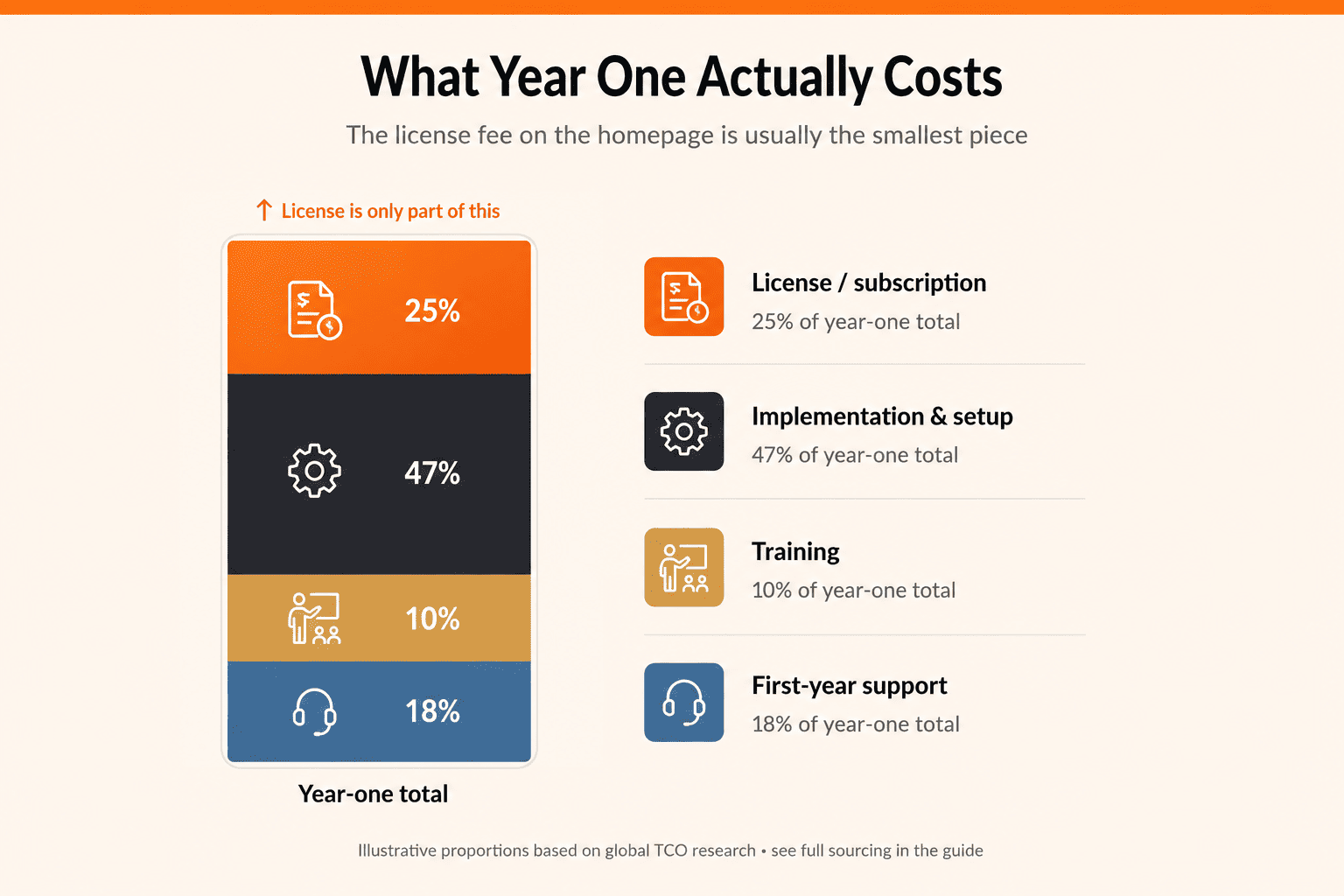
Independent industry research on ERP total cost of ownership, gathered from hundreds of implementations globally, consistently shows the same shape: software licensing typically makes up only 15 to 35 percent of total project cost. Implementation services, configuration, data migration, integration, testing, commonly run one to three times the annual license cost on their own. Training and change management add another 5 to 10 percent. And once you're live, annual maintenance and support typically runs 15 to 22 percent of the original license value, every year, for as long as you use the system. Most of the total spend lands in year one specifically, not spread evenly across the system's life.
We haven't found Bangladesh-specific research measuring these exact percentages locally, so treat the splits above as the well-established global shape of ERP cost, not a guaranteed local figure. But the shape matters more than the precision: it explains exactly why two ERP quotes that look wildly different on the license line can end up costing about the same, or why a "cheaper" system can quietly become the more expensive one within a year.
A worked illustration, not a quote. Picture two systems for a mid-sized Bangladeshi distributor. System A is quoted at ৳8,000 a month, roughly ৳96,000 a year in licensing. System B is quoted at ৳5,000 a month, roughly ৳60,000 a year, cheaper on the sticker. But System B needs heavier customisation to handle the distributor's multi-branch stock transfers, work that isn't included in the monthly fee. Applying the implementation-to-license ratio above, even conservatively, that customisation alone could plausibly cost several times System B's annual license fee, before training and support are added. System A, quoted higher but built to handle multi-branch stock out of the box, could easily end up the cheaper option once the first year is totalled honestly. This is illustrative math to show the mechanism, not a real quote for either system, but it's the exact trap the cheaper number on a homepage sets for a buyer who never asks about implementation.
What to actually ask every vendor, based on this structure:
- What's included in the license or subscription fee, and what's billed separately as implementation?
- What does data migration from our current system, spreadsheets, existing software, cost, specifically?
- Is training a one-time cost, or do we pay again every time we onboard new staff?
- What's the annual maintenance or support fee, as a real number, not a percentage promise?
- What does year one cost in total, all of the above added together, not just the license?
Ask every name on this list, including us, the same five questions in the same order. The vendor willing to walk through all five clearly, before you've signed anything, is telling you something about how they'll behave after you have.
How to actually run your evaluation
Everything above gives you the questions to ask and the traps to watch for. This section is about the process itself, how to run the actual evaluation so a good sales pitch doesn't out-perform a good product.
Bring your own data to the demo, not theirs. Every vendor demo you'll see is built on data chosen to make the system look effortless. Ask instead to bring a real order, a real customer record, a real month of your actual stock movements, and have them process it live, in front of you. If the answer is "we can show you that in a follow-up," that's useful information on its own.
Ask directly: is this standard, or was this built for today? A demo that looks flawless can be a genuine reflection of the product, or it can be a screen specifically configured for your meeting. Ask the question plainly. A vendor confident in their base product will answer it without hesitating.
Get references that actually match you, not just any reference. A glowing testimonial from a business three times your size, in a completely different industry, tells you very little about how the system will handle your specific situation. Ask for a customer close to your size, in your industry, who's been live for at least six months, long enough for the honeymoon period to be over.
Ask the reference the harder questions, not just "are you happy." Once you're on the call: did the implementation finish on time and on budget? Were there gaps you discovered after go-live that nobody mentioned during the sales process? Would you choose the same vendor again, knowing what you know now? A reference who seems reluctant to go beyond generic praise, or who the vendor seems to be steering carefully, is telling you something too.
Get the total cost breakdown in writing before you sign anything, using the five questions from the previous section. A vendor who answers clearly, in writing, is behaving the way you want them to behave after the contract is signed. A vendor who deflects into "let's talk about your needs first" every time cost comes up is showing you the negotiation you're about to have.
Watch for artificial urgency. "This price is only valid this week" is a sales tactic aimed at stopping you from doing exactly what this section recommends, comparing calmly, checking references, sleeping on it. A system you'll run for the next five to ten years deserves more than a few days of pressured deciding.
None of this is complicated. It's also, deliberately, not something a vendor's own marketing page will ever hand you, because it's built to slow down the sale, not speed it up. Use it on every name in this guide, ours included.
Which ERP should you choose?
If you've read this far, you already have more to go on than a features comparison, you have the four questions and the technical questions from earlier, a readiness check, a real sense of what things cost beyond the sticker price, and a process for running the evaluation itself. This section is the fast path, a starting point by situation, not a substitute for doing that work.
- Group of companies, or a multi-branch business needing one consolidated view, with local VAT and support built in → This is what ZAB ERP is built for. Talk to us, and we'll tell you honestly if your specific situation fits.
- Established mid-market or larger business wanting a global enterprise platform with real local implementation support → SAP Business One has the deepest local partner track record of the international options.
- Cloud-only operations, or international ambitions alongside your Bangladeshi business → Oracle NetSuite's cloud-native design is built for this.
- Already standardized on Microsoft 365, want ERP and CRM together → Microsoft Dynamics 365, but vet your local support option carefully, this is the one platform on this list where that answer isn't automatic.
- Want a globally standard, deeply customisable platform, and you're prepared to vet an implementation partner carefully → Odoo, but remember you're evaluating the partner as much as the software.
- Garment or textile factory, production is the core of your business → PrideERP's depth in merchandising, industrial engineering, and factory-floor tracking is built specifically for this, not adapted to it.
- Mid-sized trading, service, or general manufacturing business without one dominant industry template → PrismERP's breadth is worth a serious look.
- Hospital, clinic, or diagnostic center needing patient records, billing, and pharmacy connected in one system → General ERP isn't built for this. See our hospital management software comparison for ZAB Medisuit and other healthcare-specific options.
- Established local suite, strong Bangla usability, small group of related companies → Sheba ERP is worth a demo, with the caveat from earlier: verify any specific claim that matters to you directly.
- Retail chain or multi-branch business wanting POS, inventory, and a centralized loyalty program together → See our retail management software comparison for ZAB Retail and other Bangladeshi vendors built specifically for this.
- Single shop, one location, and your current POS or accounting software is still coping → You may not need an ERP yet. Look at our comparison of the best POS software in Bangladesh or our guide to accounting software in Bangladesh instead, and revisit this when the signs from the readiness section above start showing up.
Whichever direction this points you, don't skip the readiness, cost, and evaluation sections above. The vendor is only half the decision. Whether your business is actually ready, and how carefully you run the evaluation, decide the other half.
Frequently asked questions
What is the best ERP software in Bangladesh?
There's no single best system, only the best fit for your industry, size, and budget. A garment factory, a group of companies, and a single retail shop need genuinely different systems. This guide ranks the main options, local and international, by who each one actually suits, and the section above gives you a fast starting point by situation.
How much does ERP software really cost in Bangladesh?
More than the license fee alone. Software licensing is typically only a fraction of total cost; implementation, data migration, training, and ongoing annual support usually add up to considerably more than the sticker price, often concentrated in the first year. The cost section above walks through this in detail, with the five questions to ask any vendor before you sign anything.
Which ERP is best for the garments industry?
PrideERP is the most established name specifically for RMG and textile production, with real depth in merchandising, industrial engineering, and factory-floor tracking. If your business also handles heavy import/export and multi-branch or group consolidation alongside garment production, it's worth comparing against ZAB ERP as well.
Does Orange Solutions offer anything smaller than full ZAB ERP?
Yes. ZAB Lite is a lighter, subscription-based cloud ERP covering accounts, sales, inventory, and purchase management, built as an affordable entry point for small manufacturers, retailers, and trading businesses moving off spreadsheets. Full ZAB ERP adds multi-branch and group consolidation, manufacturing, HR and payroll, and deeper customisation for larger or more complex operations. Many businesses start on ZAB Lite and move up later without losing their data, as their needs grow.
Is local or international ERP better for a Bangladeshi business?
It depends on what you need. Locally built systems generally handle NBR VAT, Mushak reporting, and Bangla usability natively, out of the box. International platforms like SAP Business One and Oracle NetSuite have real, established local partners in Bangladesh and can be a strong fit for larger or internationally-minded businesses, though VAT and local specifics typically depend on that partner's work rather than shipping in the base product. Some international platforms, Epicor and Infor among them, currently have little to no verified local implementation presence in Bangladesh at all, worth checking directly before you shortlist one.
Do these systems actually support Bangla?
Most Bangladeshi-built systems offer genuine Bangla interfaces and reports. For international platforms like Odoo, Bangla and local compliance depend on the implementation partner's localisation work, so ask to see it demonstrated rather than assume it's included.
Is my business even ready for an ERP?
Not necessarily, and that's a genuinely useful thing to find out before you talk to any vendor. The readiness section above walks through the real readiness factors, management commitment, documented processes, usable data, staff buy-in, and a realistic budget, that research consistently shows matter more than which system you choose.
How do I avoid picking the wrong vendor?
Run a structured evaluation rather than relying on the demo alone: bring your own data, ask for references that actually match your size and industry, get total cost in writing, and watch for artificial urgency in the sales process. The evaluation section above walks through this step by step.