

Top 10 Inventory Management Software in Bangladesh Reviewed
If your business still tracks stock on spreadsheets or relies on a WhatsApp message to the warehouse to check what's available, you already know the cost. You discover an item is out of stock only when a customer asks for it. Your Dhaka showroom shows 40 units. Your Chittagong depot says 12. The actual count is somewhere in between.
Inventory problems drain a business from two directions at once: stockouts lose sales, and overstocking ties up cash. Most Bangladeshi businesses deal with both, often without the visibility to catch either until the damage is done.
The right inventory management software fixes that. But "the right one" depends on your business — your size, your industry, how many locations you run, and whether you need inventory to connect with your accounts, your sales, or your entire ERP system.
This article reviews 10 inventory management systems genuinely used by businesses in Bangladesh. For each, we cover what it does well, who it suits, and what it costs. There's also a buying framework at the end if you're not sure where to start.
What Is Inventory Management Software?
Inventory management software is a system that tracks your stock from the moment goods arrive at your warehouse to the moment they leave as a fulfilled order. It records what you have, where it is, how much it cost, and how fast it moves — all in one place.
That sounds simple. But the gap between a basic stock register and a proper inventory management system is significant. A stock register tells you what you had. An inventory management system tells you what you have right now, what you're about to run out of, what's sitting idle, and what you need to order before your next peak.
It connects the people who manage the warehouse with the people who handle purchasing and the people who process sales. When those three functions share the same data, decisions get faster and errors get fewer.
For businesses managing multiple locations, product variants, batch numbers, or a high volume of SKUs, the software also handles things that simply cannot be done reliably by hand: automatic reorder triggers, expiry date tracking, multi-warehouse stock transfers, and real-time visibility across every branch at once.
Why Bangladeshi Businesses Struggle with Inventory
Inventory management is a challenge for businesses everywhere. But in Bangladesh, a few specific realities make it harder than the global average.
The first is geography. A growing business here rarely stays in one place for long. A distributor starts in Dhaka, opens a depot in Chittagong, adds an outlet in Sylhet. Now the owner is running three locations with three separate stock records that nobody can see simultaneously. Calls get made. WhatsApp messages go back and forth. By the time the numbers are reconciled, they're already out of date.
The second is operational complexity. Businesses that grow across multiple product lines and locations face a specific problem: inventory data becomes fragmented across departments, branches, and business units. A manufacturer running separate operations for pipes, tanks, and auto components cannot afford to manage each product line's raw materials, work-in-progress, and finished goods on disconnected systems. That kind of fragmentation leads to duplicate orders, blind spots in supply chain visibility, and a finance team working off numbers they don't fully trust.
Gazi Group — one of Bangladesh's most established conglomerates, operating across manufacturing, distribution, ICT, and media since 1972 — addressed this directly by implementing Make It Orange's ERP system across their manufacturing operations. With multiple strategic business units producing everything from industrial tanks to auto tyres, the need for a centralised system to track raw materials, production batches, and finished goods across facilities wasn't optional. It was a prerequisite for operating at that scale without operational chaos.
The third reality is seasonality. Pre-Eid demand in certain product categories can surge 30 to 50 percent within a matter of weeks. Businesses relying on manual counts and gut instinct to prepare for that window consistently get it wrong — either scrambling to restock at peak prices or sitting on excess inventory after the season ends. Both outcomes hit margins directly.
There are also industry-specific complications that compound the problem. Pharmaceutical distributors are legally required to track batch numbers and expiry dates. Food businesses operating FIFO without software are doing it on trust. RMG factories need to separate raw material lots from finished goods at every stage of production. And across all sectors, when stock records don't match accounting records, the result is a cash flow picture that nobody fully believes.
The businesses that solve this early grow faster and waste less. The ones that delay tend to hit a ceiling where operational chaos limits their growth regardless of how strong their demand is.
Key Features to Look for in Inventory Management Software
Not every business needs the same things from an inventory management system. But there are eight capabilities that consistently separate software worth buying from software that creates new problems while solving old ones.
Real-time stock tracking and alerts
The baseline expectation for any inventory management system is that your stock levels are accurate right now, not as of yesterday's manual count. Real-time tracking means every purchase order received, every sale processed, and every warehouse transfer made updates the system immediately. Alerts go one step further: when a product falls below a minimum threshold you define, the system notifies the right person before a stockout happens.
For businesses managing multiple SKUs across even a single location, this alone recovers more value than the software costs. The ability to monitor stock continuously rather than reactively is what makes planning possible.
Barcode scanning and mobile access
Barcode scanning replaces manual data entry at the point of receiving, picking, and dispatching stock. The practical impact is fewer errors and faster warehouse operations — a warehouse team that previously spent 20 minutes logging a delivery can do it in 5. Most modern inventory systems support barcode scanning either through dedicated scanners or through mobile apps on Android and iOS devices.
Mobile access matters beyond the warehouse floor. A business owner in Dhaka who needs to check stock levels at a Chittagong depot shouldn't have to call anyone to find out. Mobile access to real-time inventory data closes that gap.
Multi-location and multi-warehouse support
For any business operating from more than one location, multi-location support is not a premium feature — it is the minimum requirement. The system must show a consolidated view of stock across all branches and warehouses while still allowing you to drill down into a specific location. Inter-branch transfer management is equally important: when stock moves from one depot to another, both records should update automatically rather than requiring a manual entry at each end.
Businesses that skip this capability and manage each location separately end up with the exact fragmentation problem the software was supposed to solve.
Sales and inventory integration
A sales and inventory management system that keeps both functions connected is worth considerably more than software that handles each in isolation. When a sale is processed at the point of sale or through an e-commerce channel, stock levels should update in the same moment. When a purchase order is raised, the incoming quantity should be reflected in your available-to-promise figures before the goods physically arrive.
Without that connection, your sales team is selling from memory and your warehouse team is fulfilling from guesswork. The integration between sales and inventory is where most of the operational efficiency gains actually live.
ERP connectivity
Standalone inventory software works well up to a point. As a business grows, the inventory function needs to share data with accounts payable, accounts receivable, procurement, and payroll. That is where ERP connectivity becomes relevant. Some businesses buy standalone inventory software and integrate it with a separate accounting tool. Others choose an ERP system where inventory is one module of a larger connected platform.
Neither is automatically the right answer. The section on choosing between standalone software and an ERP further in this article covers that decision in more detail.
NBR VAT compliance
This is a requirement that most international inventory tools ignore entirely and that even some local ones handle inconsistently. If your business is VAT-registered in Bangladesh, your inventory system needs to generate output that aligns with National Board of Revenue reporting requirements. That means VAT-compliant invoices, musak integration where applicable, and stock valuation methods that your accounts team can actually use for tax filings.
Choosing a system that does not handle VAT compliance forces a workaround — usually a second piece of software or a manual reconciliation step that defeats the purpose of having a system at all.
Lot numbers, serial numbers, and batch tracking
For pharmaceutical distributors, food manufacturers, electronics businesses, and anyone operating in a regulated sector, lot and serial number tracking is non-negotiable. Lot tracking lets you follow a batch of goods from supplier to customer. If a product recall is issued or a quality issue is discovered, you can identify exactly which customers received the affected stock and act immediately.
Serial number tracking serves a similar function for high-value individual items — electronics, machinery, medical equipment. Managing inventory levels for these product categories without serial tracking is a compliance risk as much as an operational one.
Bill of materials
For businesses involved in manufacturing or assembly — from light garment production to industrial goods — a bill of materials function tracks the raw material inputs required to produce each finished unit. When a production run is confirmed, the system automatically deducts the relevant components from raw material stock and adds the finished quantity to the finished goods inventory.
Without this, a factory manager is manually calculating material requirements and manually updating two separate stock records for every production run. It is exactly the kind of task that creates errors under time pressure.
Standalone Inventory Software vs. ERP: Which One Do You Need?
Most businesses asking about inventory management software are actually deciding between two different things: a tool built specifically for inventory, or an ERP system where inventory is one module of a larger connected platform. They are not the same purchase, and choosing the wrong category costs more to fix than choosing the wrong product within the right category.
A standalone inventory tool makes sense if your business operates from a single location, manages a straightforward product catalogue, and doesn't need inventory data to feed into a broader system covering accounts, HR, or procurement. For a retail shop, a small distributor, or an early-stage business getting its first system in place, a standalone tool is faster to implement, simpler to learn, and easier on the budget.
An ERP with an inventory module makes sense once your business crosses a threshold of complexity — multiple branches, a growing headcount, procurement cycles that need to connect with accounts payable, or manufacturing operations where raw materials and finished goods need to be tracked separately. At that point, a standalone inventory tool becomes a data silo. It tells you what you have in stock, but it cannot tell you what that stock is worth to your accounts team, what it cost relative to your purchase orders, or when to reorder based on sales forecasts from your CRM.
The honest signal to watch for: if you find yourself exporting data from your inventory tool into a spreadsheet to do anything useful with it, you have already outgrown a standalone system.
Top 10 Inventory Management Software in Bangladesh (2026)
The tools below cover a range of business sizes, budgets, and operational needs. Some are built specifically for inventory. Others are ERP platforms where inventory is one part of a broader system. The right choice depends on where your business is today and where it needs to be in two years.
1. ZAB ERP by Make It Orange
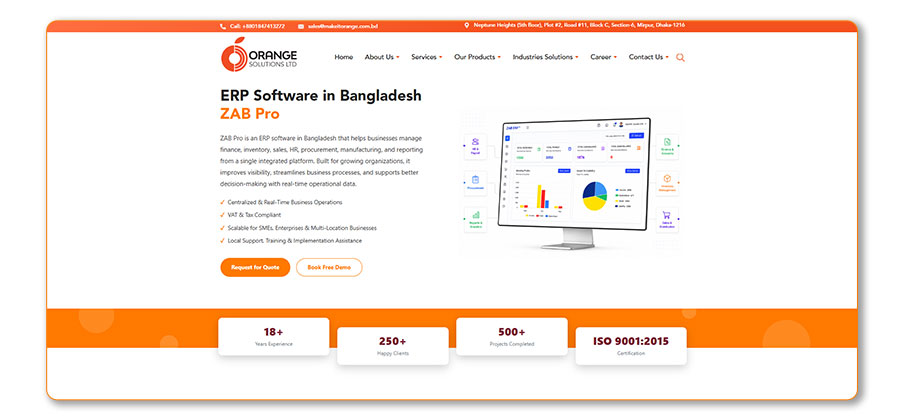
ZAB ERP is an ERP platform developed and implemented by Make It Orange, a Dhaka-based software company with over 18 years of experience serving Bangladeshi businesses across manufacturing, distribution, retail, and services. With 250+ active clients and ISO 9001:2015 certification, Make It Orange is one of the more established local names in enterprise software.
The Inventory and Warehouse Management module within ZAB ERP is built around one core problem: giving businesses real-time visibility into stock across every location, so decisions are made from accurate data rather than approximations. It handles goods receipt, stock transfers between warehouses, order fulfilment, and inventory monitoring within a single workflow — meaning a product's movement from supplier receipt to customer delivery is tracked continuously rather than recorded in fragments across different systems.
Where ZAB ERP differentiates itself is integration depth. Inventory does not sit as a standalone module — it connects directly with finance, procurement, and sales within the same platform. Stock discrepancies that typically emerge when inventory and accounts run on separate systems are substantially reduced because both functions are drawing from the same real-time data. For businesses managing multiple warehouse locations, the module provides consolidated visibility across all sites while still supporting location-level control over stock transfers, order fulfilment, and warehouse operations.
The other meaningful differentiator is implementation. Make It Orange handles deployment directly — no third-party reseller or integrator between the client and the team that built the software. For businesses that have experienced implementation problems with international tools before, that direct relationship matters considerably when something needs resolving quickly.
Best for: Mid-sized to larger Bangladeshi businesses that need inventory and warehouse management tightly connected to finance, procurement, and operations rather than a standalone stock tool.
Pricing: Available on request.
2. PrismERP
PrismERP is developed by Divine IT Limited, one of Bangladesh's longer-standing ERP vendors with over 500 clients across manufacturing, retail, distribution, and a range of other sectors. Like ZAB ERP, it is an ERP platform rather than a standalone inventory tool inventory management sits alongside supply chain, sales, finance, HR, and production planning within a single connected system.
Its inventory module covers multi-warehouse management, real-time stock tracking, material requirement planning, and supply chain visibility. The platform is cloud-based and platform-independent, which means it runs on any device without requiring a specific operating system or infrastructure setup. For manufacturing businesses managing both raw materials and finished goods simultaneously, the production planning and inventory modules work in close alignment.
PrismERP is feature-rich, and that depth comes with a corresponding implementation weight. It suits businesses that have the internal capacity to manage a structured onboarding process and want enterprise-grade functionality rather than a quick-start system.
Best for: Medium to large enterprises in manufacturing, distribution, and retail requiring full ERP capability alongside inventory management.
Pricing: Available on request via Divine IT's sales team.
3. Financfy
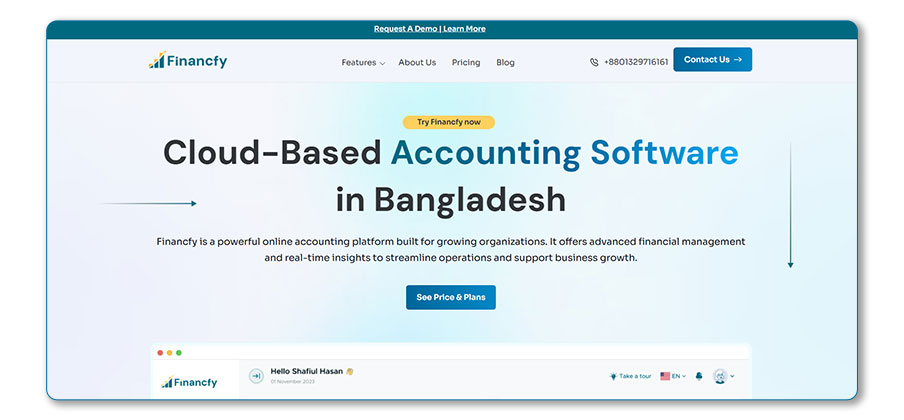
Financfy is a cloud-based platform built in Bangladesh that combines inventory management with accounting, cash flow, and sales in one system. It is designed primarily for small to mid-sized businesses that want an accessible, locally supported solution without the implementation complexity of a full ERP.
Its inventory module covers real-time stock tracking, multi-warehouse management, inter-warehouse transfers, low-stock alerts, and FIFO-based inventory valuation. The accounting integration is tighter than most tools at this price point — stock movements update financial records automatically, which reduces the manual reconciliation work that tends to accumulate in businesses running separate inventory and accounting tools.
Financfy is priced in BDT with local customer support, which removes the currency risk and time-zone friction that comes with international software. The interface is relatively straightforward to learn, making it a practical option for teams without a dedicated IT function.
Its limitations appear at the enterprise end. Businesses with complex manufacturing workflows, large SKU catalogues across many locations, or deep ERP integration requirements will likely outgrow it.
Best for: SMEs, wholesalers, and multi-outlet retailers wanting integrated inventory and accounting without full ERP complexity.
Pricing: BDT 4,500 to BDT 9,000 per month depending on plan.
4. TallyPrime
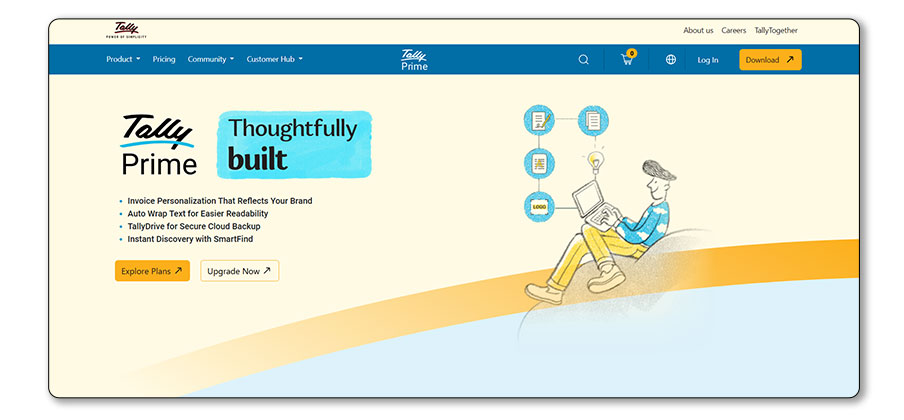
TallyPrime is developed by Tally Solutions, an Indian software company with a large installed base across South Asia. It has a significant presence in Bangladesh, particularly among finance-centric businesses, distributors, and wholesalers who prioritise accounting accuracy alongside inventory control.
Its inventory capabilities are more sophisticated than most businesses expect. Stock classification supports unlimited groups and categories, multiple units of measure, batch and expiry date tracking, bill of materials for manufacturing operations, and several stock valuation methods including FIFO, LIFO, and weighted average. The accounting integration is deep — inventory movements and financial records stay in sync without requiring a separate reconciliation step.
Where TallyPrime creates friction for Bangladeshi businesses is pricing and support. Licenses are quoted in USD, which introduces currency risk for smaller businesses operating entirely in BDT. Local support is available through resellers rather than directly from Tally Solutions, so the quality of implementation and after-sales assistance varies depending on which partner you work with.
Best for: Finance-centric businesses, distributors, and manufacturers already familiar with Tally's accounting environment, or those requiring complex stock valuation methods.
Pricing: TallyPrime Silver at USD 405, Gold at USD 1,215. One-time license fee.
5. Biznify
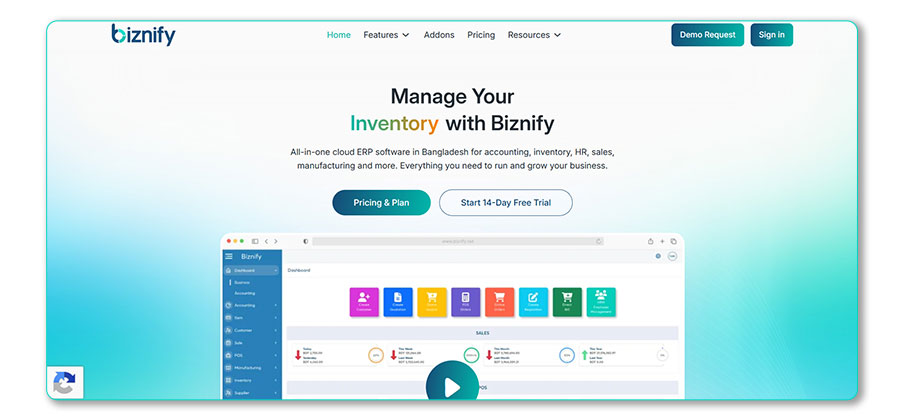
Biznify is a Bangladesh-built cloud ERP designed with local SMEs in mind. It brings inventory management, point of sale, sales tracking, and basic accounting together in one platform, priced in BDT with local support. For small to mid-sized businesses that want an all-in-one system without committing to a large enterprise implementation, it is a practical starting point.
The inventory module covers real-time stock tracking, multi-location management, barcode scanning support, automated low-stock alerts, and supplier integration. Web and mobile access means business owners can monitor stock and sales remotely without being tied to a desktop in the office.
Biznify's entry-level plans are among the most accessible in the local market, which makes it a common first step for businesses moving off spreadsheets for the first time. The trade-off is feature depth — businesses with complex manufacturing workflows, large SKU volumes, or advanced reporting requirements will find the platform's ceiling relatively quickly.
Best for: Small to mid-sized local businesses wanting an affordable all-in-one starting point with local support and BDT pricing.
Pricing: BDT 1,000 to BDT 2,000 per month depending on user count.
6. AmarSolution
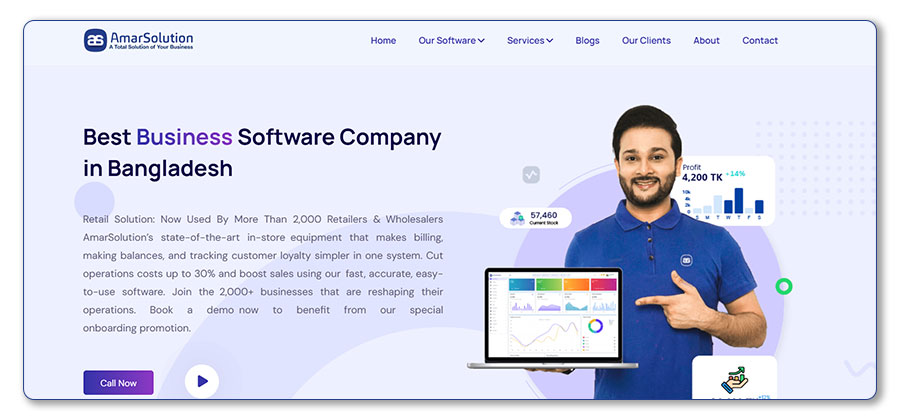
AmarSolution is a Bangladesh-focused inventory and POS management platform built primarily for retail and wholesale operations. Where some tools treat POS as an add-on, AmarSolution starts from the sales floor and builds inventory management around it — stock levels update automatically with every transaction processed at the counter, removing the lag between a sale happening and the system reflecting it.
The inventory module includes real-time stock tracking synced with POS, barcode scanning for fast stock handling, automated reorder alerts, multi-location management, and batch and expiry date tracking. That last feature makes it viable for FMCG retailers and businesses handling perishable or time-sensitive goods where expiry management is a daily operational requirement rather than an occasional concern.
Reporting covers sales performance, stock movement, and branch-level comparisons — enough for a retail or wholesale owner to make day-to-day purchasing and stocking decisions without needing a separate analytics tool.
AmarSolution is less suited to businesses with manufacturing workflows or complex ERP integration requirements. Its strength is in businesses where the primary inventory challenge is keeping sales and stock in sync across one or more retail or wholesale locations.
Best for: Retailers and wholesalers that need tight POS and inventory integration, particularly those handling FMCG or perishable product categories.
Pricing: BDT 1,000 to BDT 3,000 per month depending on user count and plan.
7. Zoho Inventory
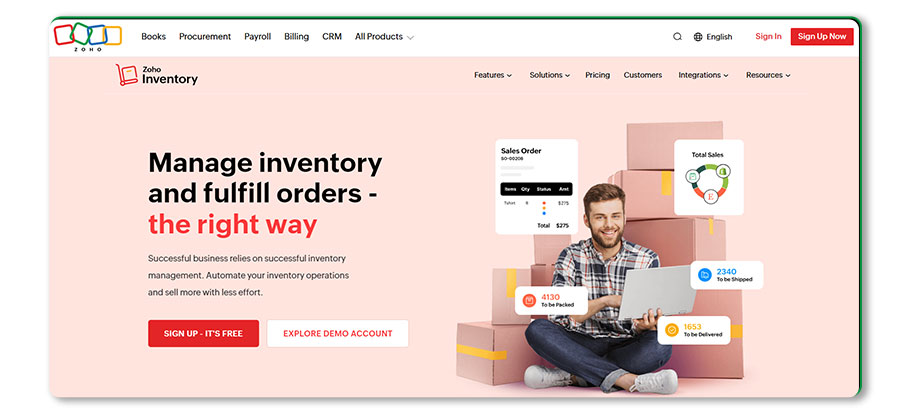
Zoho Inventory is a cloud-based inventory management platform developed by Zoho Corporation, an Indian software company with a broad suite of business applications used across South and Southeast Asia. It is one of the more capable international options available to Bangladeshi businesses, particularly for those with e-commerce operations or cross-border sales.
Its core inventory features cover real-time stock tracking, multi-warehouse management, barcode scanning, serial and batch number tracking, and automated reorder points. Where it genuinely stands apart from local alternatives is e-commerce integration — it connects natively with platforms including Shopify, WooCommerce, Amazon, and eBay, making it a strong fit for businesses selling across multiple online channels who need inventory to stay synchronised across all of them simultaneously.
As part of the broader Zoho ecosystem, it also integrates with Zoho Books for accounting, Zoho CRM for customer management, and other Zoho applications. Businesses already using Zoho tools elsewhere will find that integration straightforward. Those who are not will need to assess whether the integration effort with their existing systems is worthwhile.
The practical limitations for most Bangladeshi businesses are support and compliance. Zoho Inventory does not offer local on-site support, and its VAT configuration is not pre-built for NBR requirements — meaning additional setup work is needed to align it with Bangladesh's tax reporting obligations. Pricing is also in USD.
Best for: E-commerce businesses with multi-channel sales, or businesses already operating within the Zoho ecosystem.
Pricing: Free plan available for limited use. Paid plans start at approximately USD 39 per month.
8. Bepari
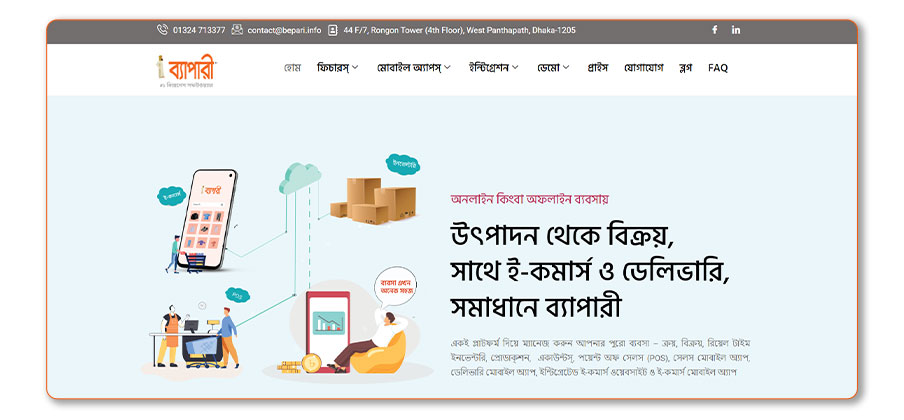
Bepari is a Bangladesh-focused business management platform built around the operational needs of retailers, wholesalers, and multi-branch store owners. Its particular strength is branch-level inventory control — stock transfers between locations, damage tracking, and inventory adjustments are all handled within the system rather than managed through workarounds outside it.
The platform integrates inventory with POS, sales, purchasing, and basic accounting, giving multi-branch businesses a single system for day-to-day operations rather than separate tools that need to be manually reconciled. Real-time stock visibility across branches, automated alerts, and inter-branch transfer management make it a practical choice for businesses where goods regularly move between locations.
Bepari also offers e-commerce integration and mobile app access, which extends its usefulness beyond the physical store environment. Reporting covers stock performance, sales, and branch comparisons at a level sufficient for most retail and wholesale decision-making needs.
Best for: Multi-branch retailers and wholesalers that need strong branch-level inventory control alongside POS integration.
Pricing: BDT 2,000 to BDT 4,500 per month depending on plan.
9. Pridesys IT
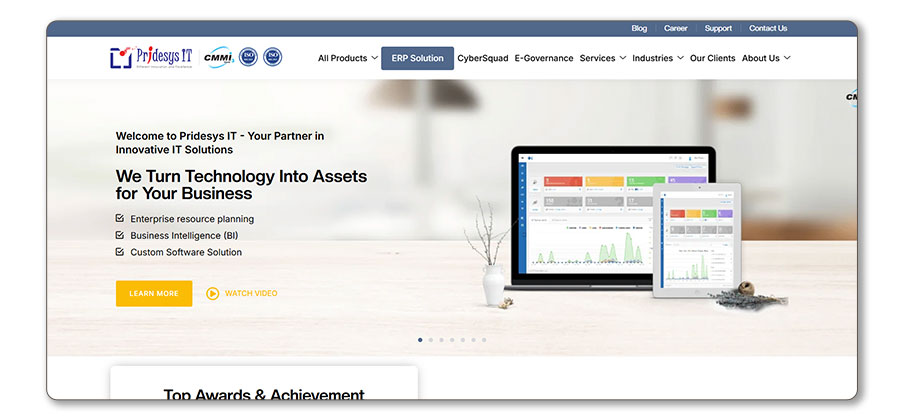
Pridesys IT is a Bangladeshi ERP vendor whose flagship product, PrideBiz ERP, is built for organisations that have moved well beyond the needs a standard inventory tool can address. The platform combines inventory control with financial management, sales, procurement, material management, and reporting in one integrated system — and the scale it operates at sets it apart from most local alternatives.
The platform is capable of managing over 1,400 inventory store locations and tracking upwards of 150,000 material entries through a centralised material library. A single server deployment can cover operations across all 64 districts of Bangladesh simultaneously, which makes it relevant for large distributors, government-linked organisations, and enterprises with genuinely national footprints.
Inventory-specific capabilities include multi-warehouse stock control, barcode-enabled gate pass and challan management, stock valuation, multi-layer approval workflows, and demand forecasting. These are not features that a growing SME needs on day one — but for organisations where inventory complexity is already a documented operational problem, Pridesys provides the depth to match it.
Implementation is handled through direct engagement with the Pridesys team. Pricing is not publicly listed and is scoped based on organisational requirements.
Best for: Large enterprises, government-linked organisations, and national distributors with high-complexity inventory and material management needs.
Pricing: Available on request.
10. Sunshine IT
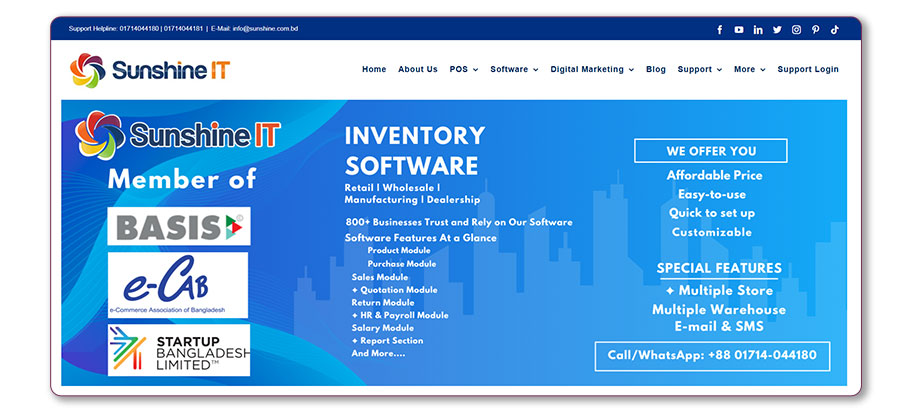
Sunshine IT is a Dhaka-based software company whose inventory management product is built specifically for Bangladeshi SME businesses. One practical differentiator is pricing transparency, Sunshine IT publishes three clear tiers on its website, which allows businesses to evaluate fit without a discovery call. That level of upfront clarity is uncommon among local vendors.
The software covers stock management, purchase management, order management, barcode scanning, customer and supplier ledgers, and product returns. Two features carry particular local relevance: VAT billing and return filing are built directly into the system rather than handled through a workaround, and daily sales and profit and loss reports are delivered via SMS — useful for business owners monitoring multiple branches without logging into a dashboard. Free online training and phone, email, and live chat support are included across all plans.
Sunshine IT is a focused SME tool, not an enterprise platform. Businesses with complex manufacturing workflows, deep ERP integration requirements, or large multi-warehouse operations will find its feature ceiling relatively quickly. For the retail shop, pharmacy, or small distributor that needs a VAT-ready, locally supported inventory system at a transparent price, it is one of the more straightforward entry points in the market.
Best for: SME retailers, pharmacies, and small distributors wanting a VAT-compliant, locally supported inventory system with transparent pricing and minimal setup complexity.
Pricing: BDT 15,000 (Basic, 1 warehouse), BDT 40,000 (Professional, cloud-hosted), BDT 80,000 (Corporate, multi-warehouse, unlimited users).
How to Choose the Right Inventory Management Software for Your Business
The right inventory management system for your business is not necessarily the one with the most features or the lowest price. It is the one that handles what your operation actually does every day, connects with the systems you already rely on, and can grow with you over the next two to three years without requiring a full replacement.
Six questions will take you most of the way to the right answer.
How many SKUs do you currently manage, and how fast is that number growing? Businesses under 500 SKUs with a stable catalogue can work effectively with a lightweight tool. Businesses above that threshold, or growing quickly toward it, need a system built for volume.
Do you operate from more than one location? If yes, multi-location support is not optional — it is the core requirement. Any system that cannot provide consolidated stock visibility across branches in real time will create the same fragmentation problem you are trying to solve.
Does your business require NBR VAT-compliant reporting? If you are VAT-registered, this filters out any tool that does not have Bangladesh tax compliance built in, regardless of how strong its other features are.
Does inventory need to connect with your accounting, procurement, or HR systems? If yes, a standalone inventory tool will eventually become a liability. An ERP with an integrated inventory module is the more durable choice.
What is your realistic total budget, including implementation, training, and customisation — not just the license fee? The full cost of getting a system live is consistently higher than the number on the pricing page.
Does the vendor have local support with Bangladeshi business hours? When something goes wrong at month-end, response time from a local team and a global helpdesk ticket queue are not comparable experiences.
Industry-Specific Inventory Needs in Bangladesh
Inventory management requirements are not the same across industries. A feature that is optional for a retail business is legally required for a pharmaceutical distributor. A capability that a wholesaler never uses is the core daily workflow for a garment manufacturer. Matching a system to your industry's specific demands saves significant time and cost compared to retrofitting a generic tool later.
RMG and textile manufacturing
Garment and textile businesses manage inventory at two distinct levels simultaneously: raw materials coming in and finished goods going out. Between them sits work-in-progress at various production stages. The system needs to handle bill of materials to track fabric, thread, and trim consumption per production run, lot tracking to trace material batches from supplier to finished product, and clear separation between raw material stock and finished goods inventory. Supply chain visibility — knowing what is on order, in transit, and at the factory floor — is equally critical given the lead time sensitivity of export-oriented production.
Pharmaceutical and healthcare
Pharmaceutical distributors and healthcare businesses operate under strict traceability requirements. Batch number tracking and expiry date management are not optional features — they are regulatory obligations. A system must record the batch number of every product received, track which batches were sold to which customers, and generate alerts before stock approaches its expiry date. In the event of a product recall, the ability to identify affected stock and the customers who received it within hours rather than days is the difference between a manageable situation and a serious compliance failure.
Food and beverage
Food businesses require rigorous FIFO enforcement — older stock must move before newer stock regardless of where it is physically located in the warehouse. Expiry date tracking, supplier batch management, and waste recording are daily operational requirements. For businesses supplying restaurants, hotels, or retail chains, the ability to generate delivery documentation with full traceability back to the source batch adds a further layer of accountability that buyers increasingly expect.
Wholesale and distribution
Distributors managing large SKU volumes across multiple depots need consolidated stock visibility above everything else. The ability to see total available stock across all locations, manage inter-depot transfers, track bulk orders against available inventory, and generate delivery documentation efficiently determines how fast orders can be fulfilled. For businesses running route-based delivery operations, integration between inventory and delivery scheduling reduces both errors and fuel costs.
Retail — single and multi-branch
Retail inventory management lives or dies on POS integration. Every sale processed at the counter should update stock levels instantly — not at the end of the day and not after a manual export. For multi-branch retailers, inter-branch stock transfers, damage tracking, and branch-level performance reporting are the additional requirements that separate a capable retail inventory system from one that creates more work than it saves.
Common Mistakes When Implementing Inventory Software in Bangladesh
The software itself is rarely what causes an implementation to fail. These five mistakes are responsible for most of the problems businesses encounter after they have already made their purchase decision.
Going live with dirty data. Migrating years of inaccurate stock records into a new system does not clean the data — it just makes the errors harder to find. Before implementation begins, run a full physical stock count and reconcile your records. The new system is only as accurate as what you put into it on day one.
Choosing on price alone. The lowest-priced option has the lowest sticker price, not the lowest total cost. Factor in implementation time, training, customisation, and the cost of switching again in 18 months if the tool hits its ceiling before your business does.
Underestimating staff training. Warehouse teams and sales staff who are not comfortable with the new system will find workarounds — usually involving the same spreadsheets and manual entries the software was supposed to replace. Budget training time as seriously as you budget implementation time.
Skipping the parallel run. Running the old system and the new system simultaneously for two to four weeks before full cutover catches integration gaps and data errors before they become operational problems. It adds time upfront and saves considerably more time later.
Expecting software to fix a process problem. If your stock discrepancies are caused by a lack of accountability in the warehouse rather than a lack of tools, a new system will surface the problem more clearly but will not solve it. Process discipline and software work together — one does not substitute for the other.
Frequently Asked Questions
What is the best inventory management software in Bangladesh?
There is no single best option — the right software depends on your business size, industry, and operational needs. For mid-to-large businesses needing inventory integrated with finance and procurement, an ERP platform like ZAB ERP or PrismERP is the stronger choice. For SMEs wanting an accessible cloud-based starting point, Financfy or Biznify are worth evaluating. The buying framework earlier in this article will help you identify which category fits your situation before you start comparing specific tools.
What is the price of inventory management software in Bangladesh?
Prices range from BDT 1,000 per month for entry-level cloud tools to BDT 80,000 or more as a one-time fee for advanced distribution or ERP-level systems. The license cost is only part of the picture — implementation, training, data migration, and ongoing support consistently add 30 to 50 percent to the total first-year investment. Always ask vendors for a full cost breakdown, not just the software price.
Can inventory management software handle multiple warehouses?
Most mid-range and enterprise inventory systems include multi-warehouse support, but the depth of that support varies. Look specifically for consolidated stock visibility across all locations from a single dashboard, inter-warehouse transfer management that updates both location records automatically, and location-level reporting. Basic tools may list multi-warehouse support as a feature while limiting it to simple stock counts per location rather than true operational management.
What is the difference between inventory software and an ERP system?
Standalone inventory software manages stock, orders, and warehouse operations as its primary function. An ERP system connects inventory with other business functions — accounts, procurement, HR, sales — on a single platform. For a small business with straightforward stock management needs, standalone software is simpler and more cost-effective. For a growing business where inventory data needs to feed into financial reporting, purchasing decisions, and production planning, an ERP with an inventory module is the more durable long-term choice.
Does inventory software in Bangladesh support NBR VAT compliance?
Local software built for the Bangladeshi market generally includes VAT compliance features aligned with NBR requirements. International tools — including globally popular platforms — typically do not have Bangladesh VAT compliance pre-configured and require additional setup or customisation to generate compliant output. If your business is VAT-registered, confirm VAT compliance capability directly with any vendor before purchase, and ask specifically whether musak integration is supported.
Which inventory software is best for small businesses in Bangladesh?
For small businesses taking their first step away from spreadsheets, Biznify and AmarSolution offer accessible entry points with local support and BDT pricing. Financfy is a strong option if integrated accounting alongside inventory is a priority from day one. MY SOFT IT's one-time license model suits businesses that prefer avoiding monthly fees. The right choice depends on whether your primary need is inventory alone, inventory with POS, or inventory with basic accounting.
What is a sales and inventory management system?
A sales and inventory management system integrates both functions on a single platform so that every sale automatically updates stock levels without requiring manual entry. When a customer purchase is processed — whether through a physical POS, an e-commerce channel, or a sales order — the available inventory count adjusts in real time. This eliminates the lag between what the sales team believes is available and what the warehouse actually holds, which is where most stock discrepancies originate in businesses running separate sales and inventory tools.
How long does it take to implement inventory management software in Bangladesh?
Implementation timelines vary significantly by system complexity and business readiness. A cloud-based SME tool can be operational within one to two weeks if your product data is clean and your team is ready to train. A full ERP implementation for a mid-to-large business typically takes two to four months from kickoff to go-live, sometimes longer if data migration is complex or customisation requirements are extensive. The businesses that move fastest are those that complete a physical stock count and prepare clean product data before implementation begins rather than during it.
Ready to Get Your Inventory Under Control?
Choosing the right inventory management system is one decision that pays back every single day — in fewer stock errors, faster order fulfilment, and a clearer picture of your business finances.
Make It Orange has been implementing ERP and inventory management systems for Bangladeshi businesses for over 18 years. With 250+ clients across manufacturing, distribution, retail, and services, and ISO 9001:2015 certification, our team understands the operational realities of running a business in Bangladesh — not just the software.
If you are evaluating inventory software and want to understand whether ZAB ERP fits your business, we are happy to walk you through it. No pressure, no generic demo — a direct conversation about your operation and what the right system looks like for it.
Book a free consultation with the Make It Orange team