
What Is ERP Software? A Guide for Bangladeshi Businesses
ERP মানে কী এবং কীভাবে এটি আপনার ব্যবসা চালায়
Ask ten business owners in Bangladesh what ERP software is, and you will get ten different answers. Some think it is accounting software. Some think it is only for big garment factories. Some have heard the term from a vendor and nodded along without ever getting a straight explanation.
This guide gives you that straight explanation. No jargon, no sales pitch. By the end you will know what ERP software actually is, what it does, how it differs from the accounting or POS software you may already use, and whether your business is at the stage where it needs one.
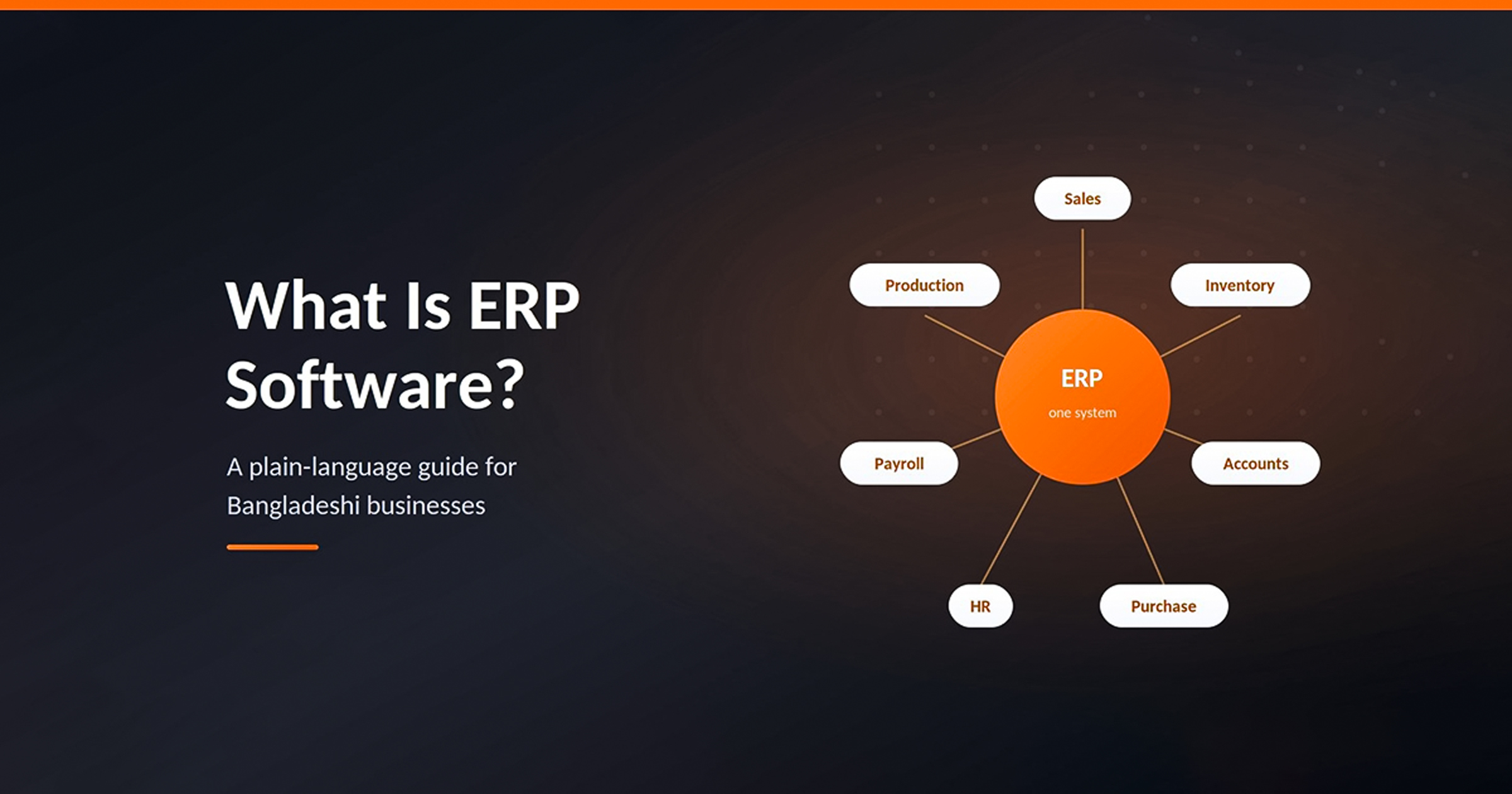
ERP (Enterprise Resource Planning) is one connected software system that runs your whole business. It brings sales, inventory, accounts, purchase, HR, and production together on a single shared database, so information entered once updates everywhere at the same time.
ERP মানে কী? সহজ ভাষায়, ERP হলো একটি সমন্বিত সফটওয়্যার যা আপনার পুরো ব্যবসা, অর্থাৎ বিক্রয়, স্টক, হিসাব, ক্রয় ও বেতন, একটি সিস্টেমে চালায়। একবার তথ্য দিলেই তা সব জায়গায় একসঙ্গে আপডেট হয়।
What is ERP software?
ERP stands for Enterprise Resource Planning. That is the full form, and it sounds more complicated than the idea behind it.
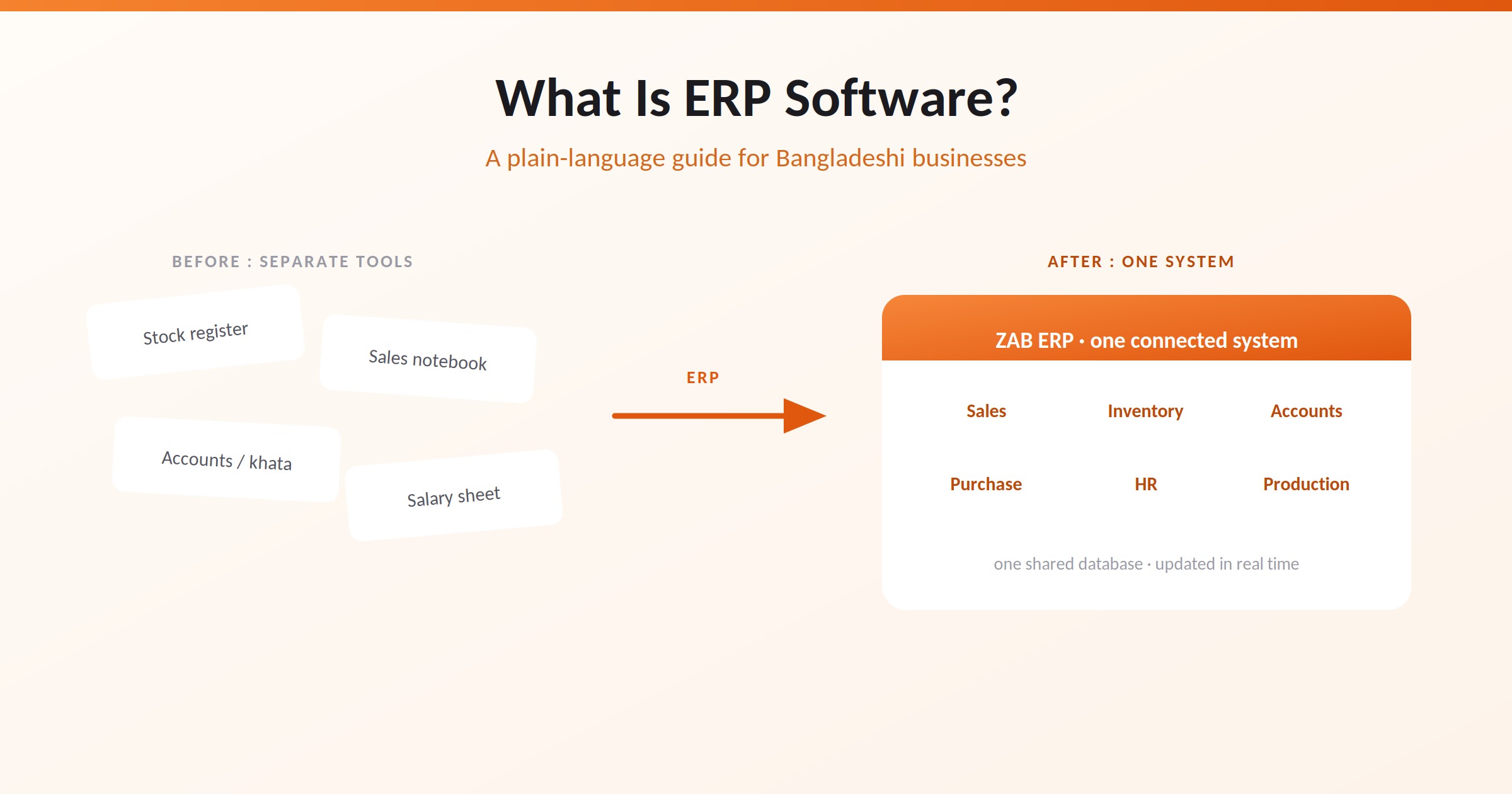
Here is the idea. Most growing businesses run on separate tools. Sales sits in one place. Stock is counted in a register or a spreadsheet. The accountant keeps the books somewhere else. Payroll is its own system. Each one works on its own, but none of them talks to the others. So when a sale should reduce your stock, or low stock should trigger a purchase order, someone has to carry that information across by hand and type it in again.
ERP replaces that patchwork with one system. When your sales team records an order, the stock count drops, the accounts update, and the reorder alert fires, all at once, without anyone re-entering anything. That is the whole point of an ERP: one source of truth for the entire business, updated in real time.
This is exactly how Orange Solutions describes what an ERP should do. It is an integrated business processor that runs the entire business in real time from a centralised system. Everything connects, so everyone sees the same accurate numbers.
You will also hear ERP called an ERP system, business management software, or an integrated business suite. These all mean the same thing.
ERP সফটওয়্যার কী?
ERP সফটওয়্যার হলো এমন একটি সমন্বিত ব্যবস্থা যা আপনার ব্যবসার প্রতিটি বিভাগকে একটি প্ল্যাটফর্মে যুক্ত করে। বিক্রয়, ক্রয়, স্টক, হিসাব ও মানবসম্পদ - সব একসঙ্গে কাজ করে একই তথ্যের ওপর ভিত্তি করে। ফলে ভুল কমে, সময় বাঁচে এবং সিদ্ধান্ত নেওয়া সহজ হয়।
The one idea that makes ERP click: everything is connected
If you remember only one thing from this guide, remember this. What makes ERP different from every other kind of business software is not a longer feature list. It is that one action automatically updates every number connected to it, with nobody typing it in twice.
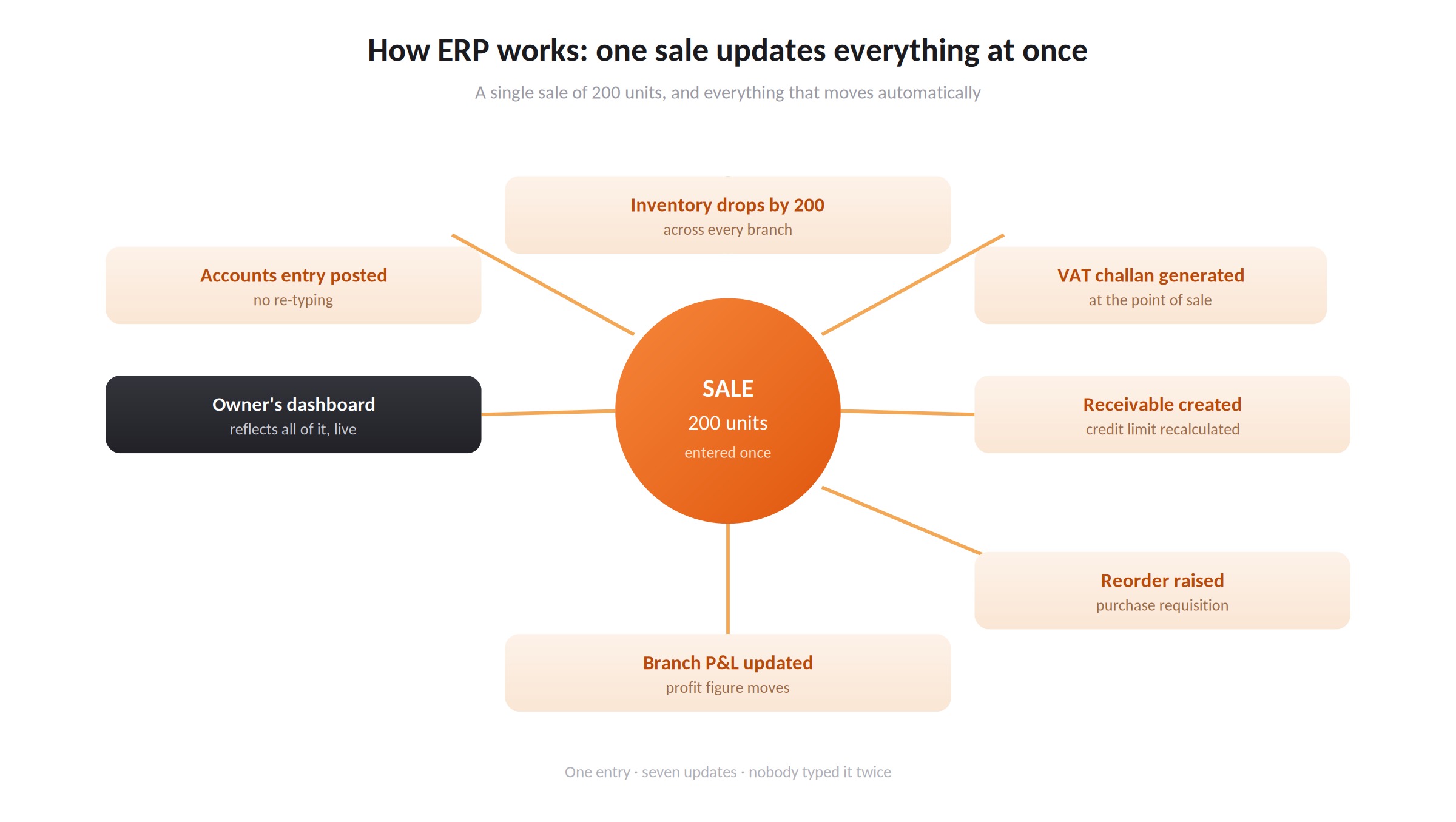
Take a single sale of 200 units in a business running on ERP. Watch what happens on its own:
- Inventory drops by 200 across every branch's view of stock.
- A VAT challan is generated at the point of sale.
- A receivable is recorded against the customer, and their credit limit recalculates.
- If that sale pushes stock below its reorder level, a purchase requisition is raised.
- The branch profit figure moves.
- The owner's dashboard reflects all of it before the customer leaves the counter.
One entry. Six updates. Nobody re-typed a thing.
Now run the same sale through separate tools. One person records the sale. Another has to remember to reduce the stock register. The accountant enters it whenever they reach it. The reorder happens only if someone notices the shelf looks empty. Every handoff is a chance for the numbers to drift apart, which is why in so many businesses no two reports ever quite agree.
That connection is the value of an ERP. Everything else is a matter of which parts of your business you decide to link together.
The main modules inside an ERP
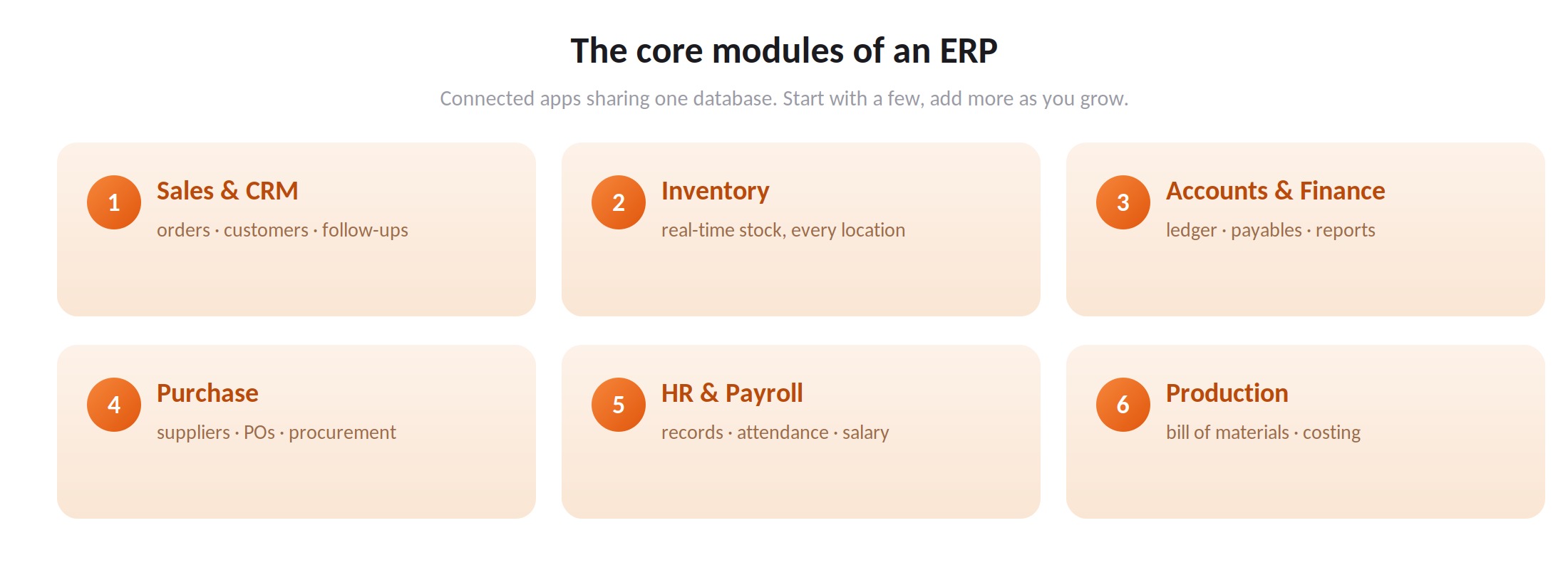
An ERP is built from modules, which you can think of as connected apps, each running one part of the business and all sharing the same data. You do not have to buy every module at once. Most businesses start with a few and add more as they grow.
| Module | What it does, and what it replaces |
| Sales & CRM | Handles quotations, orders, customers, and follow-ups. Replaces scattered notebooks, spreadsheets, and memory. |
| Inventory | Tracks stock in real time across every location. Replaces the stock register and the "let me go and check" phone call. |
| Accounts & Finance | Runs the ledger, payables, receivables, and financial reports. Replaces standalone accounting software or the manual khata. |
| Purchase | Manages suppliers, purchase orders, and procurement. Replaces loose POs and informal ordering. |
| HR & Payroll | Keeps employee records, attendance, and salary. Replaces the salary sheet and the manual attendance register. |
| Production | Plans manufacturing from a bill of materials, and tracks work in progress and costing. The module that makes ERP essential for factories. |
Standalone software can do any one of these jobs. The reason an ERP is more powerful is that the modules share one database. The sale in the Sales module is the same event as the stock reduction in Inventory and the entry in Accounts. One fact, seen by everyone, counted once.
ERP vs accounting software, POS, and inventory software
This is where many business owners get stuck, because these categories look similar on the surface. The clean way to tell them apart is to ask what question each one is built to answer.
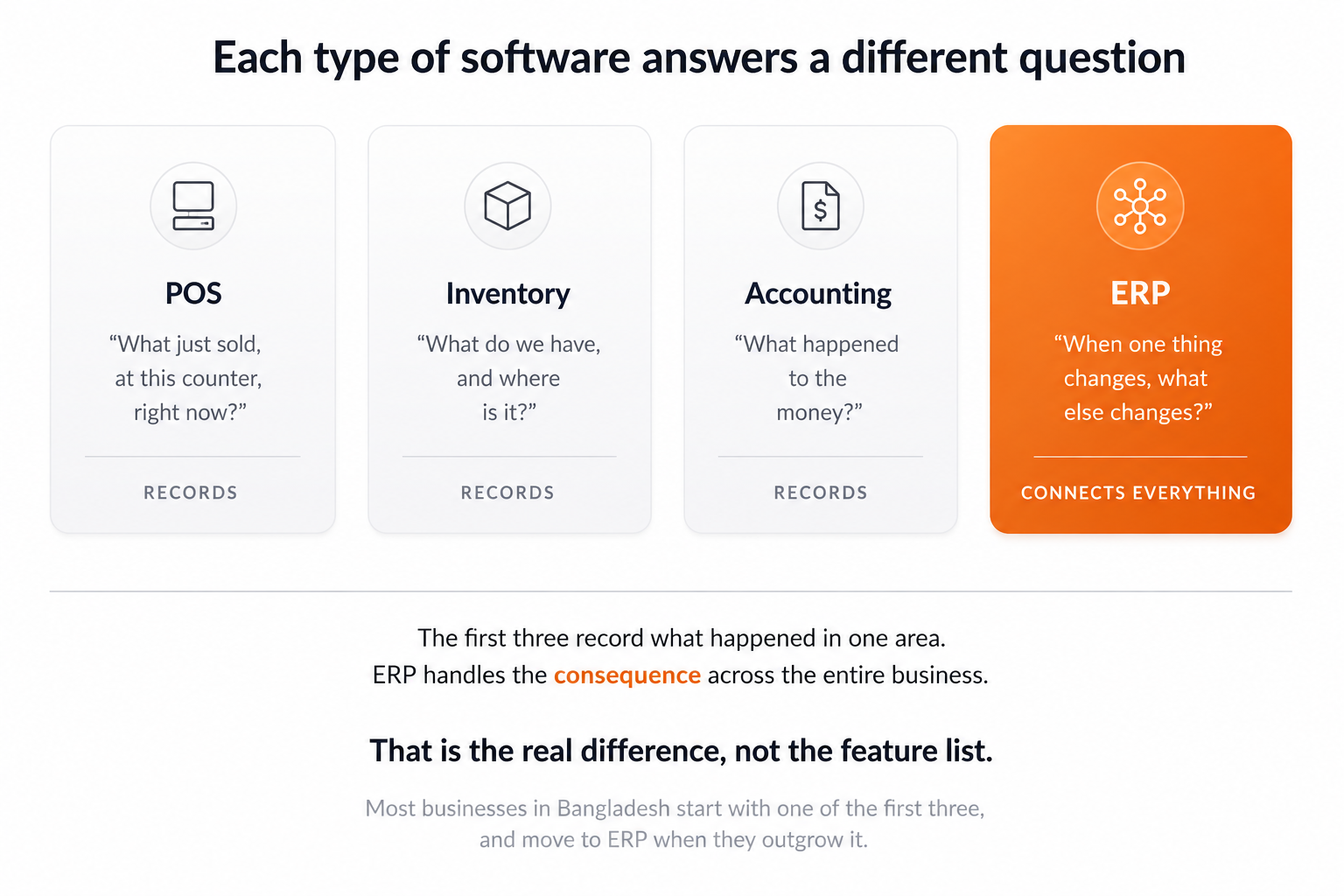
| Software | The question it answers | Best suited for |
| POS | What just sold, at this counter, right now? | A shop or restaurant recording sales at the point of sale. |
| Inventory software | What do we have, and where is it? | A business that mainly needs to track stock. |
| Accounting software | What happened to the money? | Keeping the books, VAT, and financial reports. |
| ERP | When one thing changes, what else changes? | Running the whole business as one connected system. |
The first three are about recording what happened in one area. An ERP is about consequence, making sure that what happens in one area updates everywhere else. That is the real line between them, not the feature list.
Here is the honest part that most guides leave out. Most businesses in Bangladesh do not start with an ERP, and they should not. A single retail shop is well served by a good POS system. A trading business with straightforward books runs comfortably on accounting software for years. An ERP earns its place when your business grows past what these simpler tools can hold. The next section helps you judge whether you are there yet.
Does your business actually need an ERP?
Not every business needs an ERP, and any vendor who tells you otherwise is selling to you, not advising you. The useful question is not whether ERP is good. It is whether you have outgrown the simpler tools. Here is how to tell.
Signs you are ready for an ERP:
- You run two or more branches, and tracking stock between them has become guesswork.
- You manufacture something, which means you need a bill of materials, and neither a POS nor accounting software has one.
- Your stock and your books never quite match, because they live in separate systems updated by different people.
- Month-end closing takes weeks, because you are chasing numbers across different tools.
- Your team spends real time re-entering the same data from one system into another.
- You want your VAT records to come straight from your real sales and stock, instead of being reconciled by hand every month.
Signs you are not ready yet:
- You run a single shop or one location, and a POS with basic accounting covers you.
- Your accounting software is still coping, and nothing is slipping through the cracks.
- Your team is small enough that everyone already knows what everyone else is doing.
If you sit mostly in the first list, an ERP will likely pay for itself in saved time and avoided errors. If you sit in the second, keep your money and grow into one later. There is no reward for buying the biggest system before your business asks for it.
Not sure which side you fall on? Talk to our team. We will give you an honest answer, even when that answer is "not yet."
ERP and VAT compliance in Bangladesh
For a business in Bangladesh, there is one more reason the "everything connected" idea matters, and that is VAT compliance. Your VAT records have to match your real sales and purchases. When sales, stock, and accounts live in separate tools, keeping those records accurate turns into manual work every month, done under deadline.
An ERP handles this differently. Because it records the sale, the stock movement, and the accounting entry as a single connected event, your VAT records can be produced from the same underlying data rather than rebuilt after the fact. The information is already in the system and already consistent, because it was captured once at the source.
This matters most for manufacturers and multi-branch traders, where reconciliation is hardest and the cost of a mismatch is highest. A well-run ERP built for the local market supports Bangla invoicing and VAT reporting as standard. Orange Solutions is an ISO 9001:2015 certified company, a member of BASIS, and an NBR-enlisted software provider, so VAT-ready reporting is built into how ZAB ERP is designed rather than added on later.
We cover how this works in practice in our dedicated VAT and Mushak guides.
Which businesses use ERP in Bangladesh?
ERP is not tied to one industry. Any business with enough moving parts can benefit, and in Bangladesh that covers a wide range. ZAB ERP, the cloud ERP built by Orange Solutions, is used across sectors including:
- Group of companies and multi-branch businesses
- Textile and garments (RMG)
- General and process manufacturing
- FMCG and distribution
- Supermarkets and retail chains
- Pharmaceuticals
- Hospitals and healthcare
- Hotels, hospitality, and restaurants
- Real estate
- Energy and power
The common thread is not the industry. It is complexity. When a business runs multiple departments, locations, or product lines that all need to share the same accurate information, an ERP is what holds them together.
Frequently asked questions
What is the full form of ERP?
ERP stands for Enterprise Resource Planning। ERP-এর পূর্ণরূপ হলো Enterprise Resource Planning। It is one connected software system that runs the core functions of a business, such as sales, inventory, accounts, purchase, and HR, on a single shared database.
What does ERP software do?
It connects the different parts of a business so that information entered in one place updates everywhere at once. A single sale can reduce stock, record the accounting entry, and trigger a reorder on its own, with no duplicate data entry.
Is ERP only for large companies?
No. ERP once meant large enterprises, but modern cloud and SME-focused systems serve small and mid-sized businesses too. What matters is complexity, not size. A small manufacturer or a two-branch trader can need an ERP more than a large single shop does.
What is the difference between ERP and accounting software?
Accounting software records what happened to your money. An ERP does that as well, but also connects it to sales, stock, purchase, and payroll, so one action updates everything at once. Accounting software answers "what happened to the money." ERP answers "when one thing changes, what else changes."
Is ERP software available in Bangla?
Yes. ERP software built for the Bangladeshi market supports Bangla interfaces, Bangla reports, and Bangla-language support, which matters most for the staff entering data on the shop or factory floor.
How much does ERP software cost in Bangladesh?
The cost depends on the number of users, branches, and modules, and on whether you choose cloud or on-premise. Rather than a single misleading figure, it is worth a short conversation about your specific setup to get a real number. Ask us for a quote.
Does ERP help with NBR VAT and Mushak?
It can. Because an ERP holds sales, stock, and accounts as connected data, it can produce VAT records from the same source instead of reconciling them separately each month.
Where to go from here
An ERP is not a bigger version of accounting software. It is a different idea, one connected system where everything updates everywhere at once. Whether you need one comes down to a single honest question: have you outgrown the simpler tools?
If the "signs you are ready" list sounded like your business, see what a full ERP looks like in practice with ZAB ERP, the cloud ERP built by Orange Solutions for businesses in Bangladesh.
If it did not, start where you actually are. Our guide to accounting software in Bangladesh is the better next read. You can always move up to a full ERP when your business asks for it.