
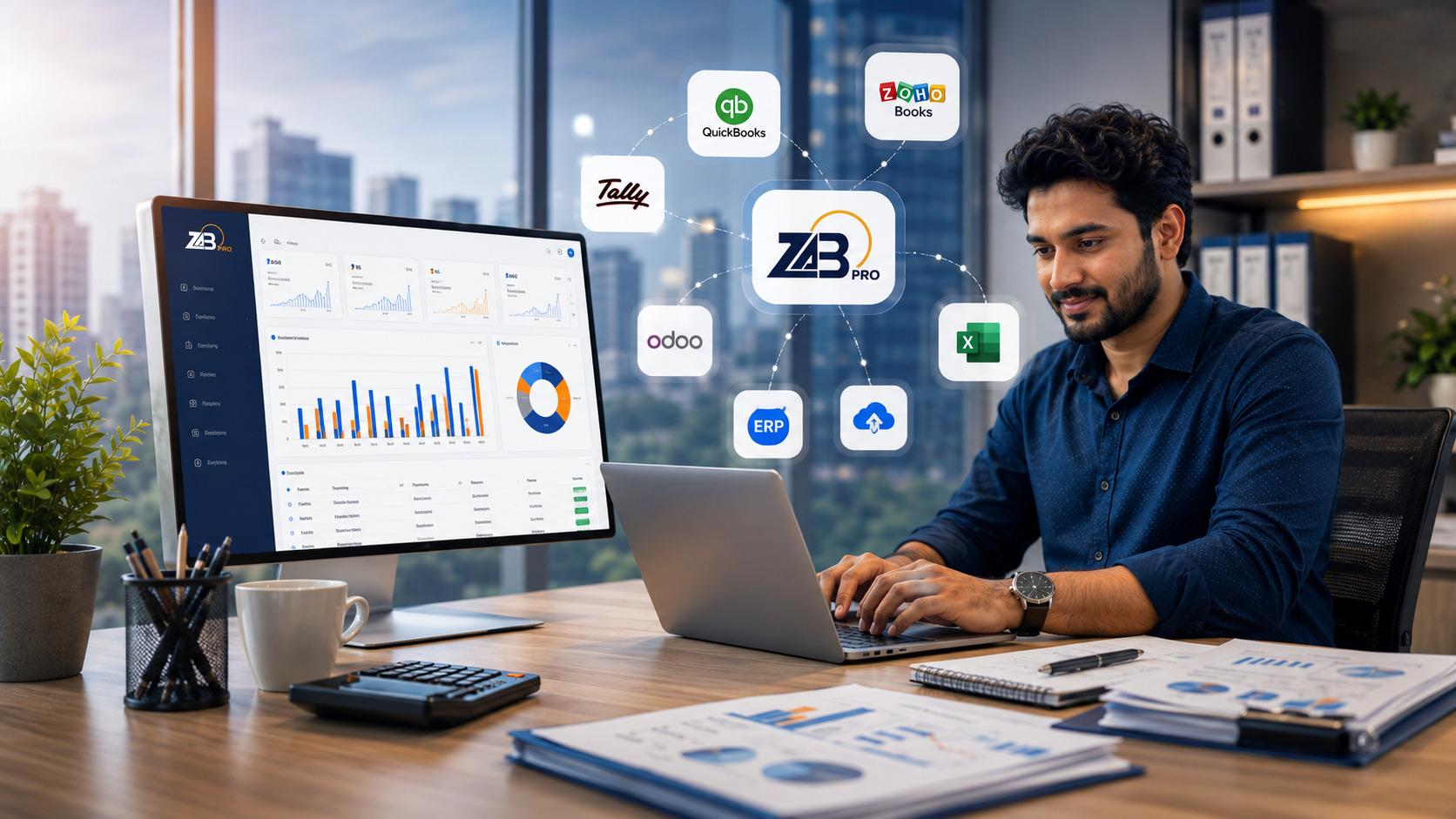
Best 10 Accounting Software in Bangladesh: A Complete Guide
Managing business finances in Bangladesh has never been more demanding. Between tracking daily cash flow, staying compliant with NBR VAT regulations, generating financial reports, and keeping up with inventory doing all of this manually is not just time-consuming, it's risky. One miscalculation in your ledger can cost your business more than just money.
That's why more and more businesses across Bangladesh from small retail shops in Dhaka to growing manufacturing firms in Chattogram are making the shift to accounting software. These tools automate the repetitive, error-prone tasks of bookkeeping and give business owners real-time visibility into their financial health.
But with so many options now available in the market both local and international choosing the right accounting software in Bangladesh can feel overwhelming. Should you go with a globally trusted name like Tally or QuickBooks? Or a locally built solution designed around how Bangladeshi businesses actually operate?
This guide is here to help you decide. In this article, we'll cover:
- Why Bangladeshi businesses need accounting software in 2026
- Key features to look for before choosing one
- Top 10 accounting software used in Bangladesh reviewed and compared
- How to choose the right fit for your business size and budget
- FAQs answered clearly
Whether you're a small business owner or managing a growing enterprise, by the end of this guide, you'll know exactly which tool is right for you.
Why Businesses in Bangladesh Need Accounting Software
For decades, most businesses in Bangladesh relied on manual bookkeeping handwritten ledgers, Excel spreadsheets, and paper receipts. While this approach worked at a smaller scale, it comes with serious limitations as a business grows.
The Problem with Manual Accounting
Manual data entry is slow, and more importantly, it leaves room for human error. A missed entry, a miscalculated VAT figure, or a misplaced receipt can throw off your entire financial statement. For businesses that deal with high transaction volumes daily retail shops, distributors, wholesalers, or service providers these small errors add up fast and can trigger compliance issues with the National Board of Revenue (NBR).
Beyond errors, manual processes simply don't scale. As your product range, customer base, and team grow, keeping track of income and expenses manually becomes a full-time job in itself.
What Accounting Software Changes
The right accounting software addresses these challenges directly. Here's what it does for businesses in Bangladesh:
- Saves time: Automates repetitive tasks like invoicing, expense recording, and bank reconciliation freeing up hours every week
- Improves accuracy: Eliminates manual calculation errors across financial transactions
- Ensures VAT & tax compliance: Automatically generates NBR-compliant reports and VAT returns, reducing the risk of penalties
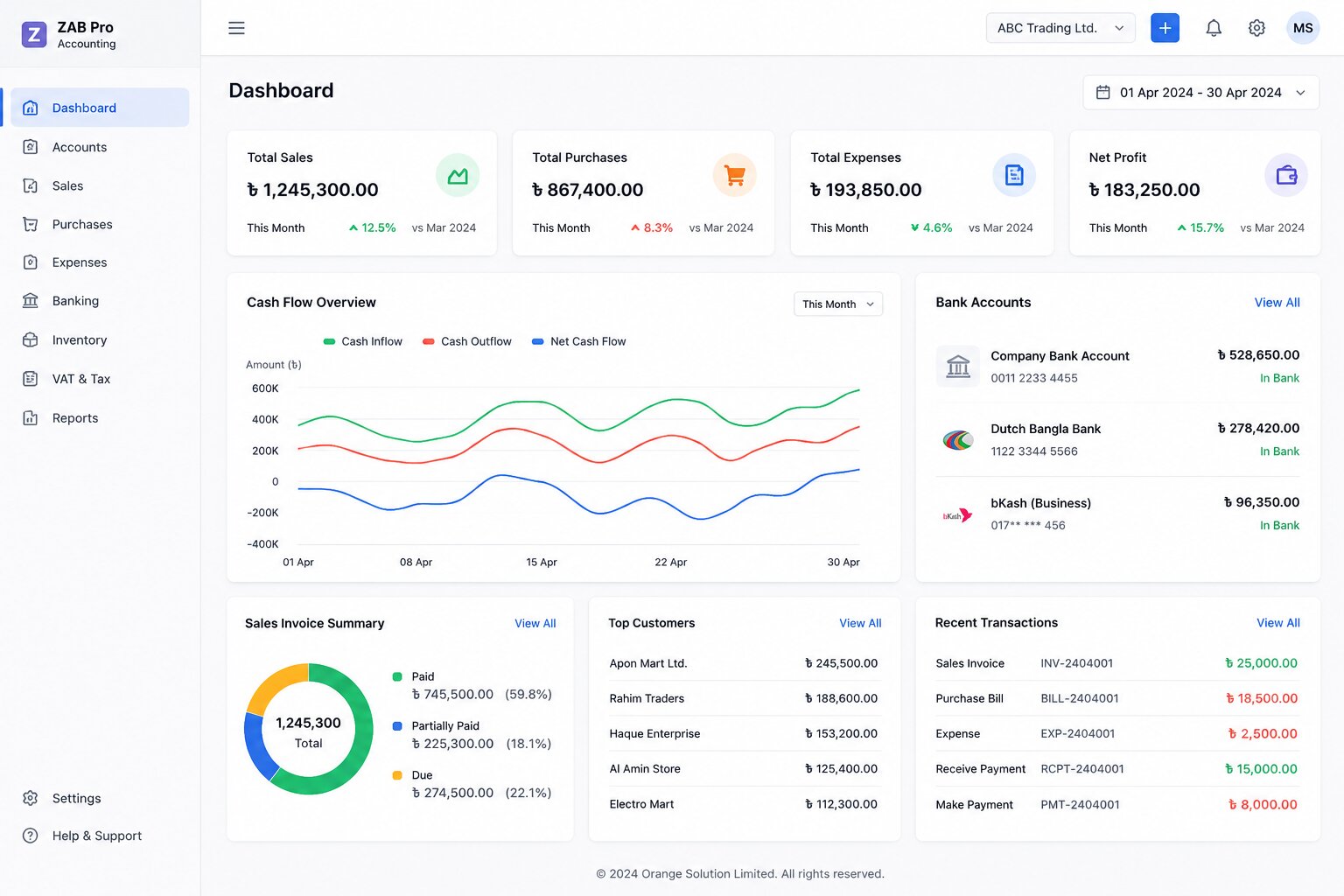
- Provides real-time financial insights: Business owners can check cash flow, outstanding payments, and profit/loss at any moment from any device
- Supports business growth: With clean financial reports and inventory data always available, decision-making becomes faster and more confident
The Bigger Picture
Bangladesh's business environment is evolving rapidly. Whether you run a small shop or a mid-sized enterprise, accounting software is no longer a luxury it's a competitive necessity. Businesses that adopt it early save time, reduce costs, and are far better positioned for sustainable growth.
Knowing why accounting software matters is only half the picture. The other half is knowing what to look for when evaluating your options.
Key Features to Look for in Accounting Software
Not all accounting software is built the same. Before you invest in a solution for your business, it's important to know which features actually matter — and which ones you can skip. Here are the core capabilities every business in Bangladesh should evaluate:
1. NBR VAT & Tax Compliance
This is non-negotiable for Bangladeshi businesses. Your software must support VAT Mushak formats (6.3, 6.6) and automatically calculate taxes based on current NBR regulations. Manual tax filing is one of the leading causes of compliance penalties — the right software eliminates that risk entirely.
2. Cloud-Based Access
Cloud-based accounting software lets you manage your finances from anywhere — your office, home, or on the go. It also means your data is automatically backed up and accessible to multiple team members simultaneously, without expensive server setups.
3. Income & Expense Tracking
The foundation of any good accounting tool is clear, real-time visibility into your income and expenses. Look for software that categorizes transactions automatically and flags inconsistencies before they become problems.
4. Inventory Management
For businesses dealing in products — retail, wholesale, manufacturing — integrated inventory management is essential. It connects your stock levels directly to your financial reports, so you always know what you have, what it's worth, and when to reorder.
5. Financial Reporting & Statements
Your software should generate key financial statements — profit & loss, balance sheet, and cash flow reports — with a single click. Real-time dashboards are even better, giving you an always-updated picture of your business health.
6. Multi-User Access & Role Management
As your team grows, you'll need to control who sees what. Good software lets you assign roles and permissions so your accountant, manager, and sales team each access only what's relevant to them.
7. Local Support & User-Friendly Interface
For businesses in Bangladesh, having access to local customer support ideally in Bangla makes a significant difference, especially during tax season. A clean, easy-to-navigate interface also means your team spends less time learning the software and more time using it.
With those criteria in mind, here is how the leading accounting software solutions in Bangladesh actually compare.
Top 10 Accounting Software in Bangladesh
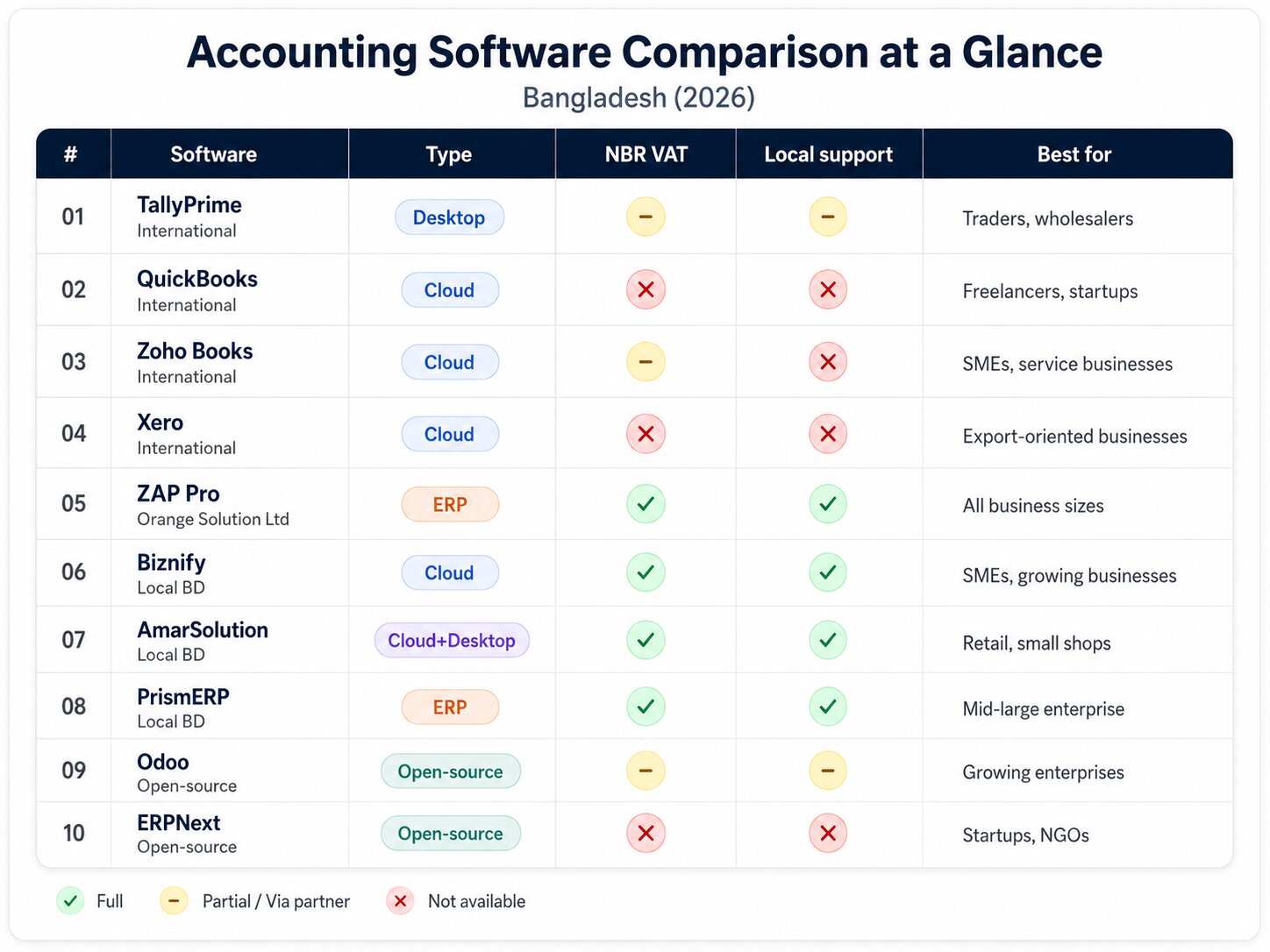
With dozens of options available today, we've narrowed down the list to the ten most relevant accounting software solutions for businesses in Bangladesh — evaluated based on features, local usability, VAT compliance, and overall value.
1. TallyPrime
TallyPrime is the most recognized accounting software in Bangladesh, trusted by businesses for over two decades. Built for South Asian business environments, it is the go-to choice for traders, wholesalers, distributors, and manufacturers who handle high transaction volumes daily.
Unlike cloud tools, TallyPrime is primarily desktop-based — meaning it runs fully offline, making it reliable for businesses in areas with unstable internet connections. Newer versions do offer remote access and cloud connectivity when needed.
Key Features:
- General Ledger management across multiple companies or branches
- Inventory tracking across multiple godowns with batch and expiry support
- VAT and tax report generation with audit trail
- Built-in payroll processing for salary and statutory compliance
What to Keep in Mind:
TallyPrime has a steeper learning curve and typically requires formal staff training. As a desktop solution, multi-location real-time access needs additional setup. The licensing cost — approximately BDT 49,000 — may also feel high for very small businesses.
Best For: Mid-to-large businesses, traders, wholesalers, and manufacturers that prioritize accounting depth, offline reliability, and have an experienced accounts team.
2. QuickBooks
QuickBooks is one of the most widely used cloud-based accounting tools globally, and it has built a solid following in Bangladesh — particularly among freelancers, consultants, small agencies, and startups with international clients. Its biggest strength is simplicity: you don't need an accounting background to navigate it, yet it covers all the essential financial management needs of a growing small business.
Being fully cloud-based means you can manage invoices, track expenses, and check financial reports from any device, at any time. This is especially valuable for business owners who are frequently on the move or managing remote teams.
Key Features:
- Automated invoicing, payment reminders, and expense categorization
- Real-time cash flow tracking and financial dashboards
- Bank reconciliation with direct bank feed integration
- Detailed profit & loss and balance sheet reporting
- Mobile app for managing finances on the go
What to Keep in Mind:
QuickBooks is not specifically built for the Bangladesh market, so NBR VAT compliance support is limited and may require manual workarounds. Customer support is also primarily English-based with no local Bangla assistance. Pricing is in USD, which can fluctuate with exchange rates.
Best For: Freelancers, small agencies, consultants, and startups in Bangladesh — especially those dealing with international clients — who need a simple, reliable, and globally recognized cloud accounting tool.
3. Zoho Books
Zoho Books is a modern cloud-based accounting platform that has gained steady popularity among Bangladeshi SMEs, particularly in service-based and technology-driven businesses. It strikes a strong balance between affordability and functionality — offering features that compete with premium tools at a significantly lower price point.
One of Zoho Books' standout advantages is its deep integration with the broader Zoho ecosystem — including Zoho CRM, Zoho Inventory, and Zoho Payroll — making it an attractive choice for businesses already using or planning to use Zoho's suite of business tools.
Key Features:
- Automated invoicing, payment reminders, and recurring billing
- VAT compliance support with tax report generation
- Inventory and purchase order management
- Seamless integration with 40+ third-party business applications
- Client portal for easy invoice sharing and payment collection
What to Keep in Mind:
While Zoho Books supports VAT, full NBR Mushak format compliance for Bangladesh requires manual configuration. Local customer support is limited, and the platform works best for businesses comfortable managing software independently. It is also less suited for businesses with complex inventory or manufacturing workflows.
Best For: Tech-savvy SMEs, service businesses, and startups in Bangladesh looking for an affordable, feature-rich cloud accounting tool with strong third-party integration capabilities.
4. Xero
Xero is a powerful cloud-based accounting platform originally built in New Zealand, now used by businesses across the globe including a growing number of companies in Bangladesh. It is particularly well-regarded for its clean, intuitive interface and its ability to facilitate seamless real-time collaboration between business owners and their accountants or financial advisors.
For Bangladeshi businesses that deal with international clients or foreign currencies, Xero's multi-currency support and global banking integrations make it a practical and capable choice.
Key Features:
- Real-time bank feeds with automated transaction reconciliation
- Multi-currency support for international payments and invoicing
- Detailed financial forecasting and customizable reporting
- Accountant-friendly tools for real-time collaboration and review
- Unlimited users on all pricing plans — no per-user charges
What to Keep in Mind:
Xero is not localized for the Bangladesh market, meaning NBR VAT compliance and Mushak report generation are not natively supported. There is no local customer support or Bangla language interface. Pricing is in USD, and its advanced features may feel unnecessary for businesses that only need basic accounting functions.
Best For: Export-oriented businesses, international service providers, and companies that work closely with professional accountants and need strong multi-currency and financial reporting capabilities.
5. ZAP Pro by Orange Solution Limited
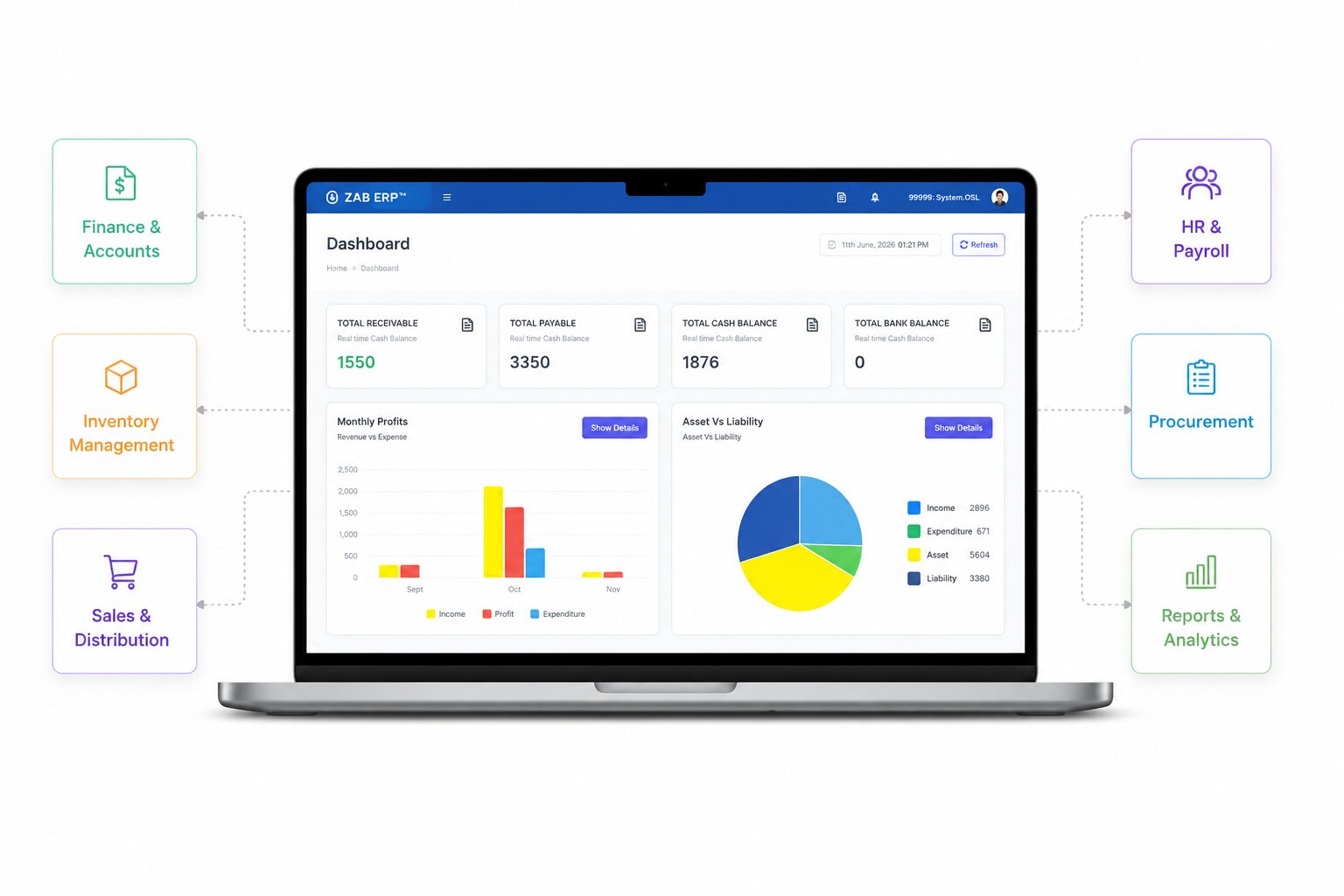 ZAP Pro is a locally developed ERP-based accounting solution by Orange Solution Limited, built to address the financial management needs of Bangladeshi businesses across various industries. As a homegrown platform, it combines an understanding of local business workflows with enterprise-grade accounting capabilities — offering a compelling alternative to both foreign software and generic local tools.
At the core of ZAP Pro is its Finance & Accounts Management module — a comprehensive system that goes well beyond basic bookkeeping to deliver complete financial control across your organization.
Key Features:
- General Ledger Management: Centralizes all financial transactions in one structured system, ensuring accurate, audit-ready records at all times
- Accounts Payable & Receivable: Manages vendor payments and tracks customer collections efficiently, improving cash cycle management
- Cash Management: Provides real-time visibility into daily cash positions, helping business owners make faster and more informed decisions
- Financial Reporting: Generates accurate financial statements to support management decisions, regulatory compliance, and audit requirements
What to Keep in Mind:
ZAP Pro is backed by Orange Solution Limited's local support team, meaning businesses get hands-on assistance in their own language and time zone — a significant advantage over international platforms. It is best evaluated through a direct consultation to assess how well it aligns with your specific business requirements.
Best For: Businesses in Bangladesh seeking a locally supported, ERP-backed accounting solution with robust financial management capabilities and reliable after-sales service.
6. Biznify
Biznify is a locally developed cloud-based ERP and accounting platform built specifically for Bangladeshi businesses. What makes it stand out from international tools is its deep understanding of local business requirements — including NBR VAT compliance, Bangla language support, and locally available customer service. For SMEs that have struggled with adapting foreign software to Bangladesh's regulatory environment, Biznify offers a refreshing alternative.
The platform goes beyond basic accounting, integrating HR, payroll, and inventory management into a single system — reducing the need to manage multiple disconnected tools.
Key Features:
- NBR-compliant VAT reporting including Mushak 6.3 and 6.6 formats
- Integrated inventory, HR, and payroll management
- Real-time cash flow tracking and financial dashboards
- Multi-branch support for businesses operating across locations
- Bangla language interface with local customer support
What to Keep in Mind:
As a relatively newer platform, Biznify may not yet have the same depth of features or community resources as globally established tools. Businesses with highly complex accounting structures may find some advanced reporting capabilities still developing. It is worth requesting a demo to evaluate whether it meets your specific workflow needs.
Best For: Bangladeshi SMEs and growing businesses that want a locally built, NBR-compliant, cloud-first solution with Bangla support and a single platform for accounting, inventory, and HR.
7. AmarSolution
AmarSolution is an emerging Bangladeshi software provider offering an integrated accounting, inventory, VAT, and POS platform designed specifically for local small businesses, retail stores, and entrepreneurs. It positions itself as an accessible, affordable entry point into digital financial management — particularly for business owners with little to no prior accounting software experience.
What makes AmarSolution appealing is its practical, ground-level approach. It is built around how small Bangladeshi businesses actually operate day-to-day — from managing shop-level sales to tracking supplier payments — rather than adapting a foreign solution to the local context.
Key Features:
- Real-time income and expense tracking with cash flow visibility
- Automated NBR-compliant VAT and tax calculations
- Integrated POS system for retail and shop-based businesses
- Multi-user access with role-based permissions
- Both cloud and desktop versions available
What to Keep in Mind:
AmarSolution is best suited for smaller operations. Businesses that are scaling rapidly or managing complex multi-department finances may find the platform limiting over time. It also lacks some of the advanced reporting and ERP-level capabilities that larger businesses require. Pricing details are not publicly listed, so a direct consultation with their team is necessary before committing.
Best For: Small retailers, shop owners, startups, and entrepreneurs in Bangladesh looking for an affordable, easy-to-use, locally built accounting and POS solution.
8. PrismERP
PrismERP is a well-established Bangladeshi ERP solution designed for mid-to-large businesses that have outgrown basic accounting software and need a more comprehensive system to manage their operations. Developed locally with a strong understanding of Bangladesh's business and regulatory landscape, PrismERP brings together finance, supply chain, HR, and operations management under one unified platform.
For businesses in manufacturing, trading, or retail distribution — where financial data needs to connect directly with procurement, production, and logistics — PrismERP offers that level of integration without relying on foreign software customization.
Key Features:
- Advanced financial management including accounts payable, receivable, and General Ledger
- Supply chain and procurement management integrated with accounting
- Multi-branch and multi-currency support for larger operations
- NBR-compliant VAT and tax reporting
- HR and payroll management within the same platform
What to Keep in Mind:
PrismERP is a complex system that requires proper implementation, staff training, and ongoing support — making it less ideal for small businesses or those looking for a quick setup. The pricing is not publicly listed and varies based on modules and number of users, so budget planning requires a direct consultation with their team.
Best For: Medium to large businesses in manufacturing, trading, and distribution that need a full-featured, locally supported ERP system beyond standalone accounting software.
9. Odoo
Odoo is a globally popular open-source ERP platform with a strong and growing presence in Bangladesh, supported by several certified local implementation partners. What makes Odoo particularly attractive is its modular structure — businesses can start with just the accounting module and gradually add CRM, inventory, HR, manufacturing, and more as their needs evolve. This flexibility makes it suitable for a wide range of industries and business sizes.
Being open-source also means there are no mandatory licensing fees for the community version, significantly lowering the barrier to entry for budget-conscious businesses.
Key Features:
- Fully integrated accounting with invoicing, expenses, and bank reconciliation
- Modular design — add only the features your business needs
- Highly customizable workflows to match industry-specific requirements
- Cloud and on-premise deployment options
- Strong local partner network in Bangladesh for implementation and support
What to Keep in Mind:
Odoo's open-source community version is free but limited in features. The enterprise version, which unlocks advanced capabilities, comes with a per-user monthly cost. Additionally, proper implementation requires technical expertise — businesses typically need to work with a certified local partner, which adds to the overall cost and setup time.
Best For: Growing businesses and enterprises in Bangladesh looking for a flexible, scalable ERP system with long-term expansion potential and access to local implementation support.
10. ERPNext
ERPNext is a free, open-source ERP platform that includes a comprehensive accounting module, making it one of the most cost-effective options available for businesses in Bangladesh. It has gained traction particularly among startups, NGOs, and budget-conscious SMEs that want enterprise-grade financial management without the burden of heavy licensing fees.
Built on a modern technology stack, ERPNext covers the full spectrum of business operations — from accounting and inventory to HR and project management — all within a single platform. It is cloud-hosted by default but can also be self-hosted for businesses that prefer full control over their data.
Key Features:
- Full double-entry bookkeeping with real-time financial reporting
- Accounts payable, receivable, and General Ledger management
- Inventory, payroll, and project management included at no extra cost
- Multi-currency and multi-branch support
- Active global open-source community with regular updates
What to Keep in Mind:
ERPNext's biggest challenge is implementation. Because it is highly customizable, setting it up properly requires technical knowledge or the help of an experienced developer. Local support options in Bangladesh are limited compared to commercial platforms, and businesses may face longer resolution times for technical issues. It also lacks native NBR VAT compliance out of the box.
Best For: Startups, NGOs, and small businesses in Bangladesh with limited budgets and access to technical resources who want a scalable, feature-rich ERP system at minimal cost.
You have now seen what each platform offers. The next step is figuring out which one fits your specific business.
How to Choose the Right Accounting Software for Your Business
With so many options available, selecting the right accounting software comes down to understanding your own business needs clearly. Here are the key factors to consider before making a decision:
1. Know Your Business Size & Complexity
A small retail shop and a mid-sized manufacturing company have very different accounting needs. If you run a small business with straightforward income and expense tracking, a simple cloud tool like Zoho Books or AmarSolution may be sufficient. Growing enterprises managing multiple branches, departments, or supply chains will benefit more from an ERP-backed solution like ZAP Pro, PrismERP or Odoo.
2. Prioritize NBR VAT Compliance
For any business operating under Bangladesh's VAT framework, compliance with NBR regulations is non-negotiable. Always confirm whether the software natively supports Mushak formats and local tax reporting before committing this alone can save your business from costly penalties.
3. Cloud-Based vs Desktop
Cloud-based software offers flexibility, remote access, and automatic updates ideal for businesses with multiple users or locations. Desktop solutions like TallyPrime offer offline reliability, which works better in areas with inconsistent internet connectivity. Consider your team's working environment before choosing.
4. Local Support Availability
Technical issues don't wait for convenient moments. Having access to a local support team ideally one that communicates in Bangla ensures problems are resolved quickly without disrupting your operations.
5. Budget & Total Cost of Ownership
Look beyond the initial price tag. Factor in implementation costs, training, number of users, and annual renewal fees. Some platforms charge per user, while others offer flat monthly rates understanding the full cost helps avoid surprises later.
Still have questions before making a decision? Here are the ones Bangladeshi business owners ask most.
Frequently Asked Questions
Q1: Which accounting software is used in Bangladesh?
Businesses in Bangladesh use a mix of local and international accounting software depending on their size and industry. TallyPrime remains the most widely used legacy solution, while cloud-based tools like Zoho Books, QuickBooks, and Biznify are gaining rapid adoption among SMEs. Locally built ERP platforms like PrismERP, AmarSolution, and ZAP Pro by Orange Solution Limited are also increasingly popular for businesses that need NBR-compliant, locally supported solutions.
Q2: Which software is mostly used for accounting?
TallyPrime is the most commonly used accounting software in Bangladesh, particularly among traders, wholesalers, and established businesses. However, for cloud-based accounting, Zoho Books and QuickBooks are among the most frequently chosen options by startups and small businesses.
Q3: What are the top 3 accounting software options in Bangladesh?
While the best choice depends on your business needs, three consistently top-rated options are TallyPrime for depth and reliability, Zoho Books for affordable cloud-based management, and Biznify for a locally built NBR-compliant solution. For businesses seeking an ERP-backed local option, ZAP Pro by Orange Solution Limited is also a strong contender.
Q4: Is Zoho better than Tally?
It depends on your priorities. Zoho Books is better for businesses that want cloud access, affordability, and easy third-party integrations. TallyPrime is better for businesses that need deep accounting functionality, offline reliability, and complex inventory management. For Bangladeshi businesses specifically, TallyPrime has stronger local familiarity, while Zoho Books offers more modern flexibility.
Q5: How do I get started with accounting software in Bangladesh?
The process is simpler than most business owners expect. Start by identifying your core needs the size of your business, the number of users, whether you need inventory management, and how important NBR VAT compliance is to your operations. From there, shortlist two or three tools that match your requirements and request a demo or free trial before committing.
Most software providers both local and international offer an initial consultation to walk you through their platform. For local solutions, this consultation is typically more hands-on, covering your specific business workflows rather than a generic product walkthrough. Once you choose a platform, the provider or their implementation partner handles the setup, data migration, and staff training before you go live.
Q6: Who implements your accounting software — and why does it matter?
For international platforms like Odoo or ERPNext, implementation is typically handled through authorized local resellers or certified partners third parties trained by the software vendor to deploy and support their product in Bangladesh.
For locally built solutions including Biznify, PrismERP and ZAP Pro by Orange Solution Limited you work directly with the company that built the software. Implementation, training, and after-sales support all come from a team that already understands Bangladeshi business workflows and NBR compliance requirements with no intermediary between you and the people responsible for your system.
With all of that covered, here is the bottom line.
Conclusion
Choosing the right accounting software is one of the most impactful decisions a business owner in Bangladesh can make. The right tool doesn't just keep your books clean — it saves time, ensures regulatory compliance, improves cash flow visibility, and ultimately supports better business decisions every single day.
As we've covered in this guide, the market offers a wide range of options. International tools like TallyPrime, QuickBooks, and Zoho Books bring global reliability and strong feature sets. Local solutions like Biznify, AmarSolution, and PrismERP understand the Bangladeshi business environment and offer NBR-compliant features with local support. Open-source platforms like Odoo and ERPNext provide flexibility at lower costs for the right teams.
For businesses looking for a locally built, ERP-backed solution with comprehensive Finance & Accounts Management and dedicated local support, ZAP Pro by Orange Solution Limited is well worth exploring. It is designed to grow with your business — from managing day-to-day financial transactions to delivering real-time financial visibility across your entire organization.
Ready to see how ZAP Pro can work for your business? Contact Orange Solution Limited today for a personalized consultation.